




Rising Copper Demand is Projected to Meet a 25% Supply Gap in 2035



Rising copper demand and fewer discoveries increase the need for well-defined projects that can strengthen future supply.
- S&P Global identified 263 major copper discoveries containing 1.402 billion metric tons of copper between 1990 and 2025, but recent additions came mainly from expansions of known deposits rather than new discoveries.
- Mine-site programs received 43% of global copper exploration budgets in 2025, compared with 25% for grassroots exploration, directing more capital toward lower-risk extensions and less toward new independent deposits.
- Average drilling depth has increased nearly 50% since 2010 to about 600 meters, while discovery-to-production timelines average 17.5 years, increasing the cost and duration of project evaluation.
- International Energy Agency (IEA) projects a roughly 25% primary copper supply gap in 2035 and about US$310 billion in investment through 2040.
- High-grade drill results support future supply when further work defines resources, confirms recovery, establishes realistic cut-off grades, secures permits, and demonstrates economics capable of attracting financing.
Fewer New Discoveries Limit Future Supply Despite Mine Expansions
S&P Global’s 2026 copper discoveries assessment reported that 263 major discoveries made between 1990 and 2025 contain 1.402 billion metric tons of copper across reserves, resources, and past production. The assessment added five deposits and 37 million metric tons, or 3%, but most of the increase came from expansions of known deposits. Adding new discoveries to the development pipeline would broaden future supply beyond expansions of existing deposits.
Fewer Major Discoveries Raise the Value of Defined Resources
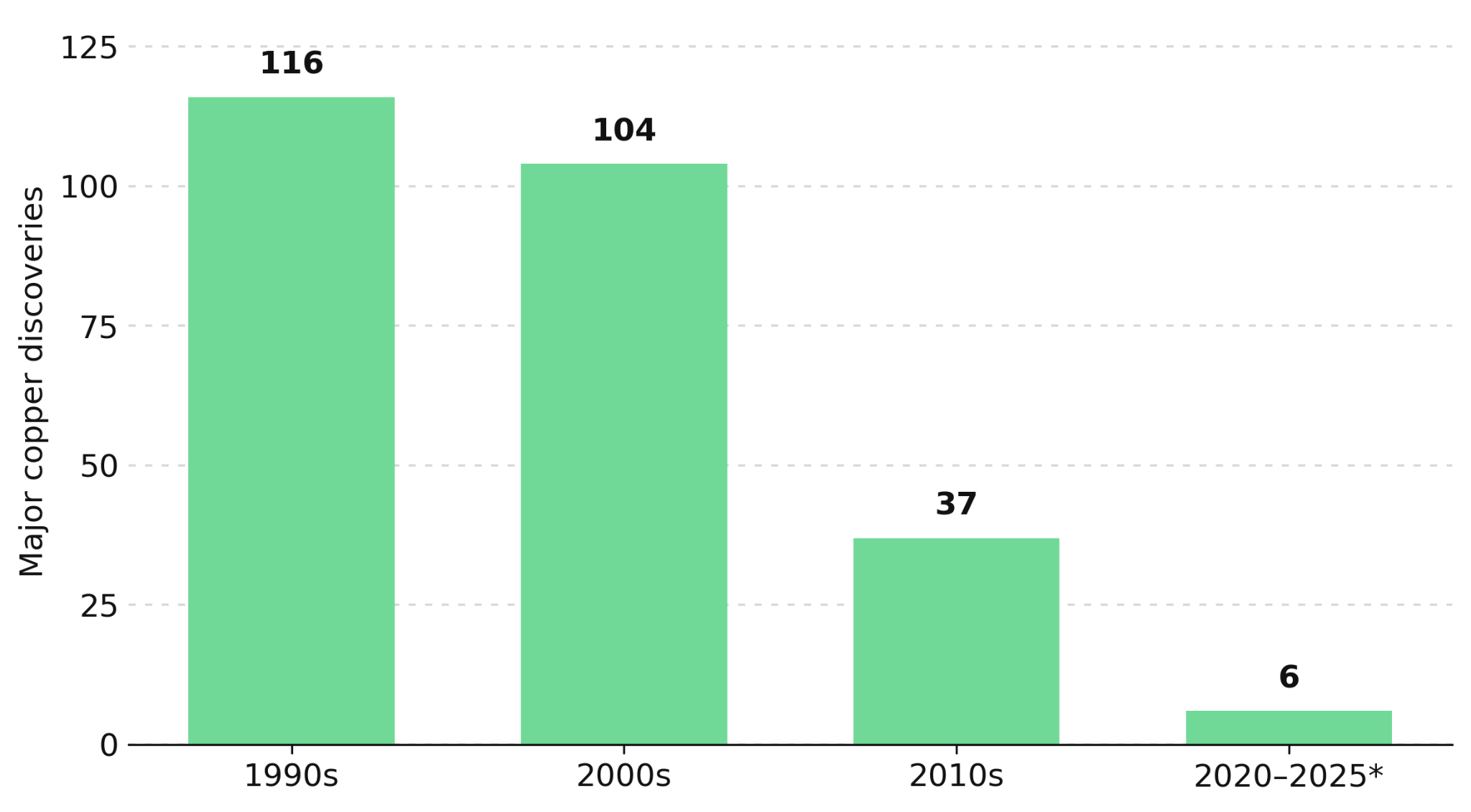
Discoveries attributed to the 1990s contain 714.8 million metric tons of copper across 116 deposits, compared with 513.0 million metric tons across 104 deposits in the 2000s. The total fell to 165.4 million metric tons across 37 discoveries in the 2010s and 8.7 million metric tons across six discoveries from 2020 through 2025. Copper discovered from 2000 through 2025 therefore remains below the 1990s volume. S&P Global defines a major discovery as a deposit that ultimately contains at least 500,000 metric tons of copper in resources, reserves, or past production.
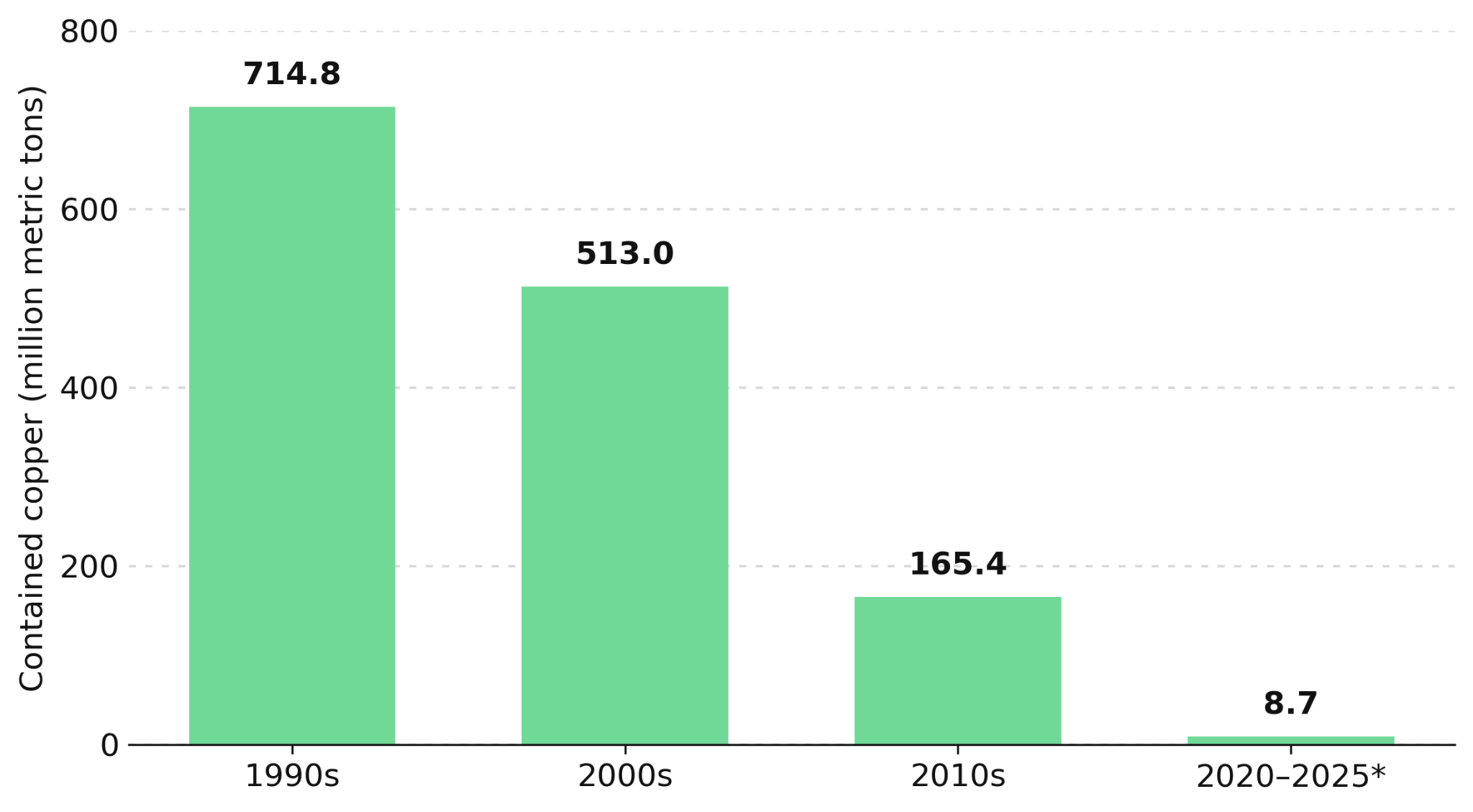
Recent discovery totals may rise because newer deposits have had less time for drilling and technical studies to define enough resources to cross S&P Global’s 500,000-metric-ton threshold. Even with future revisions, the data show a multi-decade decline in the number and contained volume of major discoveries. The smaller discovery base increases the value of projects that can define resources and advance toward development.
Long Lead Times Delay Supply Response
S&P Global recorded no deposit meeting its major-discovery threshold in 2025. Of the 263 discoveries in its database, 165 have not entered production, 135 have not completed feasibility studies, and only 17 have reached construction or preproduction. Copper discovery-to-production timelines average 17.5 years as projects move through drilling, resource definition, metallurgical testing, engineering, environmental assessment, permitting, financing, and construction.
Exploration creates the evidence needed to advance copper discoveries toward development. Drilling can support a Mineral Resource Estimate (MRE), metallurgical testing can demonstrate recoverable copper, and economic studies can assess capital expenditure, operating costs, Net Present Value (NPV), and Internal Rate of Return (IRR). Each completed milestone improves understanding of project scale, processing, costs, and potential returns, supporting informed development decisions.
Mine-Site Capital Sustains Output, but Demand Raises Need for New Projects
Existing operations can make exploration spending more productive because infrastructure and permitting pathways are already established. Mine-site programs can extend known deposits more quickly and sustain near-term output. However, rising demand and reserve depletion increase the need for independent projects that can broaden future copper supply.
Capital Shifts Toward Existing Assets, Reducing Grassroots Discovery
Mine-site programs accounted for 43% of global copper exploration budgets in 2025, compared with 25% for grassroots exploration. More than 60% of the 2025 increase in discovered copper volume came from deposits associated with existing mining complexes. Mine-site extensions can use installed mills, tailings facilities, power systems, and familiar permitting routes, while grassroots programs can create new supply options by defining geology, establishing access and infrastructure, and building community support.
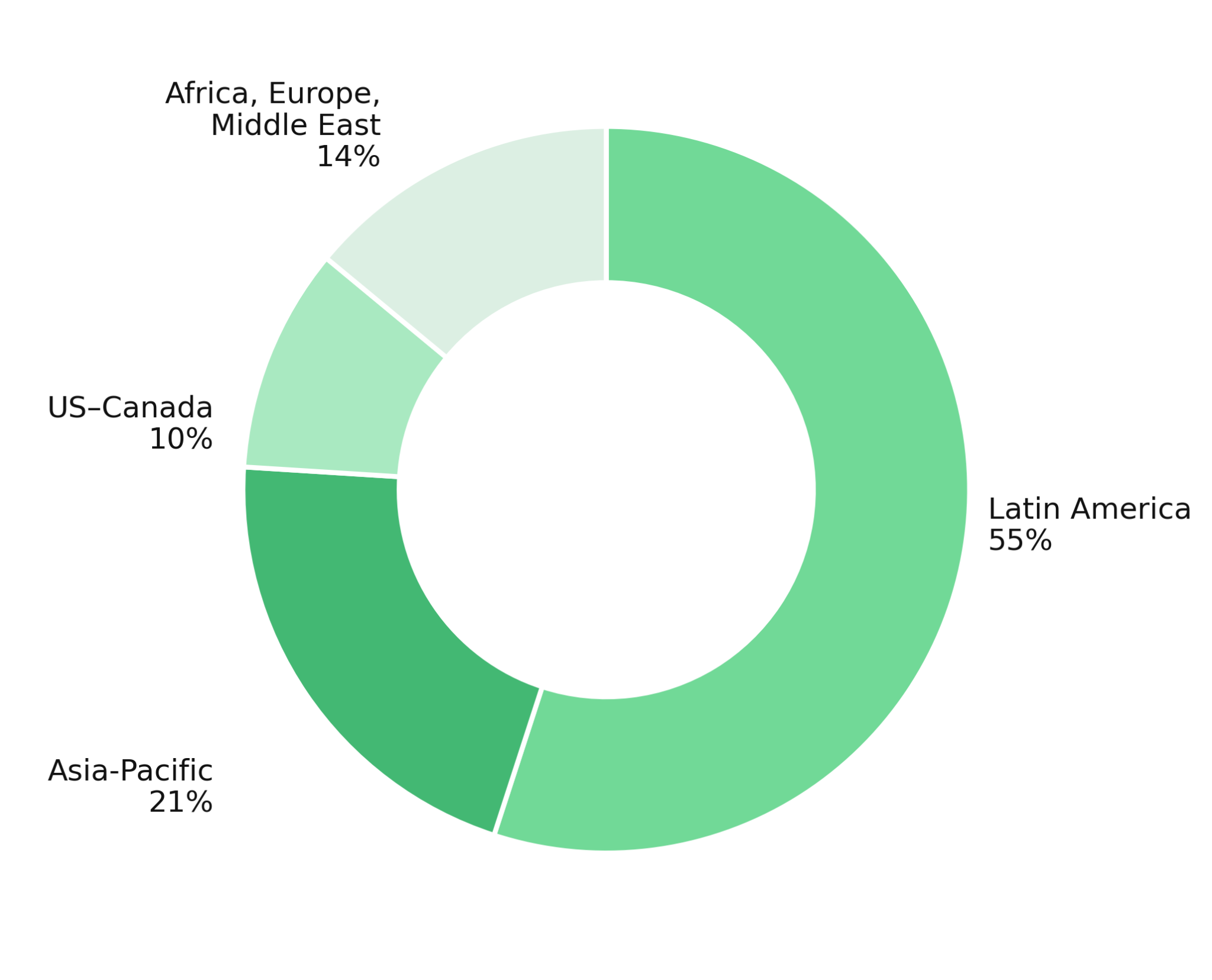
Mine-life extensions can protect output and improve the use of existing capital, while new districts add geographic and geological diversity to future supply. Maintaining output as pits deepen and grades decline requires longer haul distances, additional underground development, and higher processing volumes, increasing operating and capital requirements.
Deeper Mines & Lower Grades Raise the Cost of Sustaining Output
Existing mines require capital to sustain production, while new projects require capital to add future supply as reserves are depleted. Spending at existing mines can add copper more quickly by using established infrastructure, while new projects diversify future supply across deposits and jurisdictions.
Fitzroy Minerals reported 110 meters grading 1.94% copper at Buen Retiro, strengthening its shallow oxide opportunity within an established Chilean mining district. Nearby infrastructure and a proposed low-capital processing route could support earlier production, while deeper sulfide mineralization provides scope to expand the project beyond its initial development concept.
Deeper Drilling Raises Costs & Demands Evidence of Scale
As near-surface deposits become less common, exploration is testing deeper targets beneath surface cover. S&P Global estimates that average drilling depth has increased nearly 50% since 2010 to about 600 meters. Because deeper holes cost more, programs that use precise targeting and confirm continuity across multiple drill results can allocate exploration capital more efficiently.
Multiple Discoveries Guide Drilling Across Mining Districts
Marimaca Copper is advancing the permitted Marimaca Oxide Deposit while expanding Pampa Medina, 28 kilometers east. Recent drilling returned 216 meters grading 0.96% copper and 7.2 grams per metric ton of silver, including 62 meters grading 2.20% copper and 21.5 grams per metric ton of silver, while step-out drilling extended mineralization 300 meters south and west. The results strengthen continuity across the 3-kilometer by 1.5-kilometer area, providing an advanced development pathway alongside a growing copper-silver discovery.
Hayden Locke, President and Chief Executive Officer of Marimaca Copper, explains how copper project advancement enables parallel exploration:
“There is strong alignment that the strategy that we're pursuing is the correct one, which is to move forward on a project which is very rare in the copper industry. We have the luxury of being able to pursue a parallel exploration strategy.”
Consistent geological patterns across multiple discoveries can improve district-scale targeting across a large property. Each confirmed zone can refine drilling and infrastructure planning, allowing capital to focus on areas with the strongest grade, continuity, and scale.
Mogotes Metals completed its Filo Sur program with two copper-gold discoveries and additional targets at Luz del Sol and Cuenca. Albor returned 180 meters grading 0.98% copper equivalent, including 58 meters grading 1.77%, while Cuenca expanded to 1.3 kilometers by 0.5 kilometers. A planned 20,000-meter drilling program for 2026–2027, more than triple the previous season’s total, will extend the discoveries and test the new targets, providing several opportunities to establish greater scale.
Confirmatory Drilling Tests Continuity & Defines Project Scale
Geophysical and geological indicators help identify where drilling should test for copper mineralization. Confirmatory drilling establishes the direction, thickness, continuity, and depth of mineralization needed to define its scale. Confirming these features helps direct further drilling, use exploration capital efficiently, and assess the potential for a larger discovery.
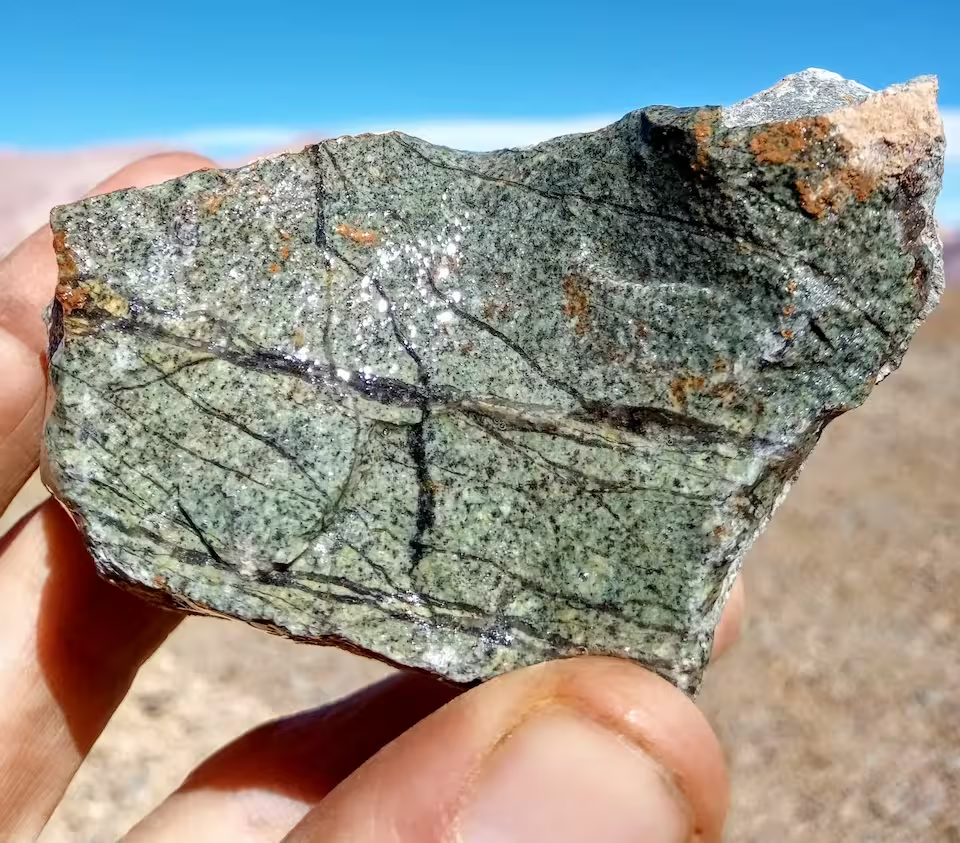
Cobra Resources’ recent diamond drilling at Blue Rose in South Australia extended sulfide mineralization to a depth of 300 meters, building on earlier results that included 74 meters grading 1.00% copper and 0.25 grams per metric ton of gold. The presence of bornite and supporting alteration indicates that mineralization extends beyond the shallow zone into a broader porphyry system, expanding the project’s potential footprint and refining targets for further drilling.
Long Timelines Require Recovery Tests & Infrastructure Studies
Contained copper establishes project scale, while recovery rates and concentrate quality determine saleable metal. Infrastructure, permits, and financing then determine whether the project can support a viable development plan. Each completed study provides evidence for the next capital decision.
Metallurgical Evidence Reduces Processing Risk, Improving Development Credibility
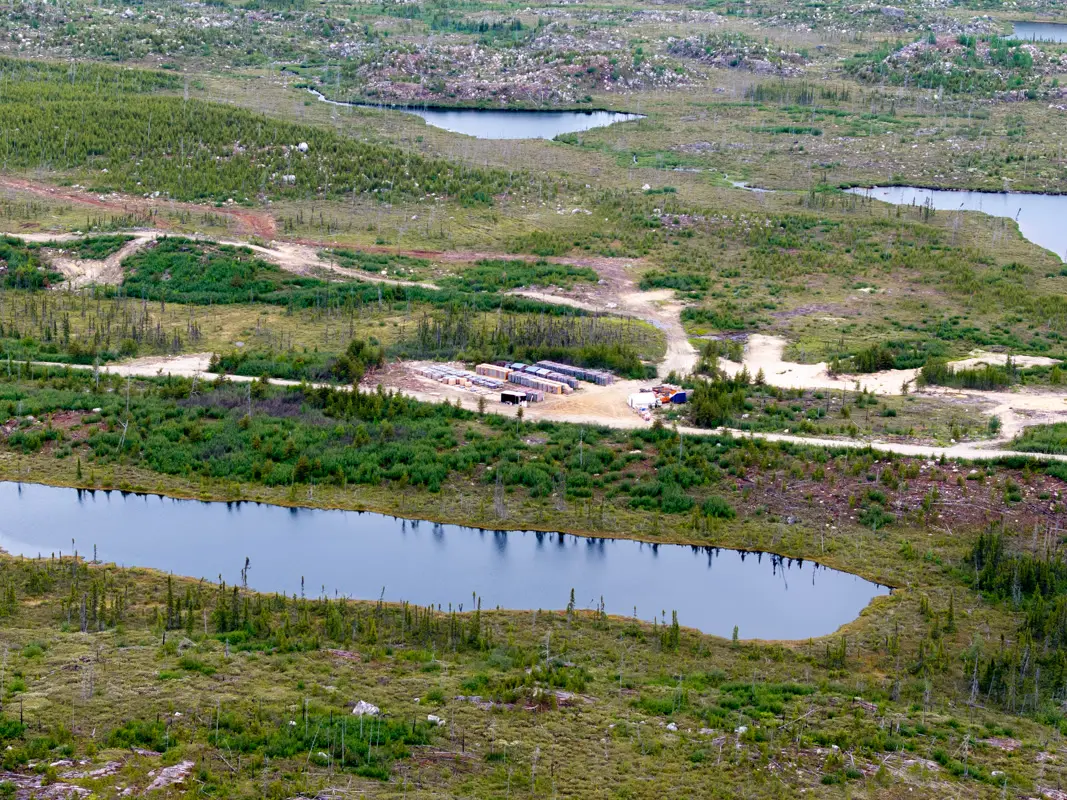
Abitibi Metals reported 98.2% copper recovery into a concentrate grading 23.7% from a larger, more representative sample of the B26 deposit. The rapid recovery suggests that a relatively simple processing circuit may be sufficient, reducing technical uncertainty as the company advances its Preliminary Economic Assessment (PEA). Together with indicated and inferred resource grades above 2% copper equivalent, the result strengthens the case for efficient processing and continued project advancement.
Metallurgical performance affects margins by determining how much contained copper becomes saleable concentrate. This performance shapes Net Smelter Return (NSR), which reflects saleable metal value after processing and transport deductions. Early test work can therefore assess processing simplicity and concentrate quality before larger engineering and environmental spending begins.
Existing Infrastructure Compresses Timelines, Improving Project Readiness
Existing infrastructure can shorten development timelines by allowing engineering teams to focus on rehabilitation and mine planning instead of designing an entirely new operation. Technical studies can then assess refurbishment costs and operating requirements, providing clearer evidence for a potential restart.
Selkirk Copper is advancing Minto with a 4,100-metric-ton-per-day mill and existing roads, power, camp, and water-treatment facilities already in place. Phase 2 drilling had completed more than 45,000 meters by August 18, 2026, ahead of schedule, with new high-grade copper-gold-silver intersections near existing underground development. These results and the expanded resource are being incorporated into a PEA targeted for the third quarter of 2026, allowing planning to focus on restarting an established operation rather than constructing a new mine.
Colin Joudrie, President and Chief Executive Officer of Selkirk Copper, explains how existing infrastructure concentrates spending on rehabilitation:
“We're not building this mine from scratch. This mine already exists, and the mill facility exists. All of our focus is on rehabilitating existing, very well-functioning equipment and gear and just getting the right investments in the right place.”
Projected Demand Outpaces Supply & Raises Project Funding Needs
IEA projects refined copper demand, excluding direct-use scrap, to rise 26% from 27.8 million metric tons in 2025 to about 35.0 million metric tons in 2040. This increase raises the need to advance additional projects toward production.
Projected 25% Shortfall Requires Mine Expansion & New Discoveries
IEA estimates that supply from existing and announced mines could fall about 25% below primary copper requirements in 2035. The projected gap narrowed from roughly 30% in the 2025 outlook as projects advanced in the Democratic Republic of the Congo, Zambia, Peru, and Canada. The 2026 outlook estimates that copper mining and refining will require about US$310 billion in capital investment through 2040. It also reports that average global copper grades have declined 40% since 1991 and capital costs per unit of brownfield capacity have risen 65% since 2020, increasing the funding needed to expand supply.
Mine-site expansion can sustain current output, while independent discoveries can add new sources of future supply. Exploration builds project value by defining resources and confirming metallurgical performance. Economic studies and permitting then establish a path toward financing and construction.
The Investment Thesis for Copper
- Producers with competitive operating costs, reserve replacement, and disciplined sustaining capital can retain margins as mature mines process lower grades and require additional development.
- Defined resources and demonstrated copper recovery give developers a shorter path to potential production as economic studies and permitting advance.
- Explorers can build evidence of scale by confirming consistent grade and mineralized thickness across multiple drill holes, then use district-scale targeting to identify additional copper zones.
- Established mining jurisdictions can support development through skilled labor and infrastructure, while project-level reviews clarify tax obligations and water access alongside community engagement and environmental approvals.
- Simple processing and clean concentrate can improve Net Smelter Return and support financing by demonstrating how much copper can be recovered and sold.
- Existing infrastructure can reduce development costs and timelines when studies confirm its condition and capacity, while permits and funding aligned with project milestones guide capital allocation.
Both new discoveries and continued work on known deposits are needed to widen the copper pipeline. Drilling must define scale and continuity, while metallurgical testing determines recovery and project studies test infrastructure, permitting, and economics. As demand grows and lead times remain long, projects that build credible evidence across this sequence will provide the strongest foundation for future copper supply.
TL;DR
Rising copper demand increases the need for additional supply, but the industry is relying more heavily on mine expansions as major discoveries decline. Expansions can sustain output, but they cannot indefinitely replace depleted reserves or provide the geographic and geological diversity created by new districts. Deeper drilling and long development timelines increase the importance of project quality and execution. Drilling must establish scale and continuity. Metallurgical testing must confirm recovery, while studies must test infrastructure, permitting, financing, and economics. Projects that reduce uncertainty at each step are better positioned to attract capital and strengthen the future copper pipeline.
FAQs (AI-Generated)
Analyst's Notes





Subscribe to Our Channel









Stay Informed


