Term Uranium Prices Reach an 18-Year High While Spot Stalls: What Markets May Be Missing


Uranium's record term prices, constrained supply, and China's reactor buildout point to a durable deficit despite flat spot prices.
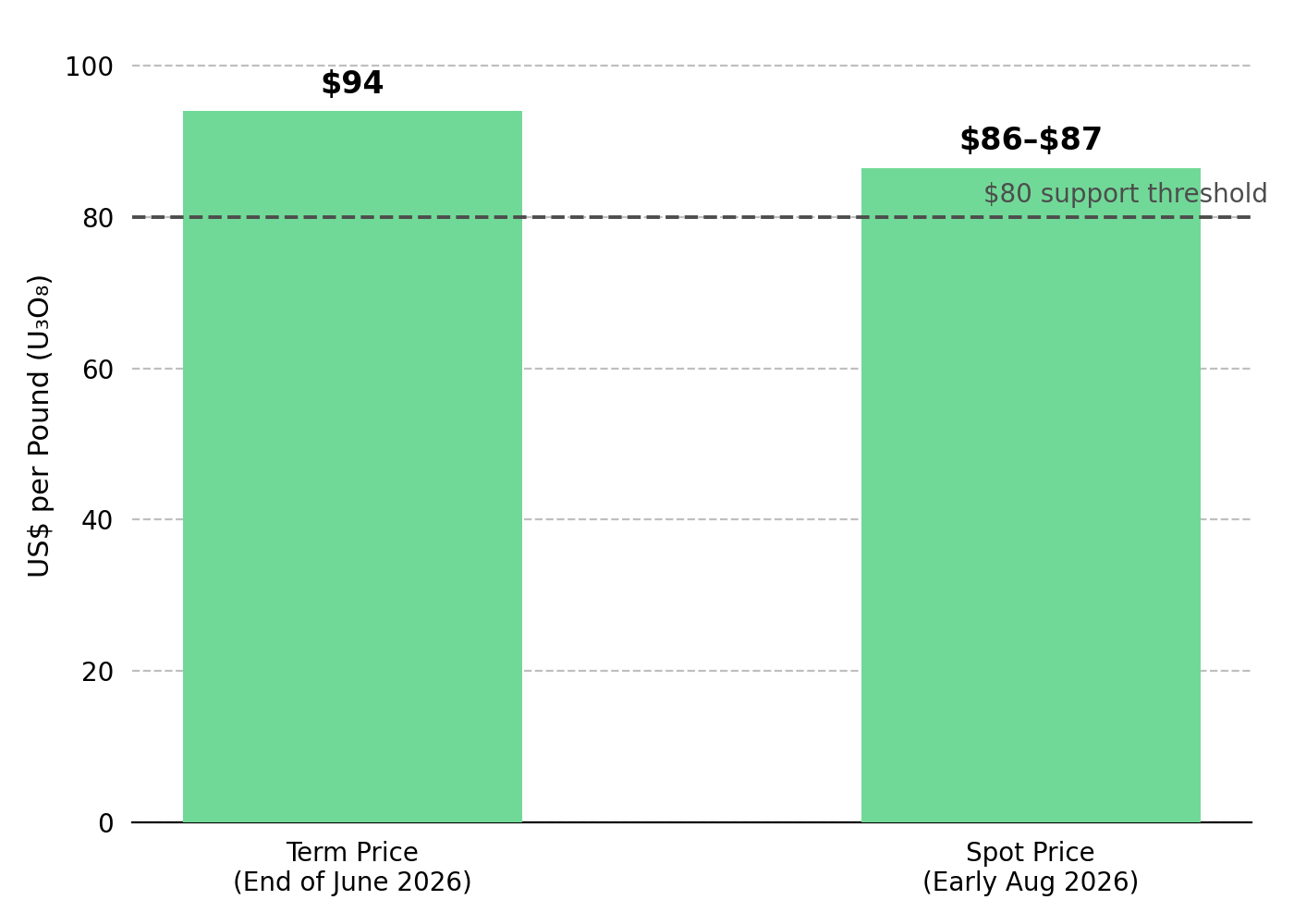
- Uranium's long-term contract price reached an 18-year high of $94 per pound at the end of June 2026, while spot held between $86 and $87 per pound for weeks, a gap that indicates utilities are paying a premium to secure long-term supply rather than driving prices through speculative spot purchases.
- A sulfuric acid shortage tied to the Strait of Hormuz closure forced a 12-day suspension at Cameco's Cigar Lake mine in July 2026, demonstrating that both in-situ recovery and conventional uranium milling depend on reagent availability as much as mining capacity.
- Kazatomprom, which accounts for roughly 40% of global mined uranium supply, is reviewing its full-year 2026 financial guidance because of currency volatility while maintaining its production and sales volume targets, signaling no near-term supply response to higher uranium prices.
- China's State Council approved eight new nuclear reactors worth approximately $25 billion on July 31, 2026, adding to a multi-year pipeline of uranium demand that does not depend on US utility contracting cycles.
- US Section 232 critical minerals negotiations, which include uranium, passed the 180-day reporting deadline on July 13, 2026, without a public resolution, leaving the potential for tariffs or a minimum import price unresolved for US uranium pricing.
Uranium Term Prices Hit an 18-Year High: What the Term-Spot Gap Reveals
Uranium does not trade on a continuous public exchange. Spot and long-term contract prices are assessed periodically by pricing services such as TradeTech and UxC using reported transactions between producers, traders, and utilities, rather than continuous exchange trading. Because uranium prices are assessed rather than continuously traded, a widening gap between term and spot prices can reflect differences in utility contracting behavior rather than short-term market speculation.
As of the end of June 2026, the long-term contract price reached $94 per pound, an 18-year high. Spot uranium, by contrast, has held in a range of $86 to $87 per pound through early August 2026. A widening gap between the two prices has historically indicated that utilities are paying a premium to secure multi-year supply, while the spot market reflects smaller, discretionary purchases that respond differently to near-term conditions. Determining whether the term-spot gap reflects tighter mined and processed uranium oxide supply or a temporary disruption caused by the Strait of Hormuz closure is central to assessing whether current pricing can be sustained.
A clear downside threshold is needed to determine whether the current term-spot gap reflects a durable supply deficit or a temporary market disruption. A weekly spot close below $80 per pound would break the 2026 trading range and challenge the view that the term-spot gap reflects a durable supply deficit rather than a short-term disruption.
Producer Discipline & Sulfuric Acid Disruptions Constrain Uranium Supply: Why US Processing Capacity Matters
Two supply-side developments in July 2026 support the view that the term-spot gap reflects tighter uranium supply: the world's largest producer maintained its production targets despite higher prices, and an unexpected disruption temporarily halted one of the world's highest-grade uranium mines. Together, these developments show that primary uranium supply cannot increase quickly, even when headline production guidance appears unchanged.
Kazatomprom, which accounts for roughly 40% of global mined uranium supply, increased first-half 2026 sales by 19% and attributable production by 10%, while realized prices lagged the stronger spot market. Despite higher uranium prices, the company is reviewing its full-year financial guidance because of currency volatility while maintaining its production and sales targets, suggesting near-term supply remains constrained.
Cameco suspended mining at Cigar Lake, the world's highest-grade uranium mine, for 12 days in July 2026 after Orano's McClean Lake mill lost access to sulfuric acid. The shortage followed the Strait of Hormuz closure, which disrupted roughly half of global seaborne sulfur trade, and was compounded by Chinese sulfuric acid export restrictions introduced in May. Although Cameco maintained its 2026 production guidance of 17.5 million to 18.0 million pounds following the restart, the disruption showed that sulfuric acid availability can interrupt both in-situ recovery (ISR) and conventional milling regardless of ore grade or mining method.
Reagent Supply Risks Increase the Value of US Uranium Processing Capacity
Energy Fuels operates the White Mesa Mill in Utah, the only fully licensed and operating conventional uranium processing facility in the US. This existing domestic milling capacity is not exposed to the overseas reagent-supply risks, such as the sulfuric acid shortage that disrupted Cigar Lake, that affect producers reliant on international processing infrastructure.
A second US producer, enCore Energy, advanced its development pipeline after securing the final federal permit for its Dewey Burdock project. The Nuclear Regulatory Commission renewed the project's Source Materials License for 20 years through June 2046, completing federal permitting requirements for the South Dakota in-situ recovery project. The renewal follows Dewey Burdock's designation under the FAST-41 priority infrastructure program in August 2025. The project uses an oxygen and bicarbonate-based lixiviant rather than sulfuric acid during uranium extraction, reducing exposure to the sulfuric acid shortages that halted production at Cigar Lake in July 2026.
China's Reactor Approvals Strengthen Uranium Demand: Why US Trade Policy Still Matters
While the supply evidence supports a tighter uranium market, the demand side still requires confirmation because a term-spot gap this wide could reflect utilities securing contracts ahead of a policy decision rather than stronger reactor-driven demand. Two developments from the same week distinguish demand already supported by reactor approvals from demand that still depends on unresolved US trade policy.
China's State Council approved eight new nuclear reactors worth approximately $25 billion across four provinces on July 31, 2026. China has approved at least ten new reactor units annually since 2022, creating a multi-year pipeline of uranium demand that does not depend on US utility contracting cycles or US trade policy. Annual reactor approvals at this pace would provide stronger confirmation of sustained uranium demand, and the July 31 decision extends China's approval trend rather than marking an isolated expansion.
Unlike China's reactor approvals, the impact of US trade policy on uranium demand remains unresolved. A presidential proclamation issued on January 15, 2026, directed the Department of Commerce and the US Trade Representative to negotiate critical minerals supply agreements covering uranium, copper, silver, and other minerals on the 2025 US Geological Survey Critical Minerals List, with a report due within 180 days. That deadline passed on July 13, 2026, without a public resolution. The unresolved outcome creates two possible pricing paths: a tariff or minimum import price could establish a higher domestic uranium price for US-focused producers, while continued uncertainty leaves the timing and magnitude of any policy benefit unclear.
Multi-Year Uranium Deficit Supports Diversified Development: Why the Thesis Extends Beyond AI
Developers with assets across multiple jurisdictions are positioning for the current uranium contracting cycle regardless of the Section 232 outcome. IsoEnergy combines the Hurricane deposit, the world's highest-grade published Indicated uranium resource at 48.6 million pounds grading 34.5% uranium oxide, with the permitted Tony M Mine in Utah. Its 33%-owned DISA Uranium venture also secured a US$105 million financing to advance processing technology targeting a fourfold grade uplift.
Philip Williams, Chief Executive Officer of IsoEnergy, argues that the long-term uranium thesis remains intact regardless of AI or other individual demand drivers:
"All of the noise around AI doesn't really impact, in my mind, the work that we've done on the fundamental thesis, there's a supply deficit. Exactly how much it is and when it really hits, we can debate about that, but the deficit is real, and it's going to come and expand irrespective of how much new power comes on, or what AI does, or what data centers do."
Uranium Supply Falls Behind Reactor Demand: Why Developers Are Expanding Resource Pipelines
A second developer is pursuing the same multi-year uranium contracting cycle from a different jurisdiction. Atomic Eagle is advancing the Muntanga Uranium Project in Zambia, which hosts a Measured and Indicated resource of 50.4 million tonnes grading 359 parts per million uranium oxide. Continued drilling at the Chisebuka target and the newly optioned Sitwe project aims to expand the project's resource base while broadening the company's development portfolio beyond Kazakhstan and Niger, where its legacy Madaouela project remains in non-binding government negotiations.
Phil Hoskins, Chief Executive Officer of Atomic Eagle, says the company's long-term strategy reflects expectations of a widening uranium deficit through 2040:
"Everyone talks about a very obvious supply-demand imbalance that's opening up, and it's an imbalance that's going to continue over time. Roughly 150 million pounds is being produced at the moment on the supply side, and 200 million pounds is being consumed by the nuclear utilities. By 2040, that supply of 150 is going to drop to 50, based on current production, and demand will double to 400 million pounds."
Neither the 18-year-high term price nor the stable spot price should be viewed in isolation. The uranium thesis can instead be tested against a defined set of near-term indicators. Four measurable signals over the next two reporting cycles can confirm or weaken that thesis.
Long-Term Uranium Deficit Supports Explorers: Why Funding Runway Matters
The four confirmation signals matter differently for producers, developers, and explorers because each group has different funding and execution risks. ATHA Energy has reported a conceptual exploration target of 60.8 million to 98.2 million pounds of uranium oxide for the Lac 50 deposit. A C$63 million financing completed in the first quarter of 2026 provides funding for approximately 24 months of exploration, reducing the likelihood that the company will need to raise capital while the current gap between spot and term uranium prices persists.
Troy Boisjoli, Chief Executive Officer of ATHA Energy, says the company is prioritizing exposure to Canada's leading uranium jurisdictions based on its long-term view of the uranium market:
"Based on where we see this macro space going, where we see this uranium market going, our objective was to maximize our exposure to the best uranium jurisdictions in Canada."
Explorers derive more of their value from the long-term uranium supply-deficit thesis than from short-term movements in the spot price, meaning a single quarter of weaker spot pricing would not necessarily undermine their development outlook.
The Investment Thesis for Uranium
- Production-stage companies benefit from stronger near-term cash flow and US reshoring initiatives, though the unresolved Section 232 outcome remains a key policy risk.
- Development-stage companies reduce project-specific risk through diversified jurisdictions and permitting stages while retaining upside if the current contracting cycle continues.
- Exploration-stage companies offer the greatest leverage to a multi-decade uranium supply deficit, particularly when backed by sufficient exploration funding.
- Kazatomprom's production discipline and the Cigar Lake sulfuric acid disruption remain the clearest near-term indicators that primary uranium supply is constrained.
- China's reactor approvals provide the clearest independent confirmation of long-term uranium demand, regardless of the Section 232 outcome.
- The term-spot price gap remains the clearest market indicator of utility contracting strength and should be monitored alongside company disclosures.
The uranium market's current pricing should be interpreted by separating what term prices signal about utility contracting from what spot prices indicate about near-term transactions. An 18-year-high term price paired with a stable spot price should not be viewed as contradictory. Instead, it reflects different purchasing behavior by long-term utility buyers and participants in the spot market. The confirmation signals outlined above, rather than either price viewed in isolation, will determine whether that difference reflects a durable supply-deficit cycle or a temporary market disruption.
TL;DR
Uranium's long-term contract price has reached an 18-year high even as spot prices remain flat, suggesting utilities are prioritizing long-term supply over short-term purchases. Producer discipline at Kazatomprom, the Cigar Lake sulfuric acid disruption, and China's continued reactor approvals all support a sustained supply deficit, while US Section 232 negotiations remain an unresolved policy risk. The article concludes that the term-spot price gap should be judged against measurable confirmation signals, including producer guidance, term and spot prices, and Strait of Hormuz developments, rather than interpreted in isolation.
FAQs (AI-Generated)
Analyst's Notes





Subscribe to Our Channel












Stay Informed