The Gateway Validated: What the MMO's KSM Decision Means for Tudor Gold



The MMO pauses KSM's tunnel permit over Tudor Gold's mineral titles as Tudor advances a standalone $1B to $1.5B underground mine at Treaty Creek.
- The Major Mines Office (MMO) of British Columbia's Ministry of Mining and Critical Minerals advised that the decision was made not to proceed to deliberate on KSM Mining ULC's permit amendment application for the Mitchell Treaty Twin Tunnels (MTT), citing the absence of legal certainty over overlapping mineral titles held by Tudor Gold Corp.
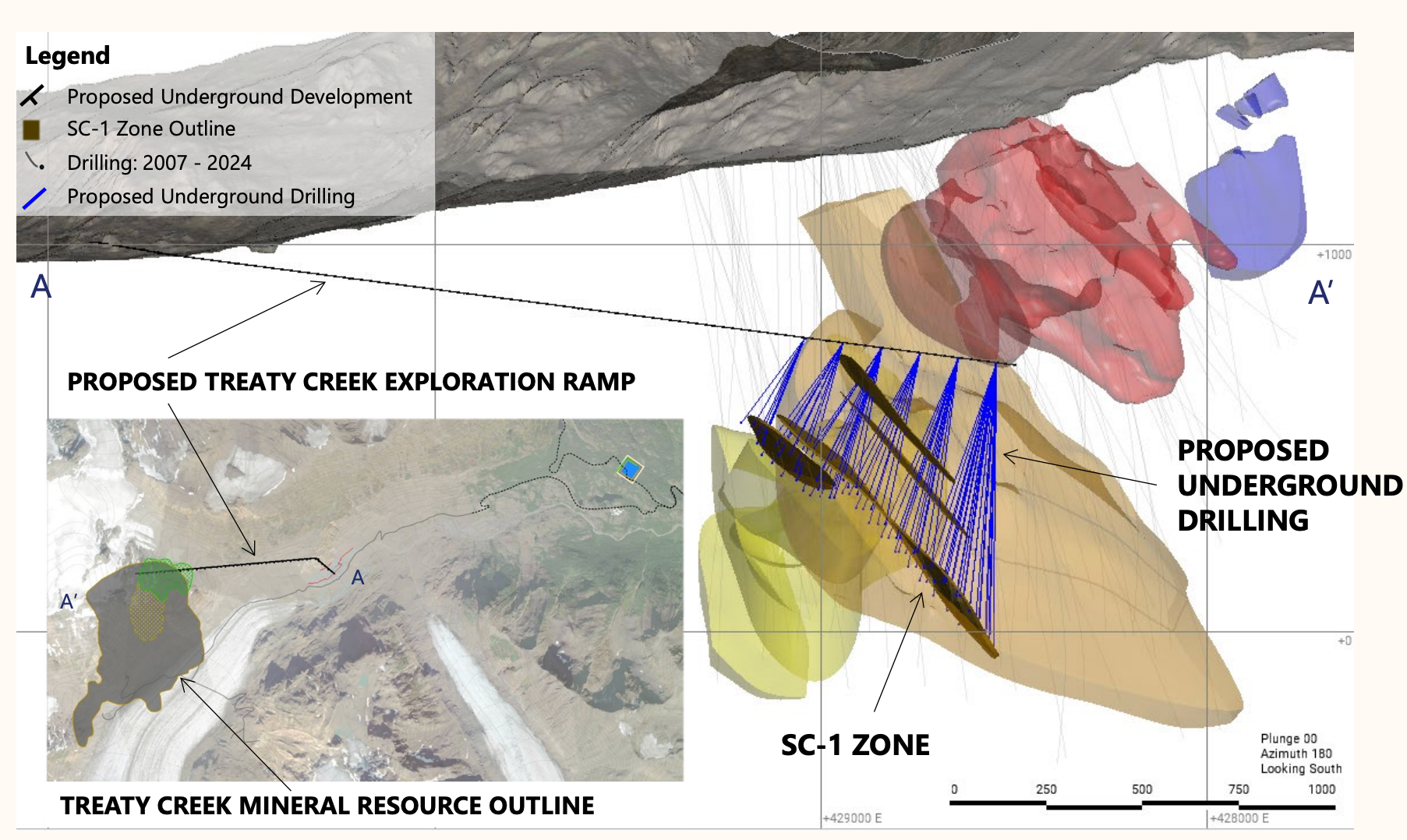
- The approximately 22-kilometre MTT, as currently conceived, would route directly through Treaty Creek's Goldstorm Deposit and pierce the Perfectstorm Zone, where Tudor is targeting an initial 8,000 metres of drilling in 2026.
- Tudor has pivoted away from a bulk-tonnage open-pit operation requiring an estimated $10 billion in capital expenditure (capex), targeting instead an 8,000 to 10,000 tonne-per-day underground starter mine with capex of C$1 billion to C$1.5 billion that the company can advance without external partners.
- Treaty Creek sits approximately 40 kilometres by road from paved highway and power infrastructure, with no glaciers to cross, a direct infrastructure cost advantage that supports the standalone development case relative to comparable Golden Triangle projects.
- A Preliminary Economic Assessment (PEA) on placing the Goldstorm Deposit into production as an underground mine is now underway, with Tudor targeting completion by summer 2026.
What Has Happened
The Major Mines Office (MMO) has paused deliberation on Seabridge Gold's Mitchell Treaty Twin Tunnels (MTT) permit amendment, citing unresolved legal uncertainty over mineral claims held by Tudor Gold Corp. (TSXV: TUD) (Frankfurt: H56). In a letter dated April 9, 2026, Seabridge was advised that the application would not proceed to deliberation until that uncertainty is resolved - either through a negotiated agreement between KSM Mining ULC and Tudor, or a court ruling. The decision matters because the proposed 22-kilometre tunnel would pass directly through the core of Tudor's Treaty Creek asset, confirming that key infrastructure for KSM cannot advance without resolving that overlap. Tudor simultaneously confirmed that 2 drills are targeting mobilisation to the site by mid-May, with an initial 8,000 metres planned for the Perfectstorm Zone.
Why the MMO Decision Carries Structural Weight
Seabridge cannot advance critical infrastructure through Treaty Creek without either securing Tudor's agreement or winning in court. The approximately 22-kilometre MTT would route directly through Treaty Creek's Goldstorm Deposit and pierce the Perfectstorm Zone - the core of Tudor's disclosed resource and the target of an initial 8,000 metres of planned 2026 drilling.
Tudor has initiated two proceedings in the Supreme Court of British Columbia to protect its rights as the recorded holder of the mineral claims at the Treaty Creek Project. In September 2025, the company filed a notice of civil claim arguing that a conditional registration reserve does not apply to its claims and cannot grant rights to third parties. This was followed in October 2025 by a petition seeking judicial review of the Ministry of Water, Land and Resource Stewardship's decision to grant Seabridge a License of Occupation over portions of those claims. No court dates have been set for either proceeding.
The MMO's pause does not resolve the underlying conflict, but it removes the risk that Seabridge could advance the MTT permit ahead of a negotiated or judicially determined resolution. It also signals that overlapping tenure disputes can stall even advanced, strategically significant projects, introducing a layer of permitting risk that is not purely technical, but legal.
The Geographic Reality Behind Gateway Positioning
The Treaty Creek Project's 17,913-hectare claim package borders Seabridge Gold's KSM property to the southwest. Seabridge's 5 deposits sit to the southwest of Tudor's claim boundary, while its processing facility sits to the northeast, right on the border of Tudor's claims. Any infrastructure connection between the two must pass through Tudor's ground.
President & Chief Executive Officer of Tudor Gold Corp., Joseph Ovsenek, addressed this constraint directly:
"We consider ourselves a gateway because any way to access the Seabridge gold copper deposits you have to access our gold storm deposit."
The MMO's decision to pause deliberation on the MTT application confirms that infrastructure access across Treaty Creek remains unresolved due to overlapping mineral tenure. Tudor is simultaneously advancing a revised underground development concept and a 2026 exploration program that the company can progress without external partners. These are the standalone mine path and the permitting conflict, which are two sides of the same strategic posture.
Standalone Independence as a Negotiating Posture
The pivot to a lower-capital underground starter mine is directly connected to the permitting dispute. The original bulk-tonnage resource estimate used a US$50 net smelter return (NSR) cutoff, producing an Indicated Mineral Resource of 24.9 million ounces of gold across 912.3 million tonnes. Mining that resource at full scale would require a bulk-tonnage open-pit operation processing approximately 150,000 to 175,000 tonnes per day - capex Ovsenek has placed at approximately $10 billion - requiring a major mining company to lead the project and fundamentally altering Tudor's negotiating position.
The revised underground scenario uses a US$175 per tonne cutoff, yielding 3.4 million ounces of gold in the Indicated category and 2.4 million ounces in the Inferred category at an average grade of approximately 2.5 to 2.8 grams per tonne gold, targeting 8,000 to 10,000 tonnes per day at a capex of C$1 billion to C$1.5 billion.
Tudor’s ability to advance its own mine on its own timeline negotiates from a materially different footing than one dependent on external capital. The revised mine scope is not a concession to smaller ambitions, it is a mechanism for preserving optionality in a dispute where the scale of independence determines leverage.
Infrastructure Cost Advantage Supports the Standalone Case
The credibility of the C$1 billion to C$1.5 billion capex estimate rests in part on Treaty Creek's infrastructure position. The project sits roughly 70 kilometres north of the town of Stewart, a deep-water port with concentrated shipping facilities, and approximately 40 kilometres by road from paved highway and power infrastructure, with no glaciers to cross.
Ovsenek cited the Brucejack Mine, located to the southeast of the Goldstorm Deposit, as a direct comparison. That project required a 75-kilometre access road, a 12-kilometre section over a glacier, and a 57-kilometre transmission line built with helicopter support. Treaty Creek's road access eliminates the glacier-crossing cost entirely and reduces helicopter dependency at the construction phase.
As Ovsenek noted:
“The more you can reduce helicopter time the more you’re saving money because they’re very expensive to operate.”
The Perfectstorm Zone: Why the MTT Conflict Intensifies
Phase Two of Tudor's 2026 Treaty Creek Exploration Program will prioritise the Perfectstorm Zone, following up on geophysics completed in 2022. The 2023 drill program returned a drill hole intersecting 1.23 grams per tonne gold and 3.43 grams per tonne silver over 102.15 metres, including 42.5 metres grading 1.80 grams per tonne gold and 5.76 grams per tonne silver. Tudor describes the zone as having potential to exceed the Goldstorm Deposit in both tonnes and grade.
An initial 8,000 metres of drilling is planned for 2026, with additional drilling contingent on results. If those results confirm the scale potential, the value of the mineral titles the MTT would traverse increases materially - and so does Tudor's leverage in any negotiated resolution.
What to Watch Next
Tudor’s 2026 trajectory is defined by three key catalysts. The first is the Preliminary Economic Assessment (PEA), due in summer 2026, which will formally test the economics of a standalone underground development at Goldstorm based on the revised mine plan. The second is exploration drilling at Treaty Creek, with two rigs mobilising in mid-May. Work will begin at the CBS Zone before shifting to the Perfectstorm Zone, where Tudor is testing a system it believes could exceed Goldstorm in scale and grade. The third is the legal and permitting pathway following the MMO’s decision to pause deliberation on the Mitchell Treaty Twin Tunnels. The outcome now rests on either a negotiated resolution with Seabridge Gold or a court ruling, which will ultimately determine how infrastructure access across Treaty Creek is resolved.
FAQs (AI-Generated)
The MMO advised that the decision was made not to proceed to deliberate on KSM Mining ULC's permit amendment application in the absence of legal certainty over the interaction between the proposed MTT and the overlapping mineral titles held by Tudor. The decision maker indicated that certainty could potentially be provided either through a negotiated agreement between KSM and Tudor or a court ruling.
The approximately 22-kilometre MTT would route directly through Treaty Creek's Goldstorm Deposit and pierce the Perfectstorm Zone - the target of an initial 8,000 metres of planned 2026 drilling.
The original scenario used a US$50 NSR cutoff and would have required a bulk-tonnage open-pit operation processing approximately 150,000 to 175,000 tonnes per day at an estimated capex of $10 billion, necessitating a major mining partner. The revised underground scenario uses a US$175 per tonne cutoff, targeting 8,000 to 10,000 tonnes per day at a capex of C$1 billion to C$1.5 billion.
Treaty Creek sits approximately 40 kilometres by road from paved highway and power infrastructure, with no glaciers to cross, compared to the Brucejack Mine, which required a 75-kilometre access road, a 12-kilometre section over a glacier, and a 57-kilometre helicopter-supported transmission line.
The MMO's decision maker indicated that certainty could potentially be provided by either a negotiated agreement between KSM and Tudor resolving the land use conflict, or a court ruling on the overlapping mineral titles question. Tudor's stated preference is negotiation with the Province and Seabridge. No court dates have been set for the two proceedings Tudor has filed in the Supreme Court of British Columbia.
Analyst's Notes





Subscribe to Our Channel






.jpg)
Stay Informed