About 70,000 Ounces at Full Capacity Sizes Madsen's Ramp-Up Ahead of 2027 Feed


Management puts Madsen's full capacity at about 70,000 ounces, against 2026 guidance of 35,000 to 45,000 ounces, with 2027 feed and shaft capacity ahead.
- Management estimates that Madsen at full capacity would produce about 70,000 ounces (oz).
- Management expects Madsen to push toward steady state over the next 6 to 9 months, possibly 12.
- Guidance for 2026 is 35,000 to 45,000 oz, with about 60% to the second half.
- Shaft Phase 2 is underway and will lift capacity to about 700 tonnes per day (tpd).
- The 904 Complex and Fork are scheduled to enter the production profile in 2027.
Madsen's Full-Capacity Estimate & Ramp-Up Window
The Madsen Mine would produce about 70,000 ounces (oz) at full capacity and push toward steady state over the next 6 to 9 months, possibly 12, by management's estimate. West Red Lake Gold Mines (TSXV: WRLG | OTCQX: WRLGF) achieved commercial production at the 100%-owned underground gold mine in the Red Lake Mining District of northwestern Ontario on January 1, 2026.
The ramp-up is still in its early stages. The team restarted production at Madsen in 2 years on infrastructure that came with the asset: a fully permitted mill, a tailings facility, and the deposit itself. Madsen is mined as a multi-complex underground operation, an approach that supports operational flexibility and long-term scalability. Mining in 2026 draws on the 960 and 4447 complexes, and the active and emerging mining areas also include the 904 and Derlak complexes. Multiple underground complexes remain open along strike, with potential to add mining fronts over time as development advances.
Vice President, Corporate Communications of West Red Lake Gold Mines, Jaclyn Ruptash, attaches both a size and a window to the end of the ramp-up:
"I think we're still moving through this ramp-up phase. I think over the next 6 to 9, maybe even 12 months, we'll be pushing toward that sort of steady state, which Madsen operating at its full capacity would be about 70,000 oz."
Each quarterly production report over that window can now be measured against a stated endpoint.
Guidance for 2026 & First-Half Production
Guidance for 2026 is 35,000 to 45,000 oz, with approximately 60% weighted toward the second half of the year to reflect the ramp-up. The growth roadmap labels the first half of 2026 as the foundation stage, the second half as the ramp-up stage, and 2027 as the operating leverage stage.
Madsen produced 5,667 oz in the first quarter of 2026 and 8,576 oz in the second. Gold production increased 51% between the 2 quarters, and first-half output reached 14,243 oz. Gold sold rose 34% to 8,260 oz in the second quarter from 6,165 oz in the first, while the average realized gold price eased 13% to US$4,288 per ounce from US$4,938 per ounce.
All-in sustaining cost (AISC) declined 30% to US$3,284 per ounce in the second quarter from US$4,678 per ounce in the first, and cash cost per ounce fell 23% to US$2,000 from US$2,594. Operating margin rose to 41% from 37%, and first-half AISC was US$3,879 per ounce.

Mill Throughput & Shaft Haulage Capacity
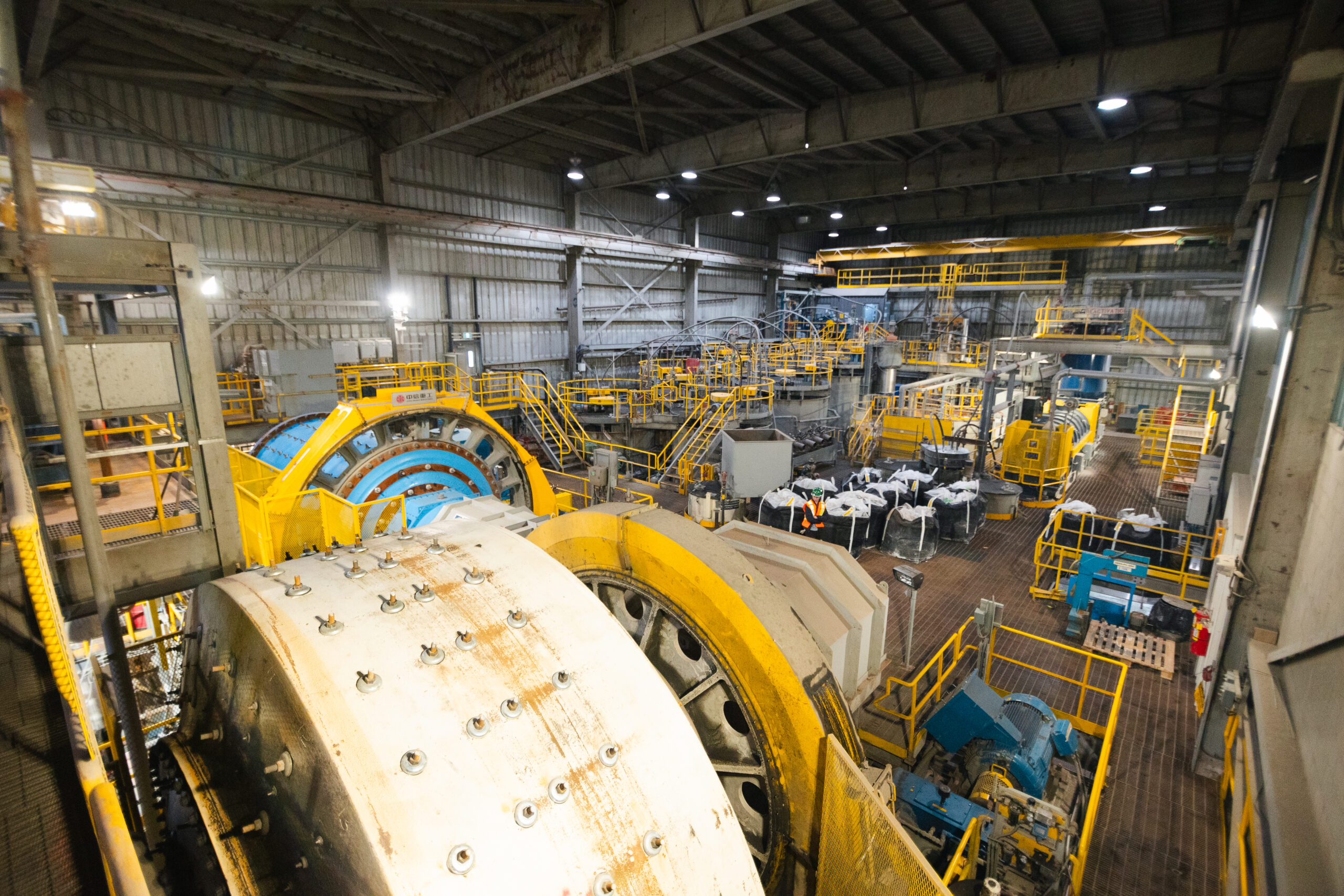
Processing at Madsen runs through the fully permitted, 100%-owned Madsen Mill, which has 800 tonnes per day (tpd) of throughput against a nameplate capacity of 1,100 tpd, with expansion potential. The hub-and-spoke strategy under evaluation is designed to bring future production from the Rowan satellite deposit to the Madsen Mill.
Shaft haulage is being expanded in phases. West Red Lake Gold completed Phase 1 of the shaft refurbishment, and Phase 2 is now underway. Phase 2 is set to increase lifting capacity to about 700 tpd, and Phase 3 will take it up to 2,000 tpd. Management expects shipping material through the shaft to be more economical, and the shaft is planned to work alongside underground trucking, which it will not replace.
Ruptash gives the hoisting figure for the next shaft step:
"We did complete phase 1. Phase 2 is ongoing now, and that's going to increase the sort of lifting capacity to about 700 tons per day."
At Phase 3, the larger shaft capacity is planned to support continued surface stockpile generation, which provides operating flexibility while underground sequencing is optimized. The growth roadmap schedules the scaling of shaft haulage capacity for 2027, alongside material underground development in the same year.
New Feed for 2027 From the 904 Complex & Fork
Additional feed for 2027 comes from 2 non-remnant sources: the 904 Complex and the Fork satellite deposit, which are both scheduled to enter the production profile that year. Non-remnant ground is rock that earlier operators did not mine. The 904 Complex is an approximately 200 meters (m) by 200 m panel of intact gold mineralization that was not historically mined, and it is in development for the first half of 2027. Full access to the mineralized zone is expected to yield larger stopes and greater efficiency in design and extraction. The definition drilling released on September 22, 2026, added confidence in the geological model and in the potential to integrate the 904 and 955 complexes into the Madsen mine plan in 2027.
Fork lies 250 m from the existing Madsen infrastructure, and a 3,200 m drill program there is complete. Initial development is expected through the second half of 2026, before Fork's expected entry into the 2027 production profile.
Ruptash places Fork's advantage in the access route it shares with the main mine:
"So, Fork is interesting because it is accessible through the infrastructure underground at Madsen. So, right now we're developing the ramp to Fork ultimately to integrate that into the production profile next year."
The 13 Level East Drive, with about 500 m of advance planned in 2026, adds another mining front and provides access to high-grade, high-tonnage areas of the deposit.
Quarterly Checkpoints & the Longer-Term Production Target
The third and fourth quarters of 2026 are the nearest measures of progress toward full capacity. The focus for 2026 is building consistency, and management says Madsen is on target to continue that through both quarters and expects the market to track its improvement quarter over quarter.
Beyond Madsen, the growth roadmap shifts to a multi-asset platform, and the transition from a single-asset to a multi-asset production profile begins as soon as 2027, when Fork is integrated. Rowan development and production ramp-up are targeted for the first half of 2029. An updated pre-feasibility study is proposed to combine Madsen and Rowan, and the long-term vision targets 150,000 oz or more per year.
Madsen's progress toward its full-capacity estimate can be followed against dated steps: second-half 2026 production against guidance, the shaft's Phase 2 and Phase 3, and the 2027 entry of the 904 Complex and Fork.
The Investment Thesis for West Red Lake Gold Mines
- Management estimates that the Madsen Mine, at full capacity, would produce about 70,000 ounces.
- Guidance for 2026 is 35,000 to 45,000 ounces, with approximately 60% weighted toward the second half of the year.
- Gold production increased 51% from the first quarter of 2026 to the second, and all-in sustaining cost fell 30% to US$3,284 per ounce.
- The Madsen Mill has a throughput of 800 tonnes per day against a nameplate capacity of 1,100 tonnes per day.
- Shaft Phase 2 is underway and will lift capacity to about 700 tonnes per day, with Phase 3 taking it up to 2,000 tonnes per day.
- The 904 Complex and the Fork satellite deposit are scheduled to enter the production profile in 2027.
West Red Lake Gold Mines has given Madsen a defined endpoint of about 70,000 ounces at full capacity and a 6- to 12-month window in which it expects to push toward steady state. Second-half 2026 consistency, the shaft's phased capacity, and the 2027 entry of non-remnant ground at the 904 Complex and Fork are the dated steps that follow that estimate.
TL;DR
Madsen is a producing underground gold mine whose full capacity management estimates at about 70,000 oz, and management expects Madsen to push toward steady state over the next 6 to 9 months, possibly 12. Guidance for 2026 is 35,000 to 45,000 oz, with about 60% to the second half, after second-quarter production rose 51% and AISC fell 30% to US$3,284 per ounce. Shaft Phase 2 will lift capacity to about 700 tpd, and the 904 Complex and Fork are scheduled to enter the production profile in 2027.
FAQs (AI-Generated)
Analyst's Notes





Subscribe to Our Channel








Stay Informed