Atomic Eagle Secures Madaouela Mining Convention, Resolving Niger Uranium Dispute


Atomic Eagle reacquires Madaouela with a 116.5M-pound uranium resource and targets JORC-compliant conversion in the fourth quarter of 2026.
- Atomic Eagle has agreed to the terms of a new Mining Convention with the Republic of Niger, re-establishing a 60% interest and operational control over the Madaouela Uranium Project through newly incorporated subsidiary Madaouela Mining Company SA (MAMICO).
- Madaouela hosts a resource of 116.5 million pounds of uranium oxide at 1,282 parts per million (ppm), reported as a foreign estimate, supported by approximately 600,000 meters of historical drilling and roughly US$160 million invested by prior holder GoviEx Uranium Inc.
- The agreement resolves a dispute that followed the project's 2024 expropriation from GoviEx, with international arbitration proceedings to be withdrawn within 7 days of the Mining Convention's signing.
- Financial terms comprise US$5 million payable within 30 days of the exploitation permit issuance and a further US$5 million at the commencement of construction, alongside a US$40 million credit applied against the Nigerien Government's future equity contributions.
- Muntanga in Zambia remains Atomic Eagle's flagship development asset and primary focus, with conversion of the Madaouela resource to comply with the Joint Ore Reserves Committee's Australasian Code for Reporting of Mineral Resources and Ore Reserves (JORC Code) expected toward the end of 2026.
Company Overview
Atomic Eagle Limited (ASX: AEU | OTCQX: AEUXF) is an ASX-listed mineral resource company focused on the exploration and development of uranium assets in Africa. Its core asset is the 100%-owned, district-scale Muntanga Uranium Project in Zambia, spanning 4 mining licenses and 2 exploration licenses over a 146-kilometer strike length, covering 1,136 square kilometers adjacent to Lake Kariba. The project hosts a combined Measured, Indicated & Inferred mineral resource of 86.2 million tonnes at 309 parts per million (ppm) uranium oxide for 58.8 million pounds of uranium oxide, with infrastructure advantages including sealed road access to Lusaka and export routes through Namibia's port of Walvis Bay. Atomic Eagle also holds a 60% interest in the Madaouela Uranium Project in Niger, which hosts a 116.5 million-pound uranium oxide resource reported as a foreign estimate.
Mining Convention Re-Establishes Niger Interest
Atomic Eagle has agreed to the terms of a Mining Convention with the Republic of Niger that re-establishes the company's interest in the Madaouela Uranium Project. The agreement follows the granting of a new exploitation permit to Madaouela Mining Company SA (MAMICO), in which Atomic Eagle holds a 60% interest and operational control, with the Nigerien state holding the remaining 40% through a 15% free carried interest and a 25% contributing interest.
The resolution follows a period of dispute that began when Madaouela was expropriated from its previous holder, GoviEx Uranium Inc, in 2024, triggering international arbitration proceedings that were paused in January 2025. GoviEx and Tombador Iron merged in November 2025 to create Atomic Eagle. Under new management, the company has reached a commercial resolution with the Republic of Niger, and arbitration is set to be withdrawn within 7 days of the Mining Convention's signing.
Madaouela hosts a resource of 116.5 million pounds of uranium oxide at a grade of 1,282 parts per million, reported as a foreign estimate. The Mineral Resource Estimate is prepared in accordance with Canadian National Instrument 43-101 (NI 43-101) and has not been classified in accordance with the Joint Ore Reserves Committee's Australasian Code for Reporting of Mineral Resources and Ore Reserves (JORC Code). The estimate is supported by approximately 600,000 meters of historical drilling and roughly US$160 million invested by GoviEx, providing what the company describes as a substantial technical foundation for further evaluation.
Ownership Structure & Financial Terms
The Mining Convention sets out a defined commercial framework governing Atomic Eagle's re-established interest in Madaouela:
- MAMICO ownership: Atomic Eagle 60%, Republic of Niger 40% (15% free carried, 25% contributing).
- Total payments: US$5 million payable within 30 days of exploitation permit issuance, and a further US$5 million payable at commencement of construction.
- A US$40 million credit applied against the Government's future equity contributions to project development, which the company states is not an additional upfront cash payment.
- Exploitation permit term of 10 years, renewable for successive five-year periods for the life of mine.
- Legal, fiscal and regulatory stabilization provisions, alongside access to international arbitration under the International Centre for Settlement of Investment Disputes (ICSID) framework.
- Offshore banking permitted, subject to applicable repatriation requirements.
Atomic Eagle will retain sole operational control of MAMICO and its mining activities, subject to the agreed governance framework. The state's 25% contributing interest requires it to fund its share of future equity contributions or dilute according to an agreed formula, a structure the company frames as aligning both parties toward project development.
Chief Executive Officer of Atomic Eagle, Phil Hoskins, described the agreement as a transformational outcome for the company:
"Re-establishing our interest in Madaouela represents a transformational outcome for Atomic Eagle significantly increasing our resource base and adding a second advanced uranium project to our project portfolio. Madaouela is a large, high-grade uranium asset supported by an extensive body of historical work, and we see clear opportunities to further define and optimize the Project's development potential. This agreement has been achieved through constructive engagement with the Government of Niger and delivers a strong, commercially balanced outcome following a period of dispute. I would like to thank Niger's Minister of Mines, His Excellency Colonel-Commissioner Abarchi Ousmane and his team for sharing our commitment to finding a mutually beneficial solution to the historical dispute."
Offtake, Marketing & Development Strategy
The Mining Convention also defines the marketing framework for future Madaouela production. All MAMICO offtake contracts require Government approval, with a 90-day deemed-approval mechanism intended to protect the company's ability to conclude transactions in a timely fashion. The Government retains the right to purchase and market a portion of production up to its shareholding in MAMICO and, in limited circumstances, may exercise pre-emption rights or requisition up to 50% of mine output. Combined Government rights over production offtake are capped at 50%, are only exercisable under certain circumstances, and cannot interfere with binding offtake contracts already entered into by MAMICO.
Atomic Eagle confirms that Muntanga remains its primary development focus. At Muntanga, the company expects to continue drilling through 2026 to support increased scale and improved project configuration, to progress optimization work aimed at enhancing development potential and project economics, and to target updated feasibility work from 2027.
In parallel, at Madaouela, the company intends to convert the Mineral Resource Estimate to comply with the JORC Code, undertake technical review and optimization work, assess updated development pathways and financing structures, and evaluate strategic partnerships, alternative ownership structures, or other commercial arrangements that may support development.
Regional Context: Niger's Uranium Industry
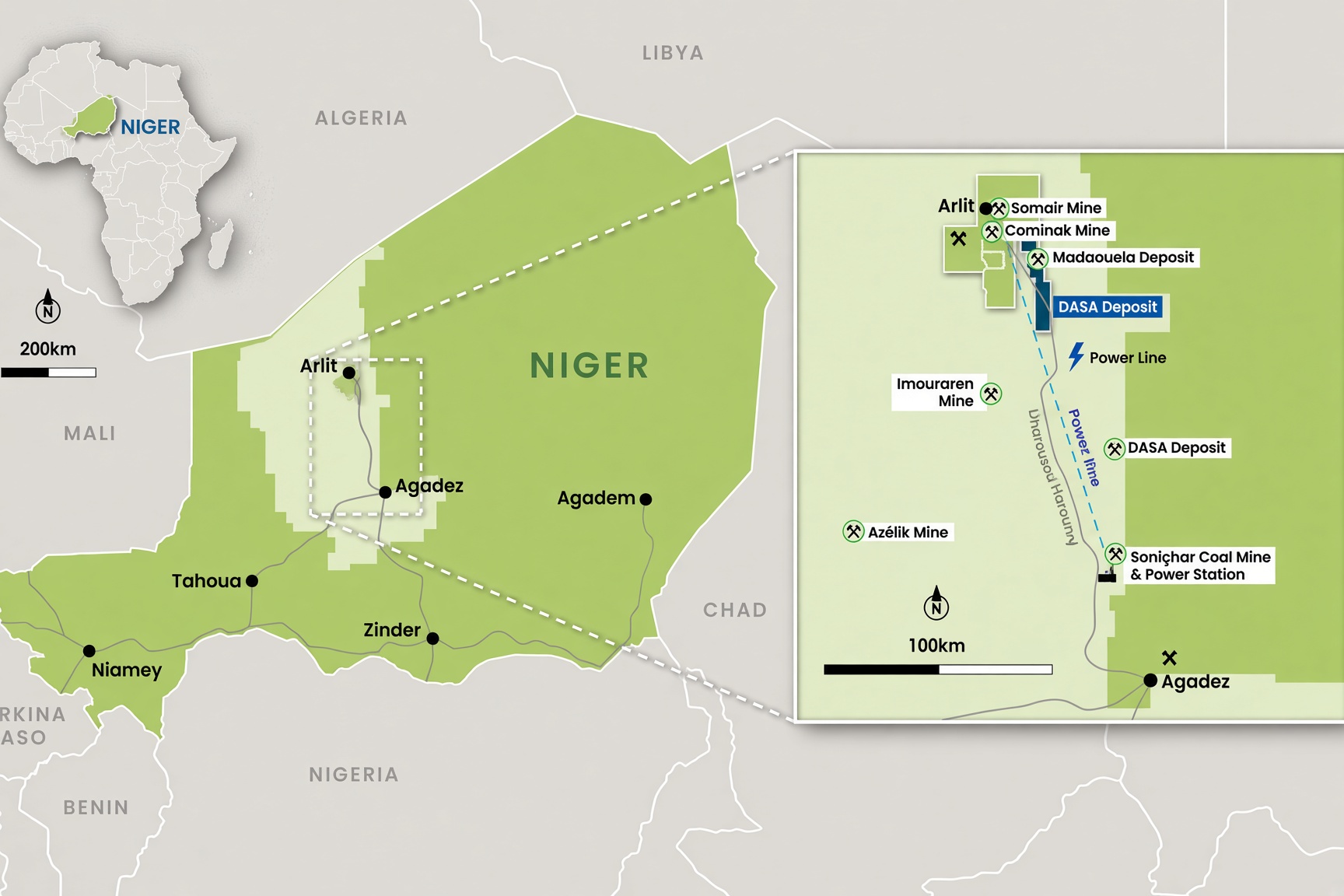
Niger has supplied uranium to the global nuclear fuel market for more than 50 years, with commercial mining beginning in 1971 at the Arlit mining district following the country's first uranium discoveries in the 1950s. The country hosts the Tim Mersoi Basin, one of the largest uranium-bearing basins globally, home to the SOMAIR operation, the historic COMINAK mine, Global Atomic's Dasa Project, Madaouela, and the Imouraren deposit. According to the World Nuclear Association, Niger holds approximately 450,000 tons (approximately 992 million pounds) of identified uranium resources and has produced in excess of 150,000 tons (330 million pounds) of uranium since production began, supplying nuclear utilities across Europe, North America and Asia.
Next Steps
Atomic Eagle's next steps for Madaouela include the commencement of technical and commercial work programs, including conversion of the Madaouela foreign estimate to a JORC Mineral Resource, expected to be released toward the end of 2026. Technical and financing workstreams will continue in parallel while the company considers the optimal development strategy for the project. The Mining Convention is set to be executed at a signing ceremony in the coming days, and the company will host a webinar on Tuesday, August 25, 2026, at 11 am AEST to discuss the announcement in more detail. The company's legal advisor for the negotiations was Boies Schiller Flexner (UK) LLP.
FAQs (AI-Generated)
Analyst's Notes





Subscribe to Our Channel





Stay Informed