Global Atomic's $400 Million Financing Validates Atomic Eagle's Niger Terms


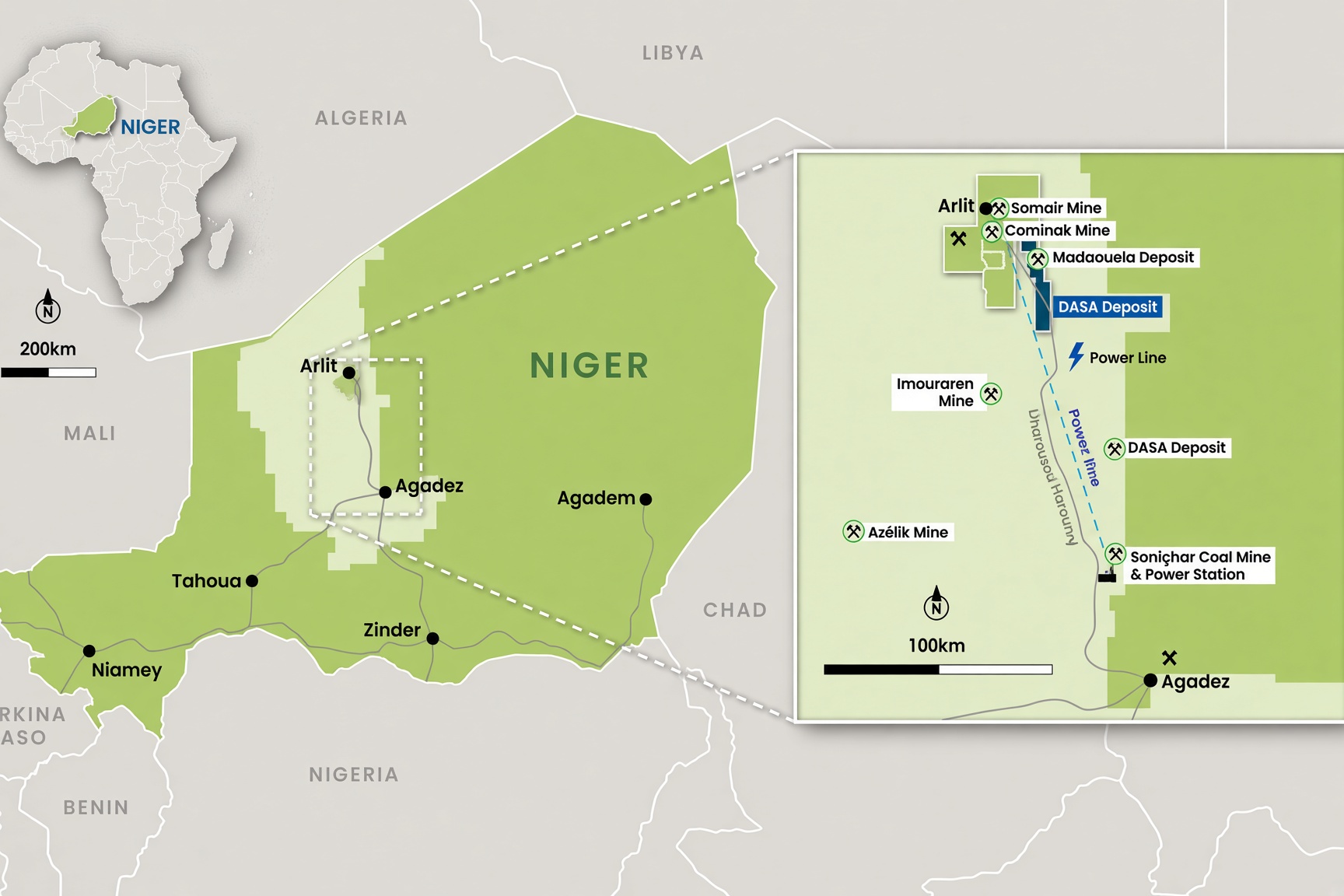
Atomic Eagle's 60% Madaouela stake and full offtake rights mirror the terms behind Global Atomic's $400 million Niger financing.
- Global Atomic secured a commitment from the US government, via the Development Finance Corporation, for $400 million in debt financing for a comparable Niger uranium project, and now trades at an approximate market capitalization of C$350 million.
- Atomic Eagle holds a 60% interest in the Madaouela Uranium Project under a newly negotiated Mining Convention, with the Republic of Niger holding a 15% free carried interest and a 25% contributing interest.
- The Mining Convention grants Atomic Eagle unfettered access to 100% of Madaouela's offtake rights on arm's-length terms, alongside legal and tax stabilization for the life of the mine.
- Atomic Eagle holds approximately $23 million in cash following its largest shareholders' recent option exercises, funding the US$5 million payment due to the Niger government in October.
- Madaouela's 116 million pound foreign estimate was previously constrained at a $70 per pound uranium price; management is now modeling a $96 per pound long-term price ahead of a fourth-quarter resource update and a first-quarter feasibility study update.
A Financing Precedent From Next Door
Junior uranium developers with African assets have faced a persistent question from investors: who will actually finance construction once a resource is defined? Niger's history of expropriating uranium licenses, most visibly from Areva's successor Orano at the neighboring Somair and Cominak operations, has made that question sharper for projects in the country than almost anywhere else in the uranium sector.
Global Atomic answered it. The company secured a commitment from the US government, via the Development Finance Corporation (DFC), for $400 million in debt financing for its own Niger uranium project, a scale of commercial bank-style capital that had not previously been available to a Niger-based developer. The financing lifted Global Atomic to approximately C$350 million in market capitalization.
For Atomic Eagle (ASX: AEU | OTCQX: AEUXF), the relevance is direct rather than thematic. Chief Executive Officer of Atomic Eagle, Phil Hoskins, described the company's own position in the same remarks:
"Market cap about $170 million, $23 million in the bank following some recent option exercises from our largest shareholders, so we're very well funded to conduct our activities."
That funding base sits behind a project built on the same jurisdictional logic Global Atomic just proved financeable: a Niger uranium convention structured to satisfy a development finance institution's lending criteria.
The Mining Convention Atomic Eagle Negotiated
Madaouela was expropriated from its previous holder, GoviEx Uranium, in 2024, before Atomic Eagle spent months renegotiating terms directly with the Niger government. The resulting Mining Convention re-establishes a 60% Atomic Eagle interest, with the Republic of Niger holding the remaining 40% through a 15% free carried interest and a 25% contributing interest that must fund its share of future production costs.
Atomic Eagle has agreed to pay US$5 million upfront, payable in October. Legal and tax stabilization provisions lock those terms in for the life of the mine, the category of protection lenders typically require before committing capital to a jurisdiction with a recent expropriation history.
The convention also addresses offtake, the piece of a financing package that determines whether a lender can underwrite future cash flows. Hoskins framed Madaouela's terms directly against Global Atomic's financing outcome:
"What we've been able to deliver on an offtake standpoint is unfettered access to 100% of the offtake rights, provided that a party is putting that up on arm's length terms. So it really is a financeable mining convention. We've seen Global Atomic's. We think ours is better than theirs, but if theirs got financed, then surely ours can, too."
Funding the Near-Term Convention Payments
The Madaouela convention's payment schedule is modest against Atomic Eagle's current balance sheet. The company's approximately $23 million in cash follows an early option exercise by its largest shareholders, funding that comfortably covers the US$5 million payment due to the Niger government in October without requiring a capital raise.
Atomic Eagle can already meet the October payment from cash on hand; the larger construction-stage financing decision is separate and depends on the outcome of the updated feasibility study (FS). Global Atomic's $400 million financing establishes that a Niger convention with comparable protections can attract that larger capital once a project reaches the appropriate technical milestone.
Resource Upside Ahead of the Fourth-Quarter Update
Madaouela's 116 million pound foreign estimate at approximately 1,300 parts per million was calculated under a $70 per pound uranium price constraint. Atomic Eagle is now modeling a $96 per pound long-term price for its fourth-quarter mineral resource conversion, a materially higher input that management expects to expand the reportable pound count from the same underlying drilling database.
The pricing shift also carries through to the mining plan. Madaouela's prior feasibility work, completed under previous ownership, optimized mining at a $55 per pound uranium price. Atomic Eagle's updated FS, targeted for the first quarter of next year, will re-run that optimization against the current $96 per pound assumption, a gap management has said is already showing meaningful economic upside in early scoping work. The company inherited approximately $160 million of historical spending and 600,000 meters of drilling on Madaouela from prior holder GoviEx Uranium, providing the technical database this update draws on rather than requiring new field work to support the reconversion.
The Investment Thesis for Atomic Eagle
- Global Atomic's $ 400 million debt financing from the Development Finance Corporation shows that development finance institutions will lend against a Niger uranium convention with legal and tax stabilization and clear offtake rights, a structure comparable to what Atomic Eagle negotiated for Madaouela.
- The Madaouela Mining Convention's US$5 million payment, payable in October, is fully funded from Atomic Eagle's current cash position without requiring near-term equity issuance.
- Madaouela's resource conversion, scheduled for the fourth quarter, will apply a $96 per pound long-term uranium price assumption against a resource previously constrained at $70 per pound, and this price shift could expand the reportable pound count.
- The updated feasibility study, targeted for the first quarter of next year, draws on a technical database of approximately US$160 million in historical spending and 600,000 meters of drilling, and will re-optimize the mining plan against that same higher pricing assumption.
- Unfettered access to 100% of Madaouela's offtake rights on arm's-length terms removes a structural constraint that has historically limited African uranium developers' ability to secure project-level debt financing.
- Atomic Eagle's approximately $23 million cash position and about $170 million market capitalization provide a funded runway through the near-term convention obligations while the larger construction-stage financing decision awaits updated technical studies.
Global Atomic's financing outcome does not guarantee Atomic Eagle will secure comparable terms for Madaouela, but it removes the open question of whether a Niger uranium convention can clear a development finance institution's lending bar. That question is now answered, and Atomic Eagle's own convention carries offtake and stabilization provisions management has already compared favorably against the deal that just cleared it.
TL;DR
Global Atomic's $400 million DFC financing for a comparable Niger uranium project validates the mining convention structure behind Atomic Eagle's own Madaouela project, where the October payment is funded from existing cash and a fourth-quarter resource update will apply a materially higher uranium price assumption.
FAQs (AI-Generated)
Analyst's Notes





Subscribe to Our Channel




Stay Informed