Atomic Eagle's Exploration Target: What a Second Dibbwi East Discovery Could Mean for Valuation


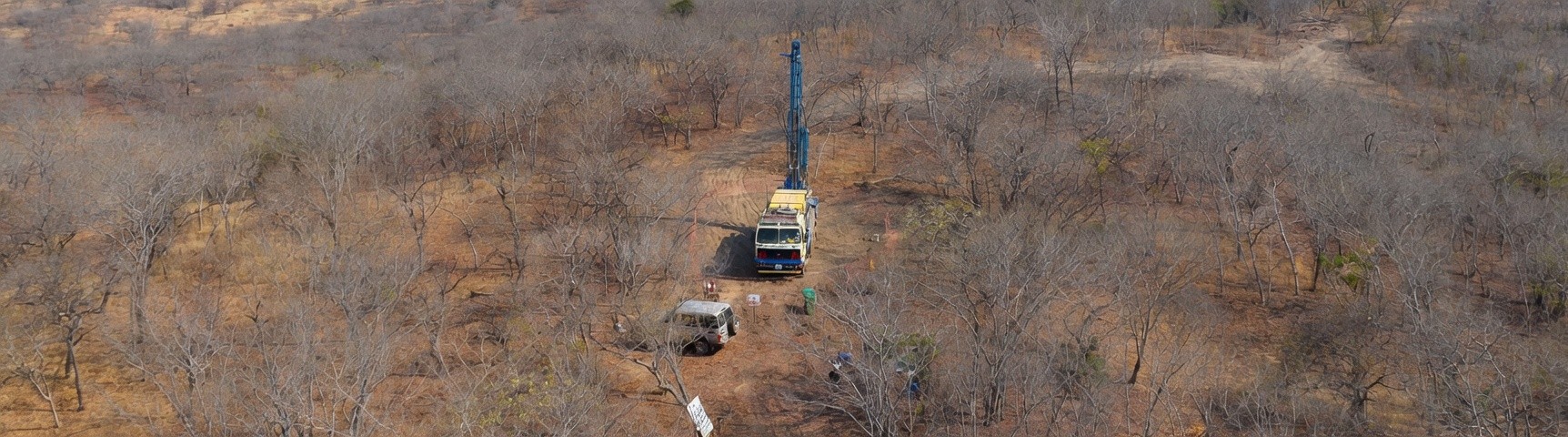
Atomic Eagle is testing a 40-100Mlb uranium Exploration Target at Muntanga, using Dibbwi East as a benchmark for potential scale and valuation upside.
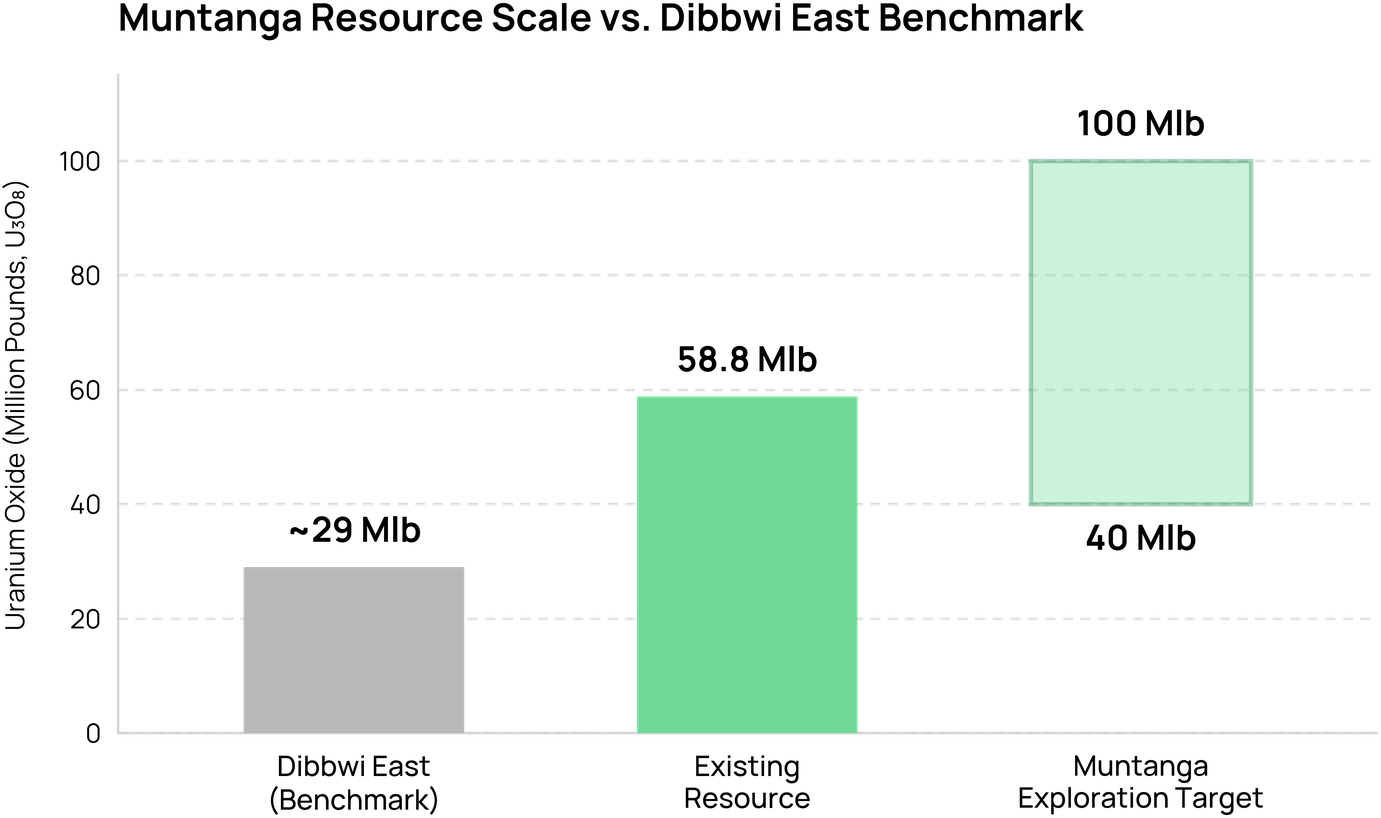
- Atomic Eagle has defined a 40 million to 100 million pound uranium oxide Exploration Target at Muntanga, on top of its existing 58.8 million pound resource.
- Management uses the existing Dibbwi East deposit, approximately 29 million pounds of uranium oxide, as its internal benchmark for that target.
- Untested radiometric anomalies at Muntanga North span 3 to 5 kilometers in strike length.
- Ground radiometric surveys have refined those anomalies into drill targets, with 424 of 854 readings above background.
- Atomic Eagle trades at a discount to peers Deep Yellow and Bannerman on an enterprise value per pound basis, a March 2026 snapshot that predates this quarter's newsflow.
What Has Happened
Atomic Eagle Limited (ASX: AEU | OTCQX: AEUXF) is treating its Muntanga Exploration Target not as an abstract range, but as a measurable scale comparison anchored to the already-drilled Dibbwi East deposit. The company has been explicit about that framing, sizing the opportunity against a known reference point already on the property, a deposit the company has drilled out and incorporated into its resource base.
That framing converts an exploration target, which carries no certainty of conversion to a resource, into a concrete scale comparison investors can test against actual anomaly data. Recent drilling activity gives the clearest picture yet of how that comparison is being used to prioritize targets across the project.
The Discovery Math Behind the Exploration Target
Atomic Eagle's current resource stands at 58.8 million pounds of uranium oxide at 309 parts per million (ppm), as confirmed in the company's March 10, 2026 announcement. Layered on top of that is a separate Exploration Target of 40 million to 100 million pounds of uranium oxide, concentrated at Muntanga North, roughly 15 kilometers north of the main resource area, and Namakande. Because an exploration target is conceptual, the practical question for investors is what scale of discovery would actually move the needle.
Management has answered that question using Dibbwi East, approximately 29 million pounds of uranium oxide, as the internal yardstick. Muntanga North's radiometric anomalies span 3 to 5 kilometers in strike length, though the company has not yet drilled to confirm comparable grade or continuity.
Chief Executive Officer of Atomic Eagle, Phil Hoskins, described the scale of the opportunity in those terms:
"That puts the size of the prize somewhere between 100 and 150 million pounds, according to our geologists, and where that step change is going to come from will be either through Muntanga North or Namakande."
That 100 to 150 million pound figure is management's characterization of the project's total scale, the existing 58.8 million pound resource combined with the Exploration Target, rather than a restatement of the 40 to 100 million pound Exploration Target alone. The comparison does not guarantee a discovery of that scale, but it establishes a specific, testable benchmark against which investors can measure incoming assay results from Muntanga North and Namakande.
Multi-Layered Targeting Ahead of the Drill Bit
Before committing drill capital to Muntanga North, Atomic Eagle ran a ground radiometric survey to refine historical airborne anomalies into higher-resolution drill targets. By late May 2026, the program had covered 53 line kilometers of a planned 80 line kilometer survey across 5 of 8 priority target areas, extending to 6 target areas by mid-June 2026, and returned 424 of 854 readings above background, defined as greater than 300 counts per second, including 87 readings exceeding 500 counts per second. The company notes such handheld scintillometer readings are preliminary and not a substitute for laboratory assays.
Hoskins linked the survey directly to drill targeting:
"The expectation is that it'll really refine those targets and help point us in the right direction for sending the rigs in there."
That refinement work has now moved to the drill bit. The anomalies sit within the Escarpment Grit Formation, the same host geology as Muntanga, Dibbwi East, and Dibbwi, and the company states its interpretation draws on airborne radiometrics, ground radiometrics, soil geochemical and radon surveys, favorable geology, and structural controls. The maiden Muntanga North drill program is now underway on the back of that targeting work, with Namakande identified as a further target for follow-up drilling.
A Valuation Gap Relative to Peers
Atomic Eagle trades at a discount to its Namibian peers on an enterprise value per pound basis: as of March 25, 2026, the company traded at A$3.12 per pound of Measured and Indicated resource, against A$6.56 per pound for Deep Yellow Limited and A$4.80 per pound for Bannerman Energy Limited, according to Atomic Eagle's March 2026 corporate presentation.
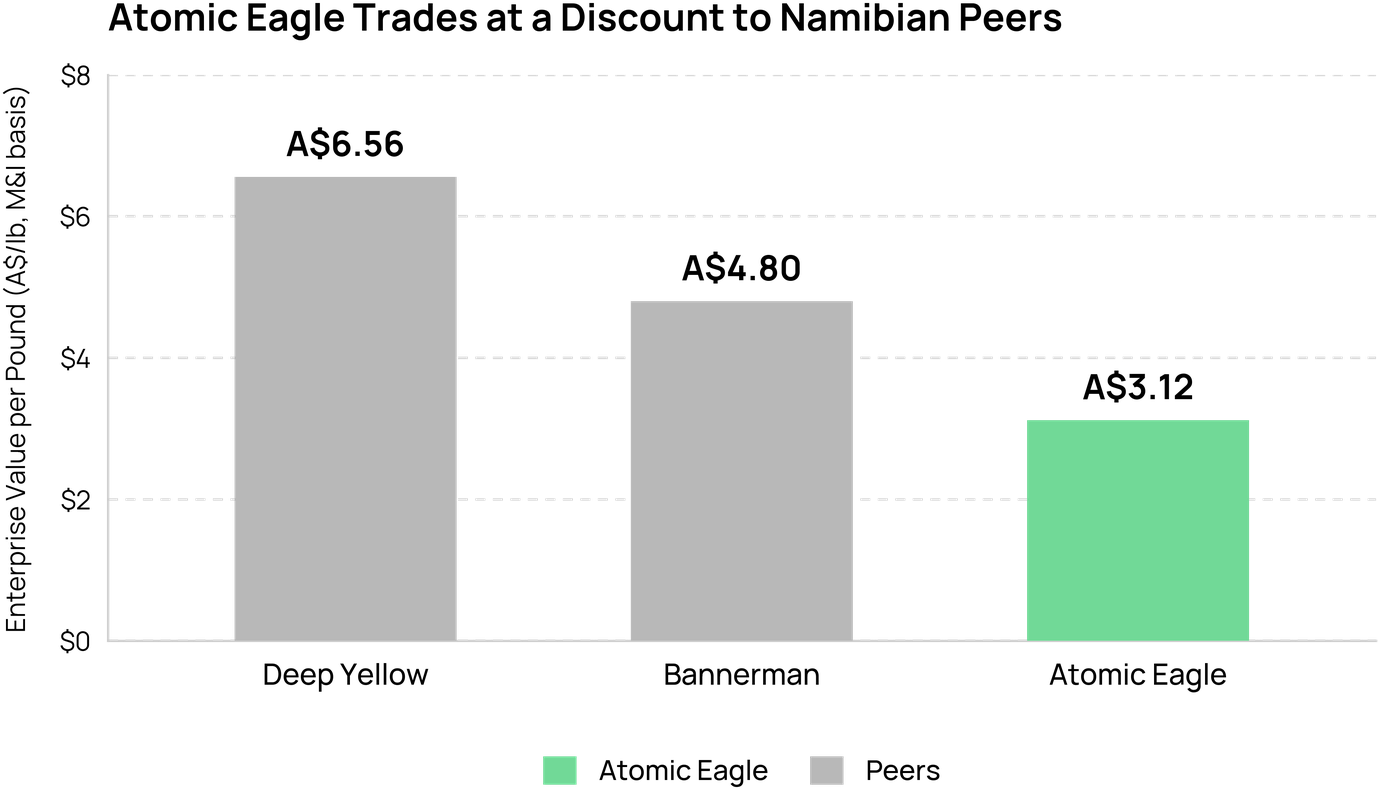
Atomic Eagle's Measured and Indicated grade of 359 ppm uranium oxide compares favorably with Deep Yellow's 285 ppm and Bannerman's 223 ppm, suggesting the discount is not primarily a grade discount.
That snapshot predates this quarter's exploration results at Chisebuka and Muntanga North, and remains the most recent published comparison available. The relevant point for investors is not that the gap has closed, but that it existed before those results were known to the market.
What to Watch Next
The nearest-term catalyst is assay results from the newly commenced Muntanga North maiden drill program, the first direct test of the Dibbwi East comparison. Namakande drilling, still to be scheduled, would provide a further test of the same benchmark. Investors should also watch for any updated peer valuation disclosure from the company, given that the only published comparison predates the current quarter's exploration results.
FAQs (AI-Generated)
Analyst's Notes





Subscribe to Our Channel




Stay Informed