




China's Gold VAT Cut Curbs Recycling, Raising Reliance on Mine Supply



China’s gold tax favors jewelry trade-ins as recycling falls, raising reliance on expandable mines while permitting and costs limit new supply.
- China’s lower value-added tax exemption can make jewelry exchanges more attractive than outright sales, keeping privately held gold within the fabrication chain instead of adding to recycled supply.
- Chinese recycled gold supply fell 15% year over year and 19% quarter over quarter in the second quarter of 2026, helping reduce global recycling by 6% year over year to 326 tonnes.
- Record second-quarter mine production rose 2% year over year to approximately 966 tonnes, but total supply remained near 1,269 tonnes as lower recycling and miners reducing hedge positions removed additional metal from the market.
- With recycled supply down 6% year over year, producers that can expand existing mines, mills and recovery circuits offer a faster route to additional gold production than projects requiring new infrastructure.
- Explorers with existing infrastructure, tested metallurgy and staged development plans have clearer routes to commercial production because they require fewer new facilities and can phase capital spending.
China’s VAT Exemption Cut Limits Gold Recycling
Effective November 1, 2025, China cut the input-VAT deduction on exchange-traded gold used for jewelry from 13% to 6%, while jewelry sales remained subject to 13% VAT. The higher net cost encourages trade-ins, keeping old gold within the jewelry supply chain and potentially reducing reported recycling.
Jewelry Exchanges Limit Recycling & Shift Near-Term Supply Toward Mines
The World Gold Council (WGC) report on Gold Demand Trends: Q2 2026 identifies jewelry exchanges as one reason Chinese recycling may remain weaker than transaction activity suggests. By exchanging existing jewelry, buyers can offset part of the VAT cost while keeping the metal within the fabrication chain instead of adding it to net recycled supply.
When holders exchange or retain gold instead of selling it, the near-term supply response shifts toward mines, where drilling, permitting, construction and ramp-up delay additional production.
Lower Recycling & De-Hedging Keep Supply Flat Despite Record Mine Output
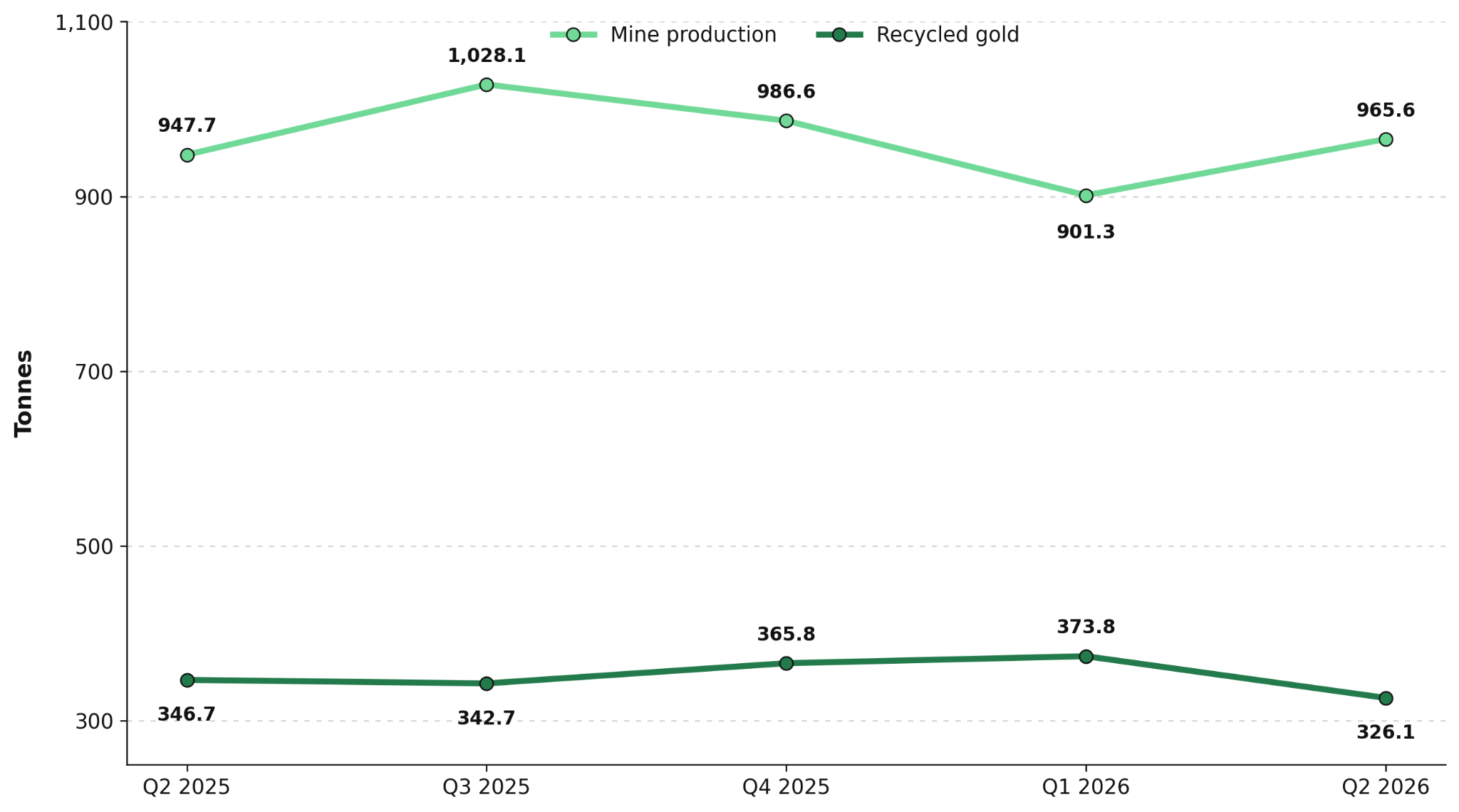
WGC data show that global mine production rose 2% year over year to approximately 966 tonnes in the second quarter of 2026, the highest second-quarter total in its series beginning in 2000. Total supply remained near 1,269 tonnes because recycled gold fell 6% and miners’ reductions in hedge positions removed an estimated 23 tonnes from market supply.
Asian Recycling Declines Lower Secondary Supply Despite Higher Gold Prices
WGC reported that global recycled gold supply fell 6% year over year to 326 tonnes in Q2 2026, as declines in China, India and the Middle East outweighed flows from Europe and North America. Recycling also fell 13% quarter over quarter despite gold averaging 37% above year-earlier levels, as the 7% decline from Q1 highs encouraged holders to retain gold in anticipation of a recovery or as protection against weak currencies.
First-half mine production reached a record 1,867 tonnes, but in Q2 a 17.9-tonne increase in mine output was offset by a 20.6-tonne decline in recycling and 22.8 tonnes of producer de-hedging, leaving total supply effectively flat at 1,268.9 tonnes. Although this does not prove a physical shortage, recycling’s 6% decline despite prices averaging 37% higher increased reliance on operating mines, as undeveloped resources require permitting, financing and construction before contributing supply.
Lower Recycling Raises Reliance on Existing Mills & Staged Gold Development
West Red Lake Gold Mines is evaluating Starratt-Olsen as a potential additional source of ore for the operating Madsen mill. Initial drilling returned 1.5 meters grading 16.16 grams per tonne (g/t) gold and 4.5 meters grading 5.16 g/t, while an existing underground exploration drift reaches within 200 meters of the deeper target. Although Starratt-Olsen does not yet have a defined mineral resource, its proximity to Madsen could support the company’s hub-and-spoke strategy by expanding potential mill feed through existing infrastructure.
Shane Williams, President and Chief Executive Officer of West Red Lake Gold Mines, explains how higher prices expand mineable mill feed:
“With the increasing gold price, cut-off grade can come down, which allows a lot more material, which allows us to switch to long-hole mining. I’ve been able to take more material at lower grade to put it through the mill.”
Serabi Gold produced 14,988 ounces during the first half of 2026, with second-quarter ore averaging 7.41 grams per tonne (g/t) gold. A fourth ball mill, targeted for commissioning in the fourth quarter of 2026, would increase Palito’s capacity from approximately 650 to 900 tonnes per day, providing a funded route to process ore from both mines without constructing a separate Coringa plant.
Existing Plants & Cash Flow Fund Expansion, Raising Gold Output
Integra Resources has expanded Florida Canyon’s reserve base and mine plan, strengthening the operation’s ability to fund future growth. The rebuilt model increased proven and probable gold reserves by 74% to approximately 1.191 million ounces, extended mining through 2033 with two additional years of residual gold recovery, and raised expected average annual production by 17% to 82,000 ounces. Florida Canyon generated US$22.8 million in operating cash flow during the second quarter of 2026, providing an internal source of capital to help advance DeLamar through permitting and development.
TRX Gold is moving Buckreef’s expansion into execution after contracting a 3,500-tonne-per-day mill circuit. Designed to operate alongside the existing 2,000-tonne-per-day plant, the circuit could raise combined nominal capacity to 5,500 tonnes per day while allowing production to continue during construction. Gold poured during the quarter rose 58% year over year to 7,426 ounces, while record adjusted earnings before interest, taxes, depreciation and amortization (EBITDA) of US$20.7 million strengthened the company’s ability to fund expansion with less reliance on new equity.
Gold Retention Limits Recycling & Raises Reliance on Mine Supply
In the second quarter of 2026, the average gold price was 37% higher year over year while recycled supply fell 6%, showing that secondary supply did not rise with the annual price increase. The decline does not establish physical scarcity because short-term price gains can still encourage holders to sell more gold into the recycling market.
Company assessment should focus on whether reserve conversion, grade reconciliation, permitted throughput, recovery rates, funded equipment and dated commissioning plans support profitable production growth. Exploration-stage projects offer more credible development paths when tested metallurgy, infrastructure access and staged capital plans reduce the facilities and funding required before production.
P2 Gold is evaluating Car Body as an early source of gold production during construction of the wider Gabbs project. Laboratory column testing recovered 95.6% of gold from oxide samples after 73 days, while the zone’s low copper content could eliminate the need for an additional copper-removal circuit. Contract mining, contract crushing and a leased portable gold-recovery plant could allow Car Body to generate cash flow roughly six months after project construction begins, with the feasibility study expected in the first quarter of 2027 to evaluate this accelerated approach.
Weaker Jewelry Demand Offsets Lower Recycling & Limits Gold Price Support
WGC reported that global gold jewelry demand fell 17% year over year to 278 tonnes in the second quarter of 2026, while mainland Chinese demand declined 28% to 50 tonnes as high prices constrained affordability. Lower jewelry demand can offset the supply effect of weaker recycling by reducing fabrication consumption, so China’s tax change alone cannot determine gold prices or mining-company valuations. Source
China’s lower VAT exemption can keep traded-in jewelry within the fabrication chain, making recycled supply less responsive to high prices. Chinese recycling, jewelry exchanges, physical demand and mine output should be assessed together because each affects whether lower secondary supply tightens the physical balance. Mine-growth forecasts require named permits, committed financing, demonstrated recovery rates and dated commissioning schedules before projected ounces can be treated as credible supply. Continued weak recycling would increase reliance on expandable mines and permitted development projects, but only completed production can change physical supply.
Lower Recycling Raises Reliance on Staged Projects Bringing Supply Forward
When recycled supply declines, staged projects with existing infrastructure can jump to production sooner and with lower initial capital requirements than standalone developments.
Mineros S.A. is pairing near-term processing growth at Hemco with a longer-term development option at Porvenir. Hemco is targeting 2,500 tonnes per day by December 2026, which would allow stockpiled ore containing approximately 11,000 ounces of gold to be processed as capacity increases. Porvenir is modeled to produce 72,300 gold-equivalent ounces annually for more than nine years at an all-in sustaining cost of US$1,295 per ounce, while detailed engineering and permitted early works are progressing ahead of a targeted early 2027 construction decision.
Permitting & Metallurgical Limits Slow Supply Growth & Pressure Margins
Greater reliance on mines cannot produce new ounces quickly because development requires technical studies, financing, permitting, construction and ramp-up. A mineral resource estimates gold in the ground, while a reserve identifies potentially economic material; neither guarantees production without permits, infrastructure and processing capacity.
Environmental approval alone may not authorize construction if land, water, forestry or consultation permits remain outstanding. Readiness should therefore be measured through dated milestones and specific approvals. Established infrastructure and community consultation can reduce development risks, but they cannot replace site-specific legal authorization.
Commercial Recovery & Throughput Determine Gold Output & Operating Margins
Metallurgical recovery, the share of contained gold captured during processing, and plant throughput, the volume of ore treated each day, determine how much gold becomes available for sale. Grade and cut-off grade determine which material qualifies as ore, while dilution and strip ratio increase the lower-value material that must be moved, raising unit costs. Faster leach kinetics convert contained gold into cash sooner, while oxide ore can often use heap leaching with fewer processing stages than sulfide or copper-bearing ore. Laboratory recovery results must be validated across commercial volumes and variable ore types before they can support production and cost forecasts.
The WGC report Gold Demand Trends: Q2 2026, published July 30, 2026, placed average industry all-in sustaining costs (AISC) at a record US$1,785 per ounce in the first quarter, up 16% year over year based on reported costs rather than a forecast. WGC attributed the increase to higher royalties and corporate general and administrative expenses, which reduced the share of higher gold prices reaching operating margins. Existing mills and recovery circuits can add saleable ounces through higher throughput and recovery without requiring a new processing plant.
The Investment Thesis for Gold
- The 6% year-over-year decline in recycled supply increases reliance on producers that can add ounces through operating mines and existing processing plants.
- Expansions at operating mines and nearby deposits can add mill feed with fewer new facilities, permits and workforce requirements than new standalone projects.
- Higher throughput and recovery rates can increase saleable gold from the same ore volume without requiring a larger resource estimate.
- Exploration-stage projects with tested oxide recoveries, infrastructure access and staged development plans can reduce the new facilities and funding required before production.
- Cash balances and operating cash flow can reduce reliance on new debt or equity, but construction budgets and commissioning schedules still determine dilution and delivery risk.
Chinese recycling fell 15% year over year and 19% quarter over quarter in the second quarter of 2026. Lower recycled supply raises near-term reliance on operating mines but does not determine bullion prices because jewelry and investment demand also shape the physical balance. Company assessment should prioritize expandable infrastructure, funded capital plans and dated permits, while exploration-stage projects require tested metallurgy, staged development and credible financing. Resource size alone cannot add supply; only permitted, financed and technically validated projects can convert contained gold into commercial production.
TL;DR
China’s lower value-added tax exemption can make jewelry trade-ins more attractive, keeping privately held gold within the fabrication chain instead of adding to recycled supply. Chinese recycling fell 15% year over year in the second quarter of 2026, while global recycling declined 6% to 326 tonnes. Record mine production still left total supply nearly flat because lower recycling and producer de-hedging offset newly mined ounces. This increases reliance on operating mines, existing mills and staged projects that can add production with less new infrastructure. However, weaker jewelry demand may offset reduced recycling, while permits, financing, metallurgy, recovery and costs determine whether identified resources become profitable supply.
FAQs (AI-Generated)
Analyst's Notes





Subscribe to Our Channel














Stay Informed






















