




Central Bank Gold Buying Holds Through Fed Rate Uncertainty



Central banks sustained gold demand despite Fed uncertainty, while flat supply and funded developers strengthen the case for new mine supply.
- Central banks purchased a net 288.9 tonnes of gold in the second quarter of 2026, up 62% year-over-year, while gold posted its steepest quarterly price decline since 2013, according to the World Gold Council.
- The People's Bank of China (PBOC) increased its gold reserves for the 21st consecutive month in July, adding approximately 20 tonnes, per Bloomberg's August 7, 2026 report.
- July nonfarm payrolls fell by 23,000 against a consensus gain of roughly 83,000 to 95,000, shifting the probability of a Fed hold at the September 16, 2026 meeting from roughly one in three to 60% within a week, based on CME FedWatch pricing cited by CNBC on August 7, with the July Consumer Price Index release due August 12 as the next test of September rate expectations.
- Gold-backed exchange-traded funds (ETFs) recorded 45 tonnes of net redemptions in the second quarter, according to the World Gold Council, before SPDR Gold Trust recorded approximately $637 million of net inflows on August 7, 2026.
Weak Jobs Data Shift Fed Rate Odds & Reprice Near-Term Gold
Gold is sensitive to real interest rates because higher inflation-adjusted yields increase the opportunity cost of holding a non-yielding asset, while a stronger US dollar can reduce demand for dollar-denominated gold. In 2026, that rate channel remained uncertain as three FOMC members dissented at the July meeting in favor of a rate increase.
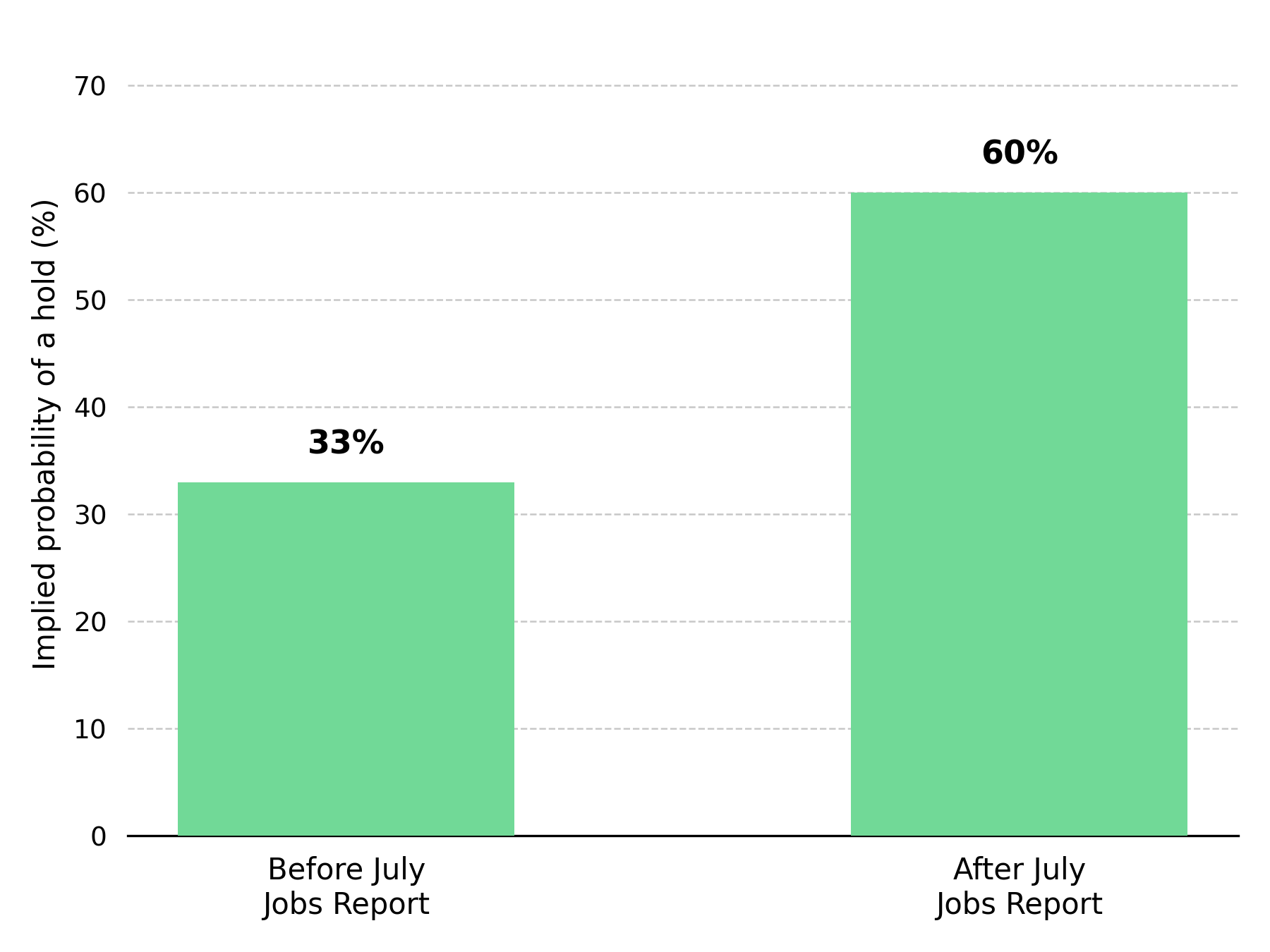
The July jobs report shifted expectations for the Fed's September policy decision within a single trading session. Nonfarm payrolls fell by 23,000 versus a consensus gain of roughly 83,000 to 95,000, according to the Bureau of Labor Statistics' *Employment Situation* release. The unemployment rate fell to 4.1% from 4.2% as 264,000 people left the labor force, pushing the participation rate to 61.4%, its lowest level in 5.5 years.
The probability of a Fed hold at the September 16, 2026 meeting rose from roughly one in three to 60% within a week, based on CME FedWatch pricing cited by CNBC on August 7. The July CPI release on August 12, 2026 is the next major test of September rate expectations: a higher-than-expected reading could increase the probability of a hike, while a softer reading could strengthen the hold case. That rate sensitivity matters when a project is underwritten on a multi-year gold-price assumption because central banks purchased a record 288.9 tonnes in the same quarter that gold posted its steepest quarterly decline since 2013.
Record Central Bank Buying Supports Gold Demand Despite Fed Rate Uncertainty
The WGC's Gold Demand Trends report for the second quarter of 2026 shows that central-bank demand increased even as gold prices declined sharply. Central banks purchased a net 288.9 tonnes in the quarter, up 62% from 177.9 tonnes in the second quarter of 2025 and the highest second-quarter total in the WGC's data series, even as gold recorded its steepest quarterly price decline since 2013.
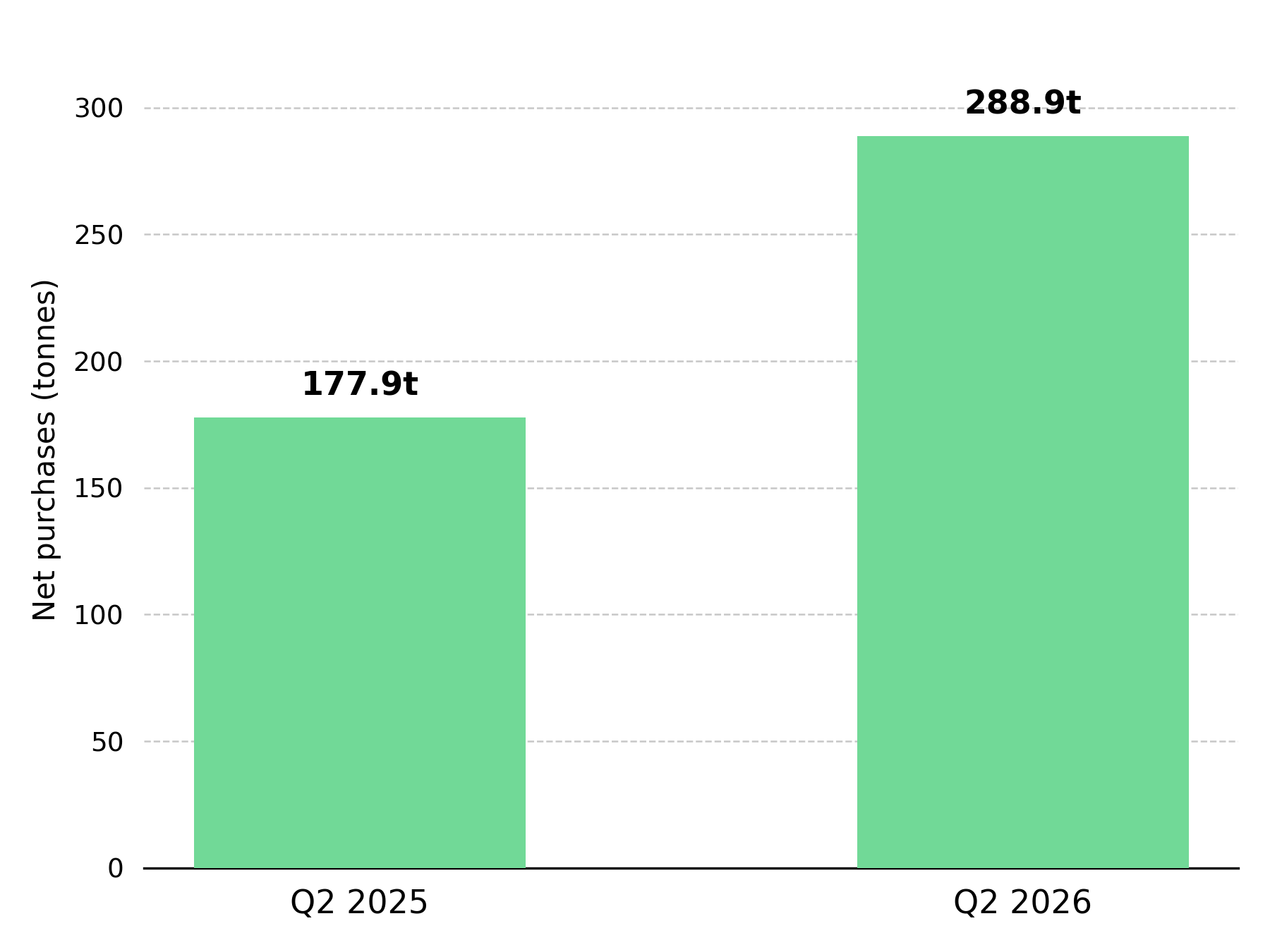
The WGC's Central Bank Gold Reserves Survey found that 45% of central banks intend to increase their gold reserves over the next 12 months, indicating that a significant share of official-sector buyers plans to maintain or increase gold allocations beyond the second quarter. The PBOC increased its gold reserves by roughly 20 tonnes in July, extending its accumulation streak to 21 consecutive months, according to Bloomberg's August 7, 2026 report. That 21-month accumulation streak indicates that official-sector demand has continued across multiple quarters rather than being concentrated around a single price move.
Development-stage gold equities declined alongside gold during the second-quarter price pullback even as central banks continued buying, a pattern Alan Carter, CEO and President of Cabral Gold, also observed across junior gold equities.
ETF Flows Reverse as Central Banks Sustain Gold Demand Through Rate Uncertainty
Gold-backed ETFs respond more quickly to changes in gold prices and rate expectations than central-bank reserve demand, as shown by their second-quarter redemptions. Gold-backed ETFs recorded 45 tonnes of net redemptions in the second quarter, according to the WGC, as gold prices declined while the dollar strengthened and rate expectations remained elevated. On August 7, SPDR Gold Trust recorded approximately $637 million in net inflows, providing a specific example of ETF demand turning positive after the second-quarter redemptions.
Central-bank buying provides a longer-duration source of gold demand, while ETF flows are more sensitive to changes in gold prices and Fed rate expectations. With central-bank buying continuing and ETF flows turning positive, company-specific catalysts such as assays, resource updates and production milestones become more important drivers of development-stage equity performance..
Flat Gold Supply Increases the Need for New Mine Supply
Total gold supply was unchanged year-over-year at 1,269 tonnes in the second quarter, according to the WGC's Gold Demand Trends report published July 30, 2026, with higher mine production offset by lower recycling. Mine production rose 2% year-over-year, while recycling fell 6% as lower quarter-over-quarter gold prices reduced the incentive to sell scrap, according to the WGC. Jewelry demand fell 17% year-over-year to 278.2 tonnes from 335.3 tonnes, and declined 5% from the first quarter as higher gold prices reduced affordability, according to the WGC.
Investment and official-sector demand remained stronger than jewelry demand in the second quarter, while mine production growth and lower recycling left total gold supply unchanged at 1,269 tonnes. With limited growth in current supply, additional mine ounces will increasingly depend on development-stage projects advancing through feasibility, permitting and financing.
Joe Ovsenek, President and CEO of exploration-stage P2 Gold, tied the company's Gabbs project in Nevada to that pipeline directly, describing the schedule behind its 2025 preliminary economic assessment (PEA), which reported a base-case after-tax net present value (NPV5%) of $942.9 million and a 33.8% internal rate of return (IRR):
"We would like to get a resource estimate out by the end of the summer, and that will feed right into our schedule to have that feasibility done by year-end."
Several projects in the pipeline generate or model revenue from copper or silver alongside gold, which can reduce their sensitivity to changes in the gold price alone.
Copper & Silver Credits Reduce Gold-Price Sensitivity in Project Economics
At Treaty Creek in British Columbia's Golden Triangle, Tudor Gold's Goldstorm deposit has an indicated mineral resource of 24.9 million ounces of gold, 148.7 million ounces of silver and 3.048 billion pounds of copper, plus a further 4 million ounces of inferred gold, according to a technical report dated November 30, 2025. An underground PEA is now underway.
At US Gold Corp's CK Gold project in Wyoming, copper accounts for roughly 30% of project economics in a definitive feasibility study (DFS) that shows a $632 million after-tax NPV5% and a 27% after-tax IRR. Luke Norman, Executive Chairman of US Gold Corp, set out the base case behind those figures:
"We ran 3,250 dollars as our base case, which is significantly below consensus, with most analysts pushing toward 3,800 dollars an ounce. When we start pushing up towards the spot price in gold, you can see a tremendous shift."
A DFS using a $3,250/oz gold-price assumption, below both prevailing spot and roughly $3,800/oz analyst consensus, provides a more conservative basis for the project's $632 million after-tax NPV5% than a model using a higher gold-price assumption.
Funded Projects Reduce Reliance on Near-Term Equity Financing
Several development-stage companies are advancing projects with funding, permits or cash balances that reduce their dependence on near-term equity financing. New Found Gold's Queensway Phase 1 project in Newfoundland is fully funded, while the Pine Cove mill conversion permit is in hand and mill capacity is being doubled to approximately 1,400 tonnes per day to process feed from Queensway and Hammerdown. The company is targeting first Queensway Phase 1 material for the mill in the fourth quarter of 2027.
Hycroft Mining Holding Corporation reported $220.5 million in cash and no debt as of June 30, 2026, providing liquidity to advance its bulk-tonnage resource and evaluate high-grade underground mining at its Nevada project.
Cabral Gold reported that commissioning at its Cuiú Cuiú project in Brazil was approximately 85% complete as of early August 2026, with commercial production targeted for the fourth quarter and construction costs remaining within the PFS capital estimate. Across the covered developers, funded construction programs and debt-free or well-capitalized balance sheets can reduce reliance on near-term equity financing as projects approach production.
August CPI May Shift Fed Rate Odds, But Central Bank Buying Supports Gold Demand
The July jobs report shifted the probability of a September Fed hold from roughly one in three to 60% within a week, while the August 12, 2026 CPI release could shift those odds again. A higher-than-expected CPI reading could increase the probability of a September hike, while a lower-than-expected reading could strengthen the case for a hold.
The August 12 CPI release can change September rate expectations, but it cannot alter the 288.9 tonnes of gold central banks purchased in the second quarter or the PBOC's 21 consecutive months of reserve accumulation. That accumulation continued while gold posted its steepest quarterly price decline since 2013.
The development-stage companies discussed above have funding, permitting and construction milestones that do not hinge solely on the August 12 CPI release. When gold prices and ETF flows respond to Fed expectations while central banks continue accumulating gold, the gap between a feasibility study's base-case gold-price assumption and the prevailing market price becomes a key measure of how conservatively the project has been modeled.
The Investment Thesis for Gold
- Central-bank demand remained strong despite Fed rate uncertainty, with purchases rising 62% year-over-year in the second quarter of 2026 as gold posted its steepest quarterly price decline since 2013, supporting the potential for official-sector buying to provide a demand floor without requiring Fed rate cuts.
- Total gold supply was flat year-over-year in the second quarter while recycling fell 6%, according to the WGC's Gold Demand Trends report, leaving limited supply growth from existing sources and increasing the importance of development-stage projects in adding future mine ounces.
- Copper and silver byproduct revenue can reduce a development-stage project's dependence on gold revenue, limiting its sensitivity to changes in the gold price while the Fed's rate path remains uncertain.
- Debt-free balance sheets and fully funded construction programs reduce the need for near-term equity financing, limiting dilution risk while September Fed rate expectations remain sensitive to incoming inflation data.
- The August 12 CPI release and September 16 FOMC meeting provide the macro catalysts against which upcoming resource updates, assays and production milestones will be assessed across the development-stage sector.
- Taken together, record second-quarter central-bank buying, flat total gold supply and well-funded development projects strengthen the case for advancing new mine supply even as Fed rate expectations change.
Central banks purchased a record second-quarter total of 288.9 tonnes of gold in Q2 2026, up 62% year-over-year, during gold's steepest quarterly decline since 2013, while gold-backed ETFs recorded 45 tonnes of net redemptions before SPDR Gold Trust received approximately $637 million in net inflows on August 7. With total gold supply flat and recycling down 6% year-over-year, development-stage projects become more important to future mine supply, particularly assets with copper or silver byproduct exposure. Several companies covered in the article also enter the August 12 CPI release and September 16 FOMC meeting with funded construction programs or debt-free balance sheets, reducing their near-term dependence on equity financing.
TL;DR
Gold's second-quarter fundamentals remained supported by central-bank buying despite a sharp price decline and shifting Fed rate expectations. Central banks purchased 288.9 tonnes, up 62% year-over-year, while the PBOC extended its buying streak to 21 months. ETF flows were weaker, with 45 tonnes of net redemptions in Q2, although SPDR Gold Trust recorded approximately $637 million of inflows on August 7. Total gold supply remained flat at 1,269 tonnes as higher mine production was offset by lower recycling. This combination increases the importance of development-stage projects, particularly those with copper or silver byproduct exposure and strong funding positions.
FAQs (AI-Generated)
Analyst's Notes





Subscribe to Our Channel








Stay Informed






















