




Grid Power & a Modular Plant Limit Cost Inflation on Bandeira's US$191 Million Build


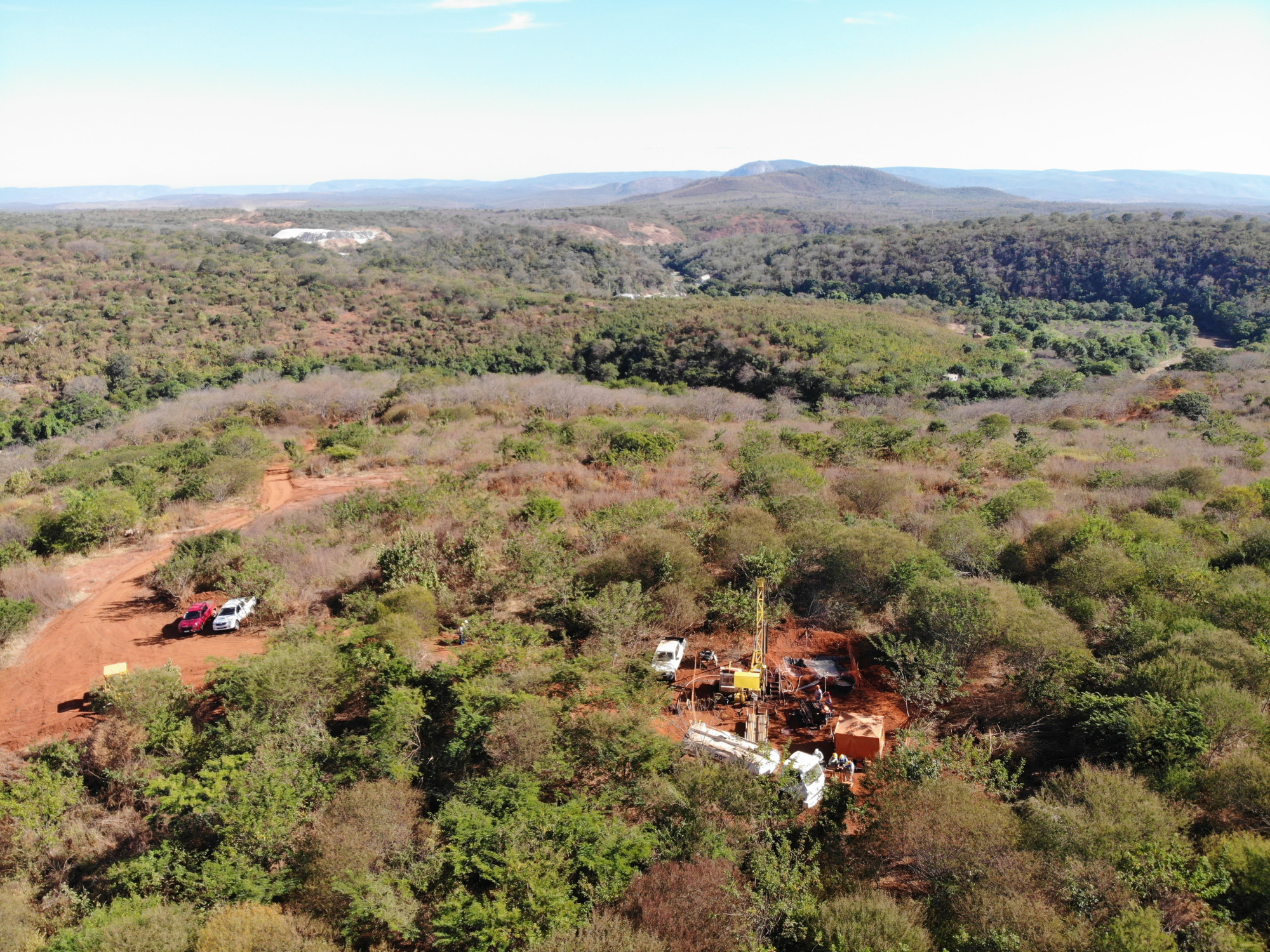
Lithium Ionic's Bandeira build leans on grid hydropower, paved roads, and a modular plant to limit inflation's impact on its US$191 million capital cost.
- Bandeira has an initial capital cost of US$191 million, including US$19.6 million in contingency.
- Initial capital fell to US$191 million in the September 2025 feasibility study (FS), from US$266 million in the May 2024 study.
- Lithium Ionic has locked in enough grid hydroelectric power for Bandeira, and paved roads are already in place.
- Bandeira will use a modular dense media separation (DMS) plant, with much of the equipment able to be sourced in Brazil.
What Has Happened
Lithium Ionic (TSXV: LTH | OTC: LTHCF | FSE: H3N) is taking its Bandeira lithium project in Minas Gerais, Brazil, toward construction. The September 2025 feasibility study (FS) puts initial capital at US$191 million, including contingency. Construction costs have risen across the mining industry, and management ties Bandeira's low costs to 2 design choices. The first is a simple processing plant design that uses only dense media separation (DMS), a process that separates heavier lithium-bearing minerals from lighter waste rock in a dense liquid. The second is the site's access to existing infrastructure such as paved roads to port and nearby hydroelectric grid power.
Chief Executive Officer of Lithium Ionic, Blake Hylands, names both choices and concedes costs will still move:
"We keep them low by being a DMS-only processing, and then we do it with having so much infrastructure in place already, and so, yeah, there's going to be some fluctuations in that."
How far those fluctuations can travel depends on which costs the build budget still has to absorb.
What the US$191 Million Covers
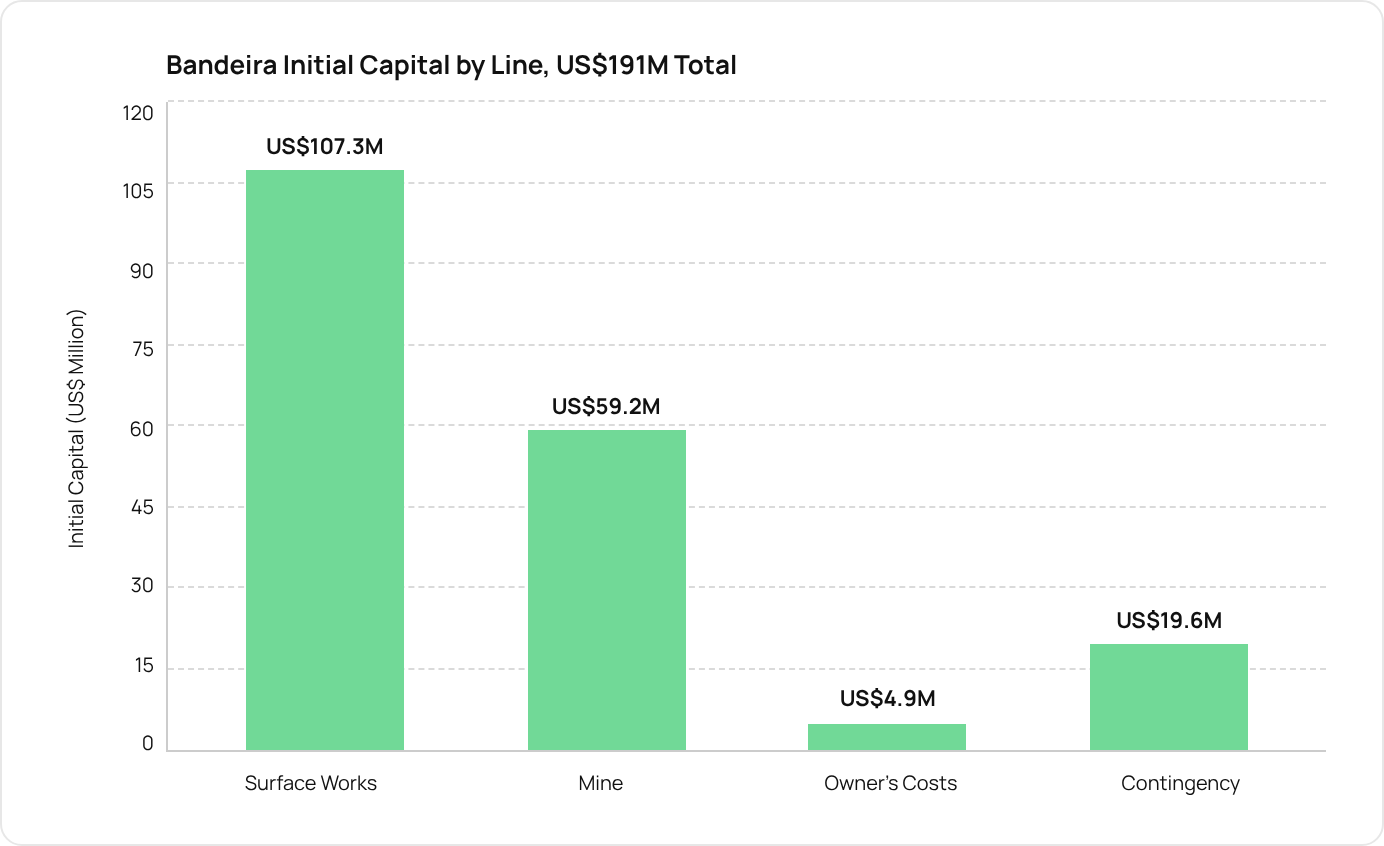
Surface works account for US$107.3 million of the initial capital, the largest single line. The mine accounts for US$59.2 million and owner's costs for US$4.9 million. A further US$19.6 million is contingency, the allowance a cost estimate sets aside for costs that cannot yet be itemized.
The initial capital cost of US$191 million in the FS compares with US$266 million in the May 2024 FS. Sustaining capital rose from US$81 million to US$100 million between the 2 studies. Nominal plant capacity also rose to 1.50 million tonnes per annum from 1.30 million tonnes per annum. Site operating costs on a 5.2% basis fell from US$420 per tonne (t) to US$378/t over the same revision.
Operating costs split into US$190/t for the mine, US$98/t for processing, US$70/t for selling, general, and administrative costs, and US$19/t for capitalized mining. That total places Bandeira below the 50th percentile on the global spodumene concentrate cost curve.
Power, Roads & Water Already in Place
Bandeira is set to draw grid power from an existing hydroelectric supply. In the fourth quarter of 2023, Lithium Ionic partnered with Cemig Distribuição S.A., Brazil's largest hydroelectric provider, to connect the future operation to the main power infrastructure. The company has secured enough power for the project, which does not draw much. The region's hydroelectric base includes the 360-megawatt Irapé Dam in Minas Gerais, and power lines run close to the project.
Hylands points to the price and local support behind that supply:
"Hydroelectric power remains some of the cheapest you can tap into and well supported in our area."
Transport and water are also in hand. Paved roads already serve the project; a paved road runs to the port at Vitória, and nearby ports are less than 300 kilometers (km) away. Araçuaí, a town of about 34,000 people near the project, has an airport and a substation. The company obtained water-rights permits for Ribeirao Piaui, with a goal of 90% water recirculation once Bandeira is in production. Management links this existing hydroelectric grid power and road network to lower exposure to energy-cost inflation and to getting the project up and running.
A Modular DMS Plant Built From Common Equipment
Bandeira's planned DMS flowsheet uses conventional crushing, sorting, separation, and dewatering. The plant is modular, and much of its equipment can be sourced in Brazil. Management expects no major long-lead delays because those components are simple and common.
The same processing route already operates beside the project. CBL's Cachoeira mine, less than 500 meters (m) from Bandeira, has produced lithium since 1991 using underground mining and DMS processing. Sigma Lithium's Grota do Cirilo, less than 4 km away, achieved first production in April 2023 using open-pit mining and DMS processing. Real-time cost data from that recent build next door, and CBL's long operating record, fed the confidence behind Bandeira's study numbers, by management's account.
Bandeira is planned as a small-footprint underground mine. Its DMS tailings handling minimizes water use, energy consumption, chemical use, and overall tailings volume.
Where Cost Pressure Can Still Reach
Bandeira is no different from other mine builds on input inflation, by management's account, which cites steel costs and the rise in what a gold project costs to build compared with 10 years ago.
Hylands sets a limit on how far the build's scope should run:
"It's not a complicated project. It shouldn't be overbuilt."
The capital cost estimate is still being refined, and engineering is well advanced. Geotechnical drilling is complete, major design packages are finalized, and detailed engineering is nearing completion. The company has placed a first long-lead order for the main substation transformer, and contractor tendering is underway.
The delivery team is taking shape. Lithium Ionic needs to expand its team for the next phase and will continue to evaluate its contractors and the build model it uses.
Broader Context
Bandeira is being built in an established mining state. Minas Gerais hosts more than 300 mines and is Brazil's third-largest economy. In May 2023, the state government and municipal agencies launched Lithium Valley Brazil, an initiative to streamline lithium development and production. A July 2022 presidential decree allows unrestricted trade in lithium-containing products.
Financing brings its own hurdles. The first is finding lenders familiar with hard-rock lithium, and the other is taking the time to educate them. Explaining these projects' small footprints and high margins is a key step, by management's account.
Hard-rock lithium is mined the same way as other hard-rock commodities, and DMS is not new technology, in management's view.
What to Watch Next
The next level of engineering has a couple more months of finalizing left, and management reads the work so far as confirming the FS. The remaining engineering work would not delay the start of work.
Permitting runs in parallel. By year-end, Lithium Ionic also aims to have ordered long-lead and semi-long-lead items and to start breaking ground.
The refined capital cost estimate and the first contractor awards will be the earliest published measures of how much of the US$191 million budget holds.
FAQs (AI-Generated)
Analyst's Notes





Subscribe to Our Channel






Stay Informed


