




New Found Gold's Valuation Case Runs Deeper Than Its TSX Listing


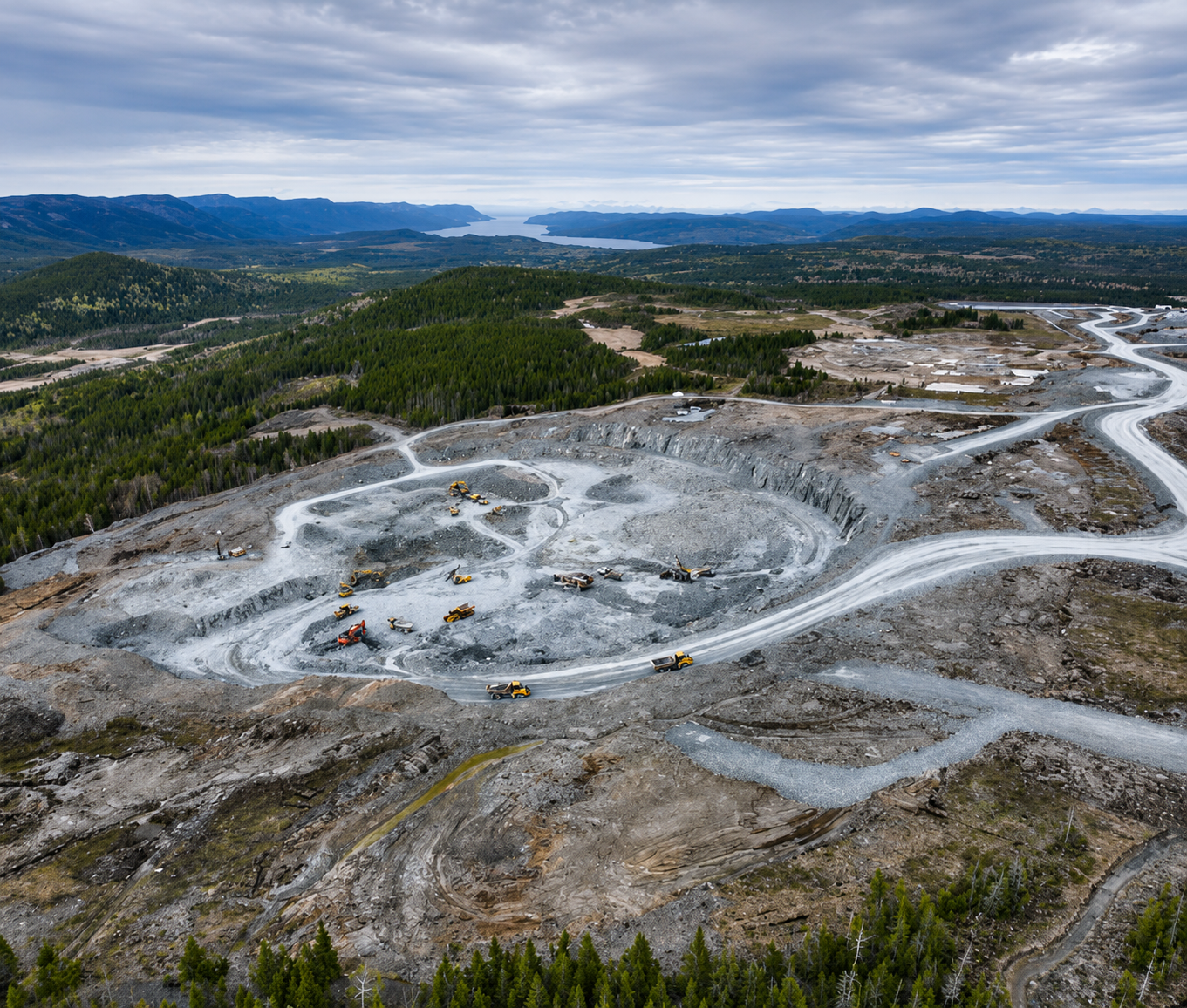
New Found Gold's TSX graduation adds to a valuation case already built on GDXJ inclusion, 5 analysts, and a funded path to production.
- New Found Gold graduated from the TSX Venture Exchange to the TSX main board on August 26, 2026, a step management ties in part to narrowing a valuation gap against junior gold peers.
- New Found Gold already trades inside the VanEck Junior Gold Miners ETF (GDXJ) and carries coverage from 5 sell-side analysts, ahead of the listing change.
- The September 2026 presentation shows Phase 1 production comparable to Hemlo and McEwen, with Phase 2's valuation left open.
- A funded path to Queensway Phase 1 is already in place through the April 2026 financing, with Hammerdown positioned to deliver first cash flow.
- The next 2 dated events in the second half of 2026 are an updated Queensway preliminary economic assessment (PEA) and Hammerdown's commercial production declaration.
What Boyle Said About the Valuation Gap
New Found Gold (TSX: NFGC | NYSE American: NFGC) common shares began trading on the TSX on August 26, 2026, under the symbol NFGC, aligning the Canadian ticker with the NYSE American listing, concurrent with delisting from the TSX Venture Exchange. Management frames the move as a marker of the company's shift from explorer to producer and expects it to widen the shareholder base. The listing is one contributing factor in the valuation case, not a complete explanation.
Chief Executive Officer of New Found Gold, Keith Boyle, points to a valuation gap against the VanEck Junior Gold Miners ETF (GDXJ) and treats the TSX listing as one way to lift demand:
"There sure is a difference in valuation that we're seeing in terms of our share price versus the GDXJ as an example. So by moving to the big board, we should see an uptick in that demand."
An Institutional Footprint Already in Place
As at August 14, 2026, New Found Gold carried 385.7 million basic shares outstanding and 411.2 million on a fully diluted basis, a share price of $2.37, and a market capitalization of $914 million, against a 52-week trading range of $1.88 to $4.89. Cash and marketable securities stood at $194 million, with a $35 million credit facility tranche and roughly $26 million in potential proceeds from warrant exercises, a balance sheet position built up ahead of the exchange listing rather than by it.
The company's shareholder base already includes Eric Sprott at 19%, alongside EdgePoint, CI Investments, Libra Investment Advisors and Earth Resource Investments, and 5 sell-side firms cover the stock: BMO Capital Markets, National Bank Financial, ROTH Capital Partners, Paradigm Capital and SCP Resource Finance.
The company also presents the TSX listing as a way to access indices it does not currently access. It is already in GDXJ. Analyst coverage and an anchor institutional shareholder were already in place before the move.
Where the Peer Chart Places New Found Gold
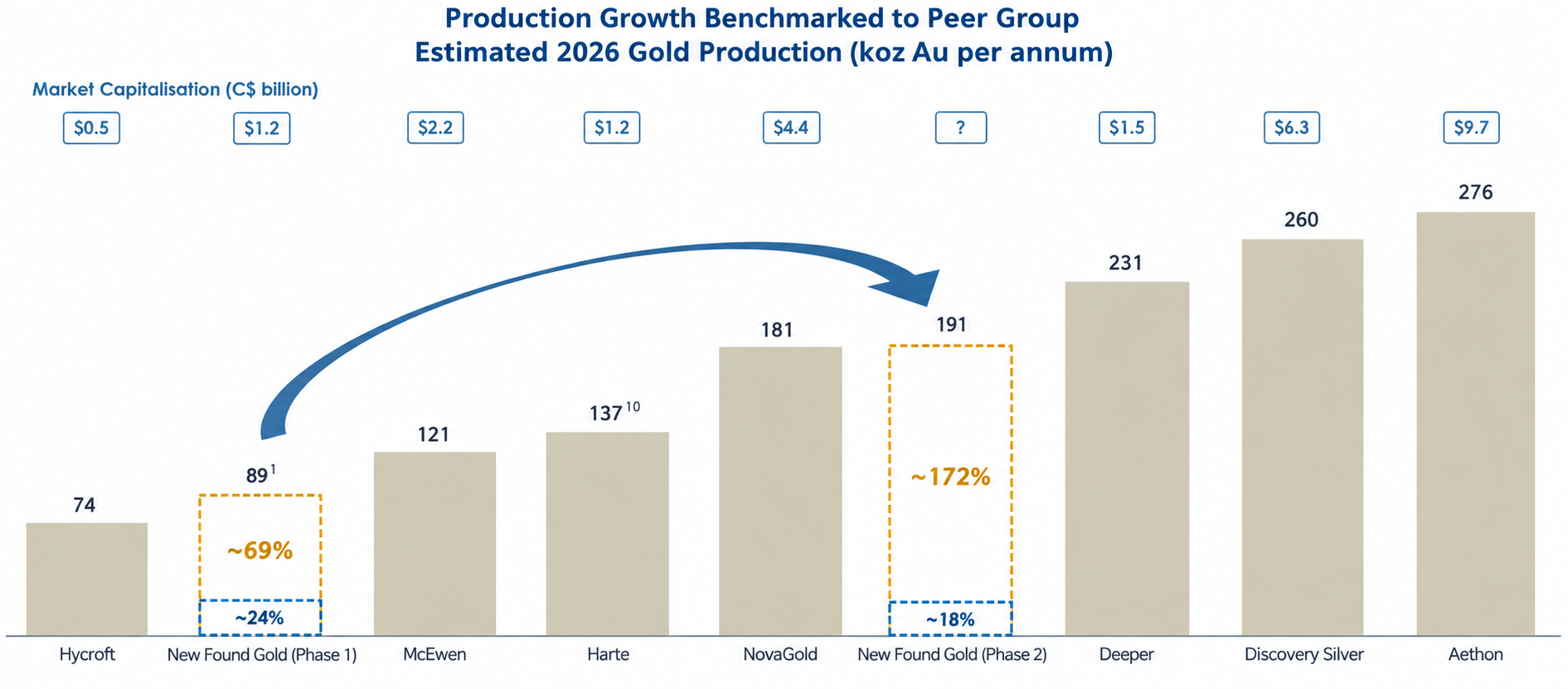
New Found Gold's September 2026 presentation benchmarks estimated 2026 gold production against market capitalization. It places the company's Phase 1 case, approximately 93,000 ounces a year (about 69,000 from Queensway and about 24,000 from Hammerdown), at a $1.2 billion market capitalization. Hemlo is shown producing 131,000 ounces at $1.8 billion and McEwen 121,000 ounces at $2.0 billion, both above New Found Gold's Phase 1 output.
The Phase 2 case is shown at roughly 191,000 ounces a year against Orezone ($1.5 billion, 231,000 ounces), Discovery Silver ($8.2 billion, 260,000 ounces) and Artemis ($7.9 billion, 278,000 ounces). Wesdome, at 191,000 ounces, matches that Phase 2 production almost exactly at $4.4 billion. New Found Gold's own Phase 2 case at the same output has no assigned market capitalization.
That comparison is the company's construction and a benchmark, not a target. It does not commit New Found Gold to closing the gap to any named peer. It does show that the valuation attached to the growth case is still open.
The Execution Levers Behind the Listing
The more direct levers on the gap sit in delivery, not in the exchange change. The April 2026 financing of $220 million is described as covering Queensway Phase 1's construction to first ore rather than as a signal aimed directly at the share price. Hammerdown is positioned to provide first cash flow on the way to that build, not as a standalone driver of value.
That financing structure points toward delivery as the more direct lever on the gap: whether Hammerdown reaches declared commercial production, whether Queensway's phased build stays inside its stated capital figures, and whether the updated preliminary economic assessment (PEA) confirms the resource base underpinning the growth case.
Management also points to trading-volume dynamics as a mechanical contributor. It puts volume at about 60% in New York and about 40% on the TSX Venture Exchange and says the main-board move should raise Canadian volume without cutting New York. Higher volume on a more liquid board could plausibly help narrow a valuation gap over time, and it is the only mechanism that ties directly to the listing itself.
Dated Catalysts Ahead
The next 2 dated events precede any read on how the gap moves. New Found Gold is targeting an updated mineral resource estimate (MRE) and an updated PEA for Queensway in the second half of 2026, and commercial production at Hammerdown in the same window. Both give the market a stated target to measure against, rather than a statement of intent, inside the period the company frames as validating its move from explorer to producer.
First ore to the Pine Cove mill from Queensway Phase 1 remains targeted for the fourth quarter of 2027, with Phase 1 commercial production following in 2028. Each milestone will give the market a dated, verifiable data point to test against the production and valuation figures New Found Gold has already put on the table.
The Investment Thesis for New Found Gold
- The TSX listing broadens who can own the shares, but institutional access is already in place through inclusion in the VanEck Junior Gold Miners ETF and coverage from 5 sell-side analysts.
- Phase 1 production in the September 2026 presentation sits near Hemlo and McEwen, which leaves room for the market to assign more value as that output is delivered rather than as the exchange changes.
- Phase 2 output is shown in line with Wesdome with no market capitalization assigned, so the growth case is drawn and still open to be priced.
- Queensway Phase 1 is funded through the April 2026 financing, and Hammerdown is positioned to provide first cash flow, limiting near-term financing pressure on equity.
- The updated Queensway mineral resource estimate and preliminary economic assessment, and Hammerdown's commercial production declaration in the second half of 2026, are the next dates on which that case can be tested.
The TSX listing broadens where New Found Gold's shares can trade, but the metrics already in place, index membership, analyst coverage, and a funded path to production, carry equal weight in whatever re-rating follows. The 2 catalysts ahead in the second half of 2026 will show how much of that case the market is prepared to price before first production.
TL;DR
New Found Gold graduated to the TSX main board on August 26, 2026, a step management ties in part to narrowing a valuation gap against junior gold peers. The company already trades inside the GDXJ and has coverage from 5 sell-side analysts. The September 2026 presentation places Phase 1 production near Hemlo and McEwen and leaves the Phase 2 market capitalization unassigned. Queensway Phase 1 is funded through the April 2026 financing, with Hammerdown positioned to provide first cash flow. The next 2 dated events set for the second half of 2026, an updated Queensway MRE and PEA and Hammerdown's commercial production declaration, are the next points at which the market gets new information to price.
FAQs (AI-Generated)
Analyst's Notes





Subscribe to Our Channel





Stay Informed






















