Serabi Gold Begins First Drill Testing of Untested Coringa Ground as Satellite Targets Return Gold


Serabi Gold tests Coringa targets in Brazil as Cabaça and Encosta return gold, with Sr. Domingos drilling underway and updated resource estimates due in Q1 2027
- Initial drill testing at Sr. Domingos, a previously untested portion of the Coringa district, commenced in July.
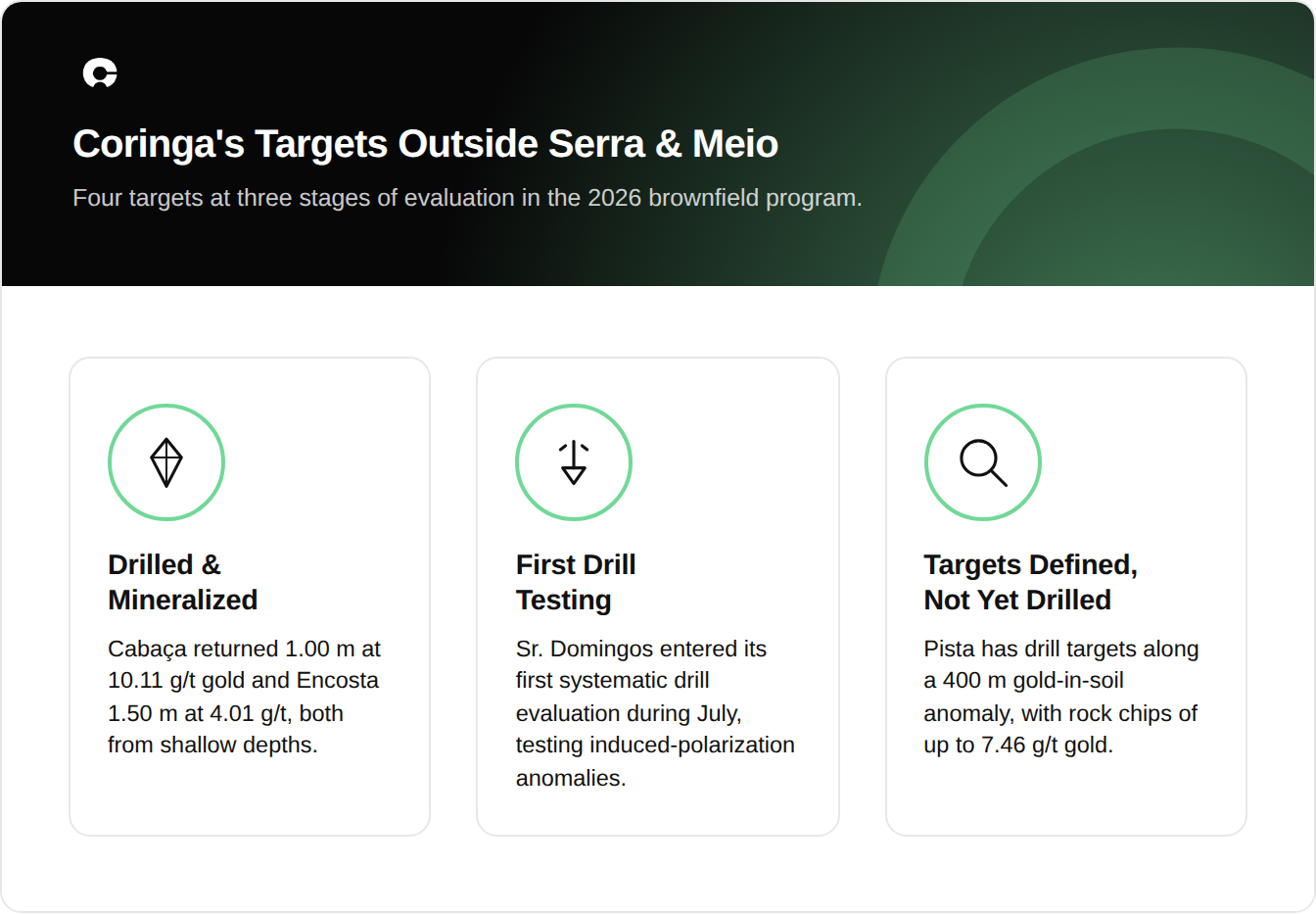
- Drill targets have been defined at Pista along an approximately 400-meter gold-in-soil anomaly, with rock-chip results of up to 7.46 grams per tonne of gold.
- Cabaça returned 1.00 meter at 10.11 grams per tonne gold, including 0.25 meters at 40.30 grams per tonne, from approximately 42 meters downhole.
- Encosta returned 1.50 meters at 4.01 grams per tonne gold from approximately 4 meters downhole, supporting an open strike opportunity of more than 300 meters.
- All validated results feed into updated Mineral Resource Estimates (MREs), expected in the first quarter of 2027.
Coringa Drilling Moves Beyond the Producing Zones
Serabi Gold (AIM: SRB | TSX: SBI | OTCQX: SRBIF) has extended its 2026 brownfield drilling at the Coringa Mine in Pará State, Brazil, past the two zones that currently feed the operation. Four targets outside Serra and Meio now carry results or scheduled drilling: Cabaça and Encosta have returned gold mineralization; Sr. Domingos entered its first systematic drill evaluation in July; and Pista has drill targets defined but not yet tested. For a producer whose resource base has been built on two zones, the question these targets address is whether Coringa is a single deposit or a district.
Satellite Targets Return Gold at Shallow Depths
At Cabaça, drilling intersected 1.00 meter at 10.11 grams per tonne of gold, including 0.25 meters at 40.30 grams per tonne, from approximately 42 meters downhole. The Company describes the shallow, high-grade intercept as confirming the presence of gold mineralization at the target and as further demonstrating the potential for additional mineralized centers outside the primary Serra and Meio zones. A second hole at Cabaça returned 0.25 meters at 3.78 grams per tonne.
At Encosta, drilling intersected 1.50 meters of gold at 4.01 grams per tonne from approximately 4 meters downhole. The company states the result provides initial confirmation of a target defined by coincident soil-geochemical and induced-polarization anomalies, and supports an open strike opportunity extending for more than 300 meters. Follow-up drilling designed for the second half of 2026 is intended to test the lateral and vertical continuity of the mineralized structure.
Two Targets Enter the Drill Program for the First Time
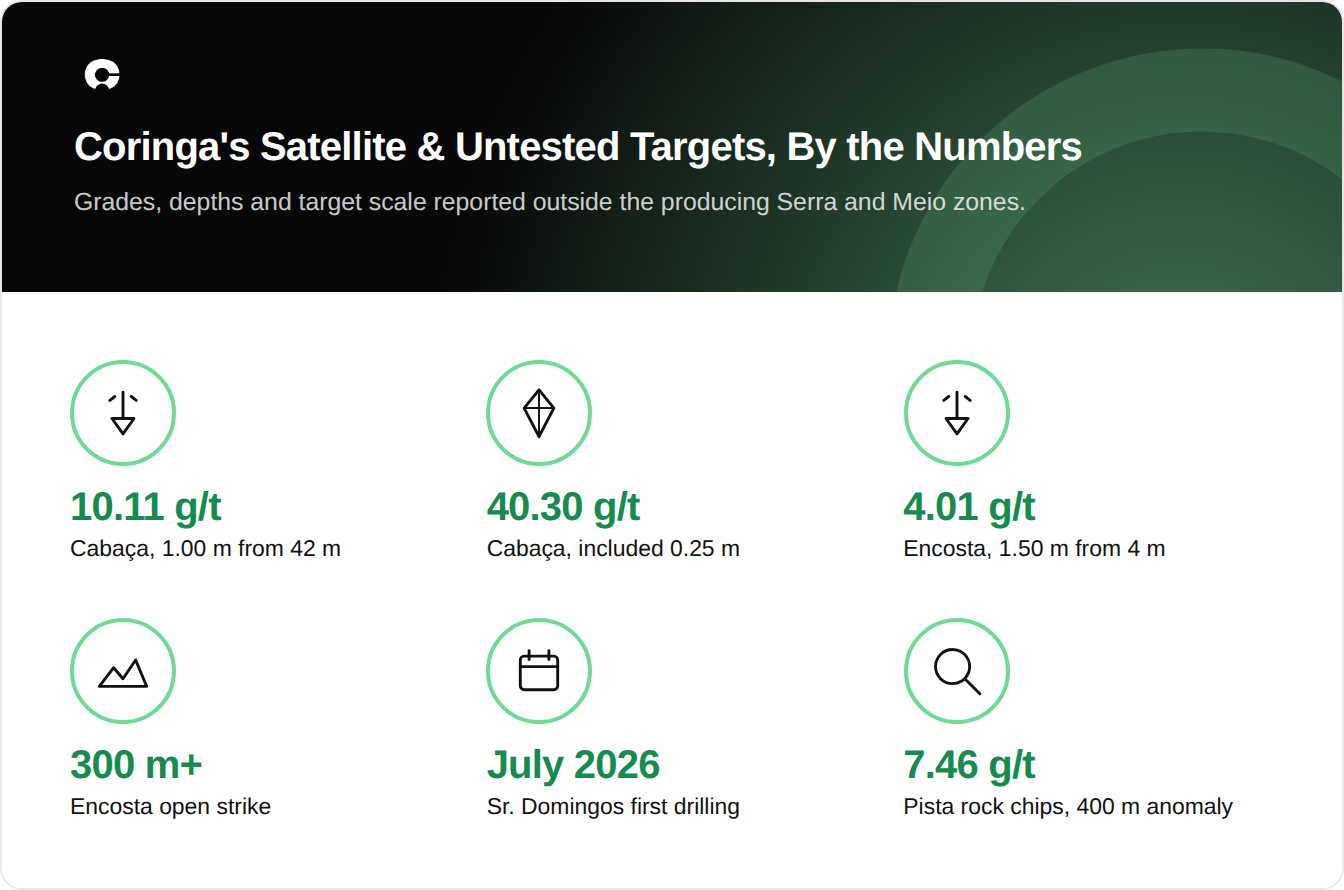
Sr. Domingos sits in a previously untested portion of the Coringa district, where multiple priority drill targets were generated from discrete induced-polarization anomalies. The program is the first systematic drill evaluation of the target and is designed to determine whether the geophysical responses are associated with sulfide-bearing structures similar to those hosting gold mineralization elsewhere at Coringa. Initial drill testing commenced in July.
Pista has not yet been drilled. Multiple drill targets have been defined along an approximately 400-meter gold-in-soil anomaly, supported by historical artisanal workings, continuous quartz-vein structures, and rock-chip results of up to 7.46 grams per tonne of gold. Mapping identified a brecciated quartz vein containing fresh pyrite, together with a broader vein and stockwork system developed along northwest-southeast structural trends.
Chief Executive Officer of Serabi Gold Mike Hodgson framed the published drill results as demonstrating the potential to delineate a larger resource at both Palito and Coringa to support production growth. He described the second year of the brownfield drilling program as continuing to yield success with the drill bit under Phase II of the Company's organic growth strategy.
Project & Regional Context
Coringa sits in the Tapajós region of northern Brazil alongside Serabi's Palito Complex, and the 2026 program has drilled 9,309 meters across 42 holes at Coringa, primarily targeting areas along the northwest-southeast trend of the producing Serra and Meio zones. Serra South, found in 2025 approximately 500 meters southeast of the producing Serra zone, entered ramp development in the second quarter of 2026. The company states that the discovery of Serra South demonstrates the potential for additional mineralized centers to occur along the broader, district-scale structural corridor, which is the model the satellite and untested targets are testing.
The Investment Case for a Multi-Centre Coringa
Serabi is in the second year of a Phase II organic growth strategy to expand the total Group mineral inventory to more than 1.5 million ounces of gold. Whether that target is reached through deeper drilling of two known zones or through a wider array of mineralized centers changes the character of the asset, because a district with several shallow centers requires a different development sequence than a single deposit drilled at depth.
The Cabaça and Encosta results are the first evidence in this program that the second path is open, while Sr. Domingos and Pista are the tests that would confirm or rule it out. Neither carries a resource today, and only validated assay results will be incorporated into the updated estimates, so the conversion of any of this into reported ounces remains unproven.
Development Context
Coringa's earlier-stage work continues alongside the main program, which totals 32,000 meters across both operations and is expected to complete in October 2026. Follow-up drilling at Encosta and continued testing at Sr. Domingos are scheduled for the second half of the year, with Pista's defined targets awaiting a rig. Updated Mineral Resource Estimates (MREs) for Palito and Coringa are expected during the first quarter of 2027, incorporating all validated results.
FAQs (AI-Generated)
Analyst's Notes





Subscribe to Our Channel







Stay Informed