




‘Undervalued?’: Recognizing Value Before the Market Does



Junior mining re-rates need funded catalysts, disciplined capital allocation, and valuation that shifts from EV/oz to NAV to cash flow as risk falls.
- High commodity prices improve project economics and financing capacity, but they do not eliminate geological, permitting, construction, or operating risks.
- Management becomes more important as projects advance because capital allocation and financing structure determine how much of the project's value ultimately accrues to existing shareholders.
- A catalyst creates value when it measurably changes the probability, economics or timing of future cash flow, rather than simply adding newsflow.
- Valuation should evolve from enterprise value per ounce during exploration to net asset value during development, and to cash flow or earnings metrics after production begins.
- Contrarian value exists when measurable fundamentals improve faster than the market's assessment, not simply when a share price or valuation multiple appears low.
Stronger Commodity Markets Create Opportunity, Not Automatic Re-Ratings
The most recent World Gold Council data (2025) shows demand remains elevated at historically high levels, with continued ETF inflows through mid-2025. However, prices remained highly volatile, with record highs earlier in the year followed by sharp pullbacks, underscoring that strong demand can coexist with large price swings.
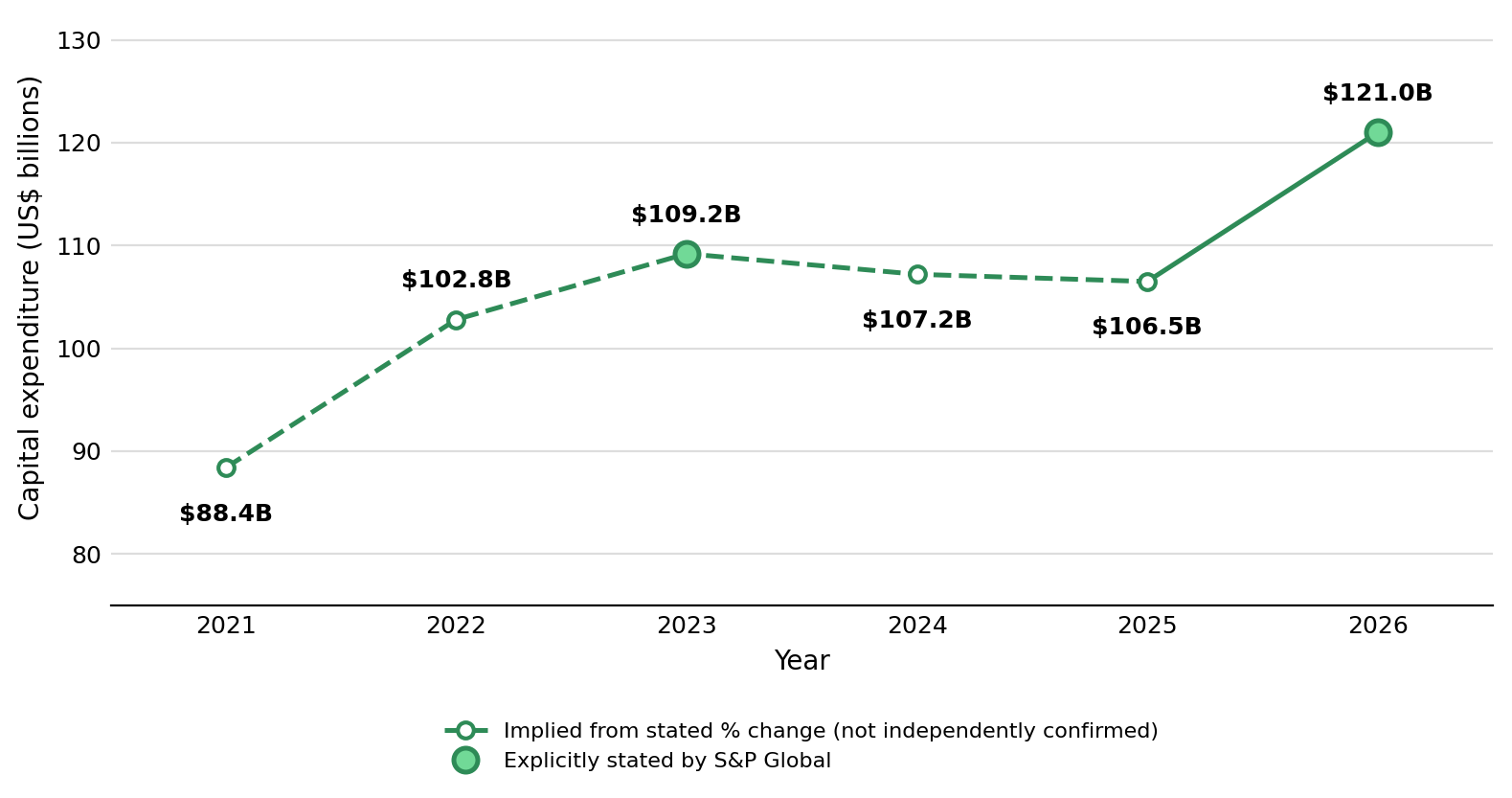
Capital availability is similarly selective. S&P Global Market Intelligence forecasts capital expenditure among the largest miners to reach a decade-high of US$121 billion in 2026. Outside gold, the International Energy Agency reported that investment in critical minerals fell 9% in 2025 despite continued long-term demand. Higher commodity prices can increase net present value (NPV), internal rate of return (IRR), margins and debt capacity, but companies still need to demonstrate that each additional dollar raised increases project value faster than it dilutes shareholder exposure.
Power Metallic Chief Executive Officer Terry Lynch describes the valuation lag management observed:
"Our underlying commodities are up over 60% across the board, yet the stock was flat. That to me doesn't make sense because these things should tend to rise with the value in the ground"
A Catalyst Matters Only When It Removes a Specific Uncertainty
Mining companies can describe drilling, studies, permitting work or corporate activity as catalysts, but investors need a stricter test. A value-relevant catalyst must change the probability, economics or timing of future cash flow. The larger the uncertainty removed, the greater its potential effect on the valuation discount.
Cartier Resources’ May 14 metallurgical program at Cadillac reported overall gold extraction of 96.3%, up from 93.1% in the 2023 preliminary economic assessment, using a conventional flowsheet. Metallurgy does not independently establish mine economics, but higher recoveries can increase the proportion of contained gold converted into saleable production and serve as an input to an updated economic model.
At the development stage, permitting and financing can carry more valuation significance than another incremental resource addition. Revival Gold closed a C$33 million financing on May 6 and subsequently completed the sale of its non-core Diamond Mountain phosphate property while advancing work at Mercur and Beartrack-Arnett.
U.S. Gold has moved further along the sequence, with its CK project fully permitted and an after-tax NPV of US$632 million at a 5% discount rate and a 27% IRR under base-case assumptions. With permitting largely resolved, the company's principal remaining risk now lies in development financing and execution rather than initial approvals.
Management Quality Is Revealed by How Capital Is Allocated
Management influence increases as a company moves beyond discovery. Exploration capital can establish scale, but development requires permitting, engineering, community engagement, financing, contracting and construction. The relevant distinction is therefore not whether management can raise money, but how much uncertainty that capital removes and how much ownership existing investors surrender in the process.
First Mining Gold has used a portfolio of non-core assets to generate cash and retained interests that support its principal development projects. As of June 30, 2026, the company reported C$40.5 million in cash and marketable securities, in addition to retained investment interests, following federal environmental assessment approval for its Springpole project. Asset monetization is inherently superior to equity issuance. Investors should monitor the relationship between capital raised, ownership surrendered, milestones achieved, and the resulting change in project value.
Dan Wilton, Chief Executive Officer of First Mining Gold, explains the strategy of monetizing assets to fund development:
"Developers just didn't have access to capital. We managed to get around that by the fact that we had a portfolio of other assets that we were able to turn into cash to allow us to keep these projects moving forward"
Erdene Resource Development took a different route through a strategic partnership with a Mongolian mining company to advance Bayan Khundii into production. President and Chief Executive Officer Peter Akerley explained:
"We recognized that we had a very high-grade, open-pitable deposit in a market where it was very difficult to raise money without massive dilution… We entered into a joint venture with Mongolia's largest mining company to allow us to get to the point where we had Bayan Khundii built and now in commercial production."
Production Is Where Management Claims Become Measurable Results
Most development-stage valuations depend on forecasts of grade, recovery, throughput, operating costs, and construction schedules. Production replaces those assumptions progressively with measured results.
Erdene Resource's Bayan Khundii mine produced and sold 11,709 ounces of gold during the second quarter of 2026 at an average realized gold price of US$4,493/oz, generating US$53 million of gross revenue. The operation reached 94% of the target throughput and averaged 96% gold recovery. Investors can therefore begin comparing actual production performance with feasibility assumptions rather than valuing the asset entirely on forecasts.
Valuation Should Change as Uncertainty Falls
Mining valuation is ultimately the pricing of uncertainty. Exploration companies are commonly assessed using enterprise value per ounce (EV/oz), which divides enterprise value by contained metal but does not establish whether those ounces are economically recoverable. Development companies increasingly rely on NPV and net asset value (NAV), while producers can also be assessed using cash flow, earnings and EBITDA, or earnings before interest, tax, depreciation and amortization. Market capitalization measures the equity value of the company; enterprise value additionally adjusts for cash and debt.
Dan Wilton, Chief Executive Officer of First Mining Gold, describes how management views the historical relationship between development stage and valuation:
"Historically, you've usually seen explorers trade at discounts to developers trade at discounts to producers, and that reflects kind of your time frame of getting to cash flow and the inherent risk in really delineating your resources. Over the last seven or eight years, that paradigm has flipped. The part of the development curve that investors least wanted to participate in was from resource going through permitting and through the feasibility stages.”
What Must Happen for the Discount to Close
Instead of beginning with a low multiple, investors can work backwards from the apparent discount. The process involves identifying the risk that appears to justify it, determining whether that risk is measurable, identifying the milestone that can remove it, establishing whether that work is funded, and calculating how much project ownership remains after financing. That framework distinguishes a company that appears cheap from a company that is investable.
The Investment Thesis for Junior Mining Re-Rates
- Commodity tailwinds expand opportunity but do not determine outcomes. Higher metal prices can increase margins, NPV and financing capacity, but execution determines how much of that improvement reaches shareholders.
- Management should be judged by the uncertainty removed per dollar spent. Exploration, studies, permitting and financing create value when they materially improve the probability or economics of future production.
- Financing structure can matter as much as project quality. Equity, debt, partnerships and asset monetization determine how future mine economics are divided between existing shareholders and capital providers.
- Catalyst quality matters more than catalyst quantity. The most important milestone is generally the one that removes the largest remaining geological, technical, permitting, financing, or operating discount.
- Valuation must evolve with the development stage. EV/oz, NAV and cash-flow multiples measure different risk profiles and cannot be compared without accounting for project maturity and remaining capital requirements.
- The strongest contrarian situations combine improving evidence with unresolved skepticism. Value emerges when measurable fundamentals advance faster than valuation, provided investors can identify both the catalyst for recognition and the evidence that would invalidate the thesis.
The investor's task is not to predict precisely when sentiment changes. It is to establish whether the evidence is improving, whether management is preserving shareholder exposure while advancing the asset, and whether the current valuation adequately compensates for everything that can still go wrong.
Read more:
The Commodities the Market is Watching Next
What Makes a Mining Project Truly Valuable
Why Do Junior Mining Companies Become Undervalued
Why Do Contrarian Investors Outperform
TL;DR
Higher commodity prices expand opportunity but don't guarantee re-rating; geological, permitting, construction and operating risk remain regardless of price strength. A catalyst creates value only when it measurably changes the probability, economics, or timing of future cash flows, not simply when it generates news flow. Valuation methodology should shift with development stage: EV/oz during exploration, NAV during development, cash flow and earnings multiples once production begins. Management quality is best judged by how much uncertainty is removed per dollar raised, and whether the financing structure preserves shareholder ownership. The strongest contrarian opportunities combine improving fundamentals with valuations that haven't yet caught up, provided investors can identify both the catalyst for recognition and the evidence that would disprove the thesis.
FAQs (AI-Generated)
Analyst's Notes





Subscribe to Our Channel








.jpg)

.jpg)



Stay Informed






















