




‘Undervalued?’: What Makes a Mining Project Truly Valuable



Grade alone doesn't determine a mining project's value; dilution, processing, infrastructure, and capital determine which resources are mineable and profitable.
- Headline grade figures overstate value unless diluted mine grade, minimum mining width, geological continuity, depth distribution, and waste-to-ore ratios are also disclosed.
- Processing route selection drives capital intensity independently of resource size, with each additional circuit adding upfront capital, power draw, and operating risk that must be justified by incremental payable metal.
- Pre-existing infrastructure can materially reduce the capital and time required to reach production, but the value of that infrastructure should be quantified by what construction scope it actually removes, not assumed from its presence.
- Resource size alone is an incomplete valuation metric; mineable ounces depend on the interaction among geometry, metallurgical recovery, processing complexity, and infrastructure access, not on any single variable in isolation.
How Ore Grade and Geometry Test Project Margins
When comparing deposits, investors should look beyond headline g/t Au and assess whether that grade is achievable with the proposed mining method. The key disclosures are diluted mine grade, minimum mining width, mineralized continuity, depth distribution and the amount of waste required to access ore. A project becomes more valuable when its geometry allows a high proportion of the resource to be mined at grades close to the resource model without excessive dilution or waste movement.
Amex Gold Mining received the main governmental authorizations for a 40,000-tonne underground bulk sample at Perron, allowing a substantially larger volume of mineralization to be tested for geological continuity, mining conditions and resource-model reconciliation than individual drill cores can provide. The bulk-sample moves analysis beyond drill-core grades to provide larger-scale information on geological continuity, mining conditions, dilution, and extracted material. High drill grades can improve margins, but only if mining can reproduce those grades at practical widths.
President & CEO Victor Cantore explains Perron's grade profile in the context of what dilution actually costs at the Champagne Zone:
“The big difference with us, and why our capex is so low and why our margins are so high, comes down to the grade... If I look at some of my peers, they're at 1.9 grams and some of 3.6 grams… At the Champagne Zone, you're looking at 16 grams per ton. Mining it on a diluted basis, you're probably going to be anywhere from 10 to 12 grams.”
A contrasting route to stronger project margins is shallow orebodies rather than exceptionally high-grade. Cassiar Gold’s June 2025 mineral resource estimate includes 410,000 Indicated ounces at 1.43 g/t Au and 1.9 million Inferred ounces at 0.95 g/t Au using a 0.4 g/t cut-off grade, but the more distinctive physical characteristic is depth: the company reports that 91% of the pit-constrained ounces occur within 150 meters of surface, which gives the mine-planning process a different starting point.
Marco Roque, President & CEO of Cassiar Gold, quantifies how much of the Taurus resource sits near-surface:
“Combined resource 2.3 million ounces outcropping starting at surface... deepest point of the pit currently at 307 meters but 91% of the ounces are within 150 meters from surface.”
Processing Routes Determine Payable Value
Two deposits with similar resource sizes can require very different amounts of money to turn into mines because the ore may need different processing methods.
Oxide ore can be treated by heap leaching, with lower upfront capital and operating costs but potentially slower, lower recoveries. Sulfide ore often requires a conventional processing plant, which typically has higher capital intensity but can deliver higher and more consistent recoveries.
Revival Gold's Mercur project combines open-pit mining with heap leaching rather than constructing a full conventional grinding and milling plant. If further technical work confirms that Mercur's ore can achieve economic recoveries through heap leaching, the project could require less processing equipment and a simpler construction and start-up program.
P2 Gold's Gabbs feasibility design is targeting a larger 12-million-tonne-per-year production rate and brings mill operations forward while retaining heap-leach processing. The additional circuit can improve the recovery of material better suited to milling and increase production capacity.
Neither processing route is inherently superior. The appropriate choice is the one where the incremental payable metal recovered justifies the added capital and operating complexity required to recover it. Each additional processing stage adds upfront capital, power consumption, operating cost, and a further system that must perform reliably once production begins.
Existing Roads, Power & Mills Reduce the Infrastructure Build
Mine construction does not stop at the pit and process plant. Projects may require access roads, transmission lines, substations, water systems, accommodation, workshops, tailings facilities and logistics networks before the first tonne of ore can be processed.
U.S. Gold Corp's CK Gold Project in Wyoming benefits from paved road access and nearby power infrastructure. Cassiar reports an existing site footprint that includes grid power, extensive road access, historical underground workings and a permitted mill. Maple Gold's Douay and Joutel properties include established road and power access in Quebec's Abitibi region, while Joutel contains infrastructure associated with historical mining.
Cartier Resources sits within an established mining district containing operating processing facilities. If suitable capacity and commercial terms are available, toll milling could allow mined material to be treated at a third-party plant rather than requiring construction of a full standalone mill from first production.
Philippe Cloutier, President & CEO of Cartier Resources, explains why the surrounding processing footprint creates more than one development configuration:
“We are proximal to other infrastructure and other producers. There are three or four different producers and six different mills. Then there's the workforce. The proximity to that workforce in those operating mills allows us to consider different milling scenarios in the initial years.”
Revival Gold's Beartrack-Arnett gold project already has access to roads, grid power, workshops, and gold-processing infrastructure, enabling a restart plan that reuses parts of an existing operating footprint rather than building supporting systems from scratch. President and CEO Hugh Agro highlights the scale of embedded value already on site:
We're redeveloping past-producing gold mines in the United States, which gives us advantages. $200 million worth of infrastructure and data.
Why Capital Intensity Alone Doesn't Determine Value
World Gold Council data show why capital efficiency matters even during a strong gold market. Its January 2026 analysis found that higher gold prices typically coincide with increased mining capital expenditure, yet global mine production responds with a lag of at least six years. Mine output was broadly unchanged between 2018 and 2024 despite rising gold prices, with the Council identifying development timelines and capital costs among the constraints on new supply.
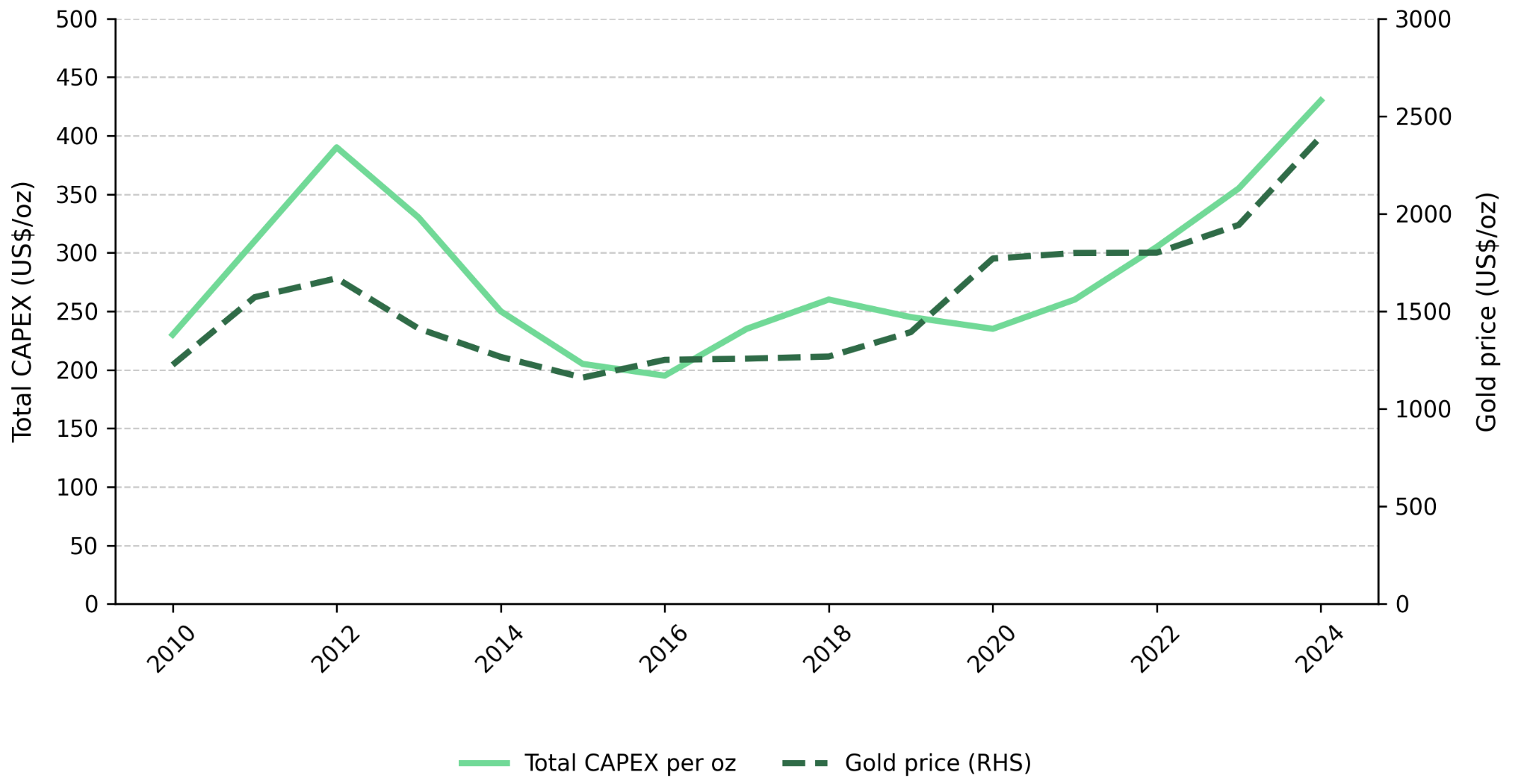
The useful comparison is how much initial capital a project requires relative to the annual production it can support, how quickly that investment can be repaid, and whether additional production can be added without another major capital build. In a sector where spending can precede new supply by six years or more, projects that convert each development dollar into greater sustainable production have a stronger basis for creating shareholder value.
The Investment Thesis
- Project quality, not resource size, will increasingly separate outperformers from underperformers as mine supply's multi-year lag behind gold prices makes currently advancing projects the ones that determine supply into the early 2030s.
- Capital markets are likely to reward disclosure depth over headline resource figures, favoring companies that demonstrate diluted grades holding close to resource-model grades and infrastructure that offsets rather than adds to capital requirements.
- Projects that rely on headline grade or ounce counts without addressing dilution, waste stripping, or processing complexity face a widening credibility gap as the market's evaluation standards mature.
- Capital-intensity decisions made now will lock in cost structures that determine which projects remain economic across a range of future gold price scenarios.
- Projects with fewer execution variables carry an advantage in reaching production within the current price window, before any lagged supply response from the broader sector compresses margins industry-wide.
The distinction between a large resource and a mineable asset ultimately comes down to how many variables between discovery and production have been resolved, and how much capital remains required to resolve the rest. As that filter narrows the space of investable gold projects, the same discipline extends naturally to the question of which commodities beyond gold are entering their own supply-constrained window, where similar dynamics of lagged production response, capital intensity, and infrastructure availability are beginning to shape investor attention.
Read more:
Why Do Junior Mining Companies Become Undervalued
Why Do Contrarian Investors Outperform
TL;DR
Headline grade figures can mislead investors unless paired with diluted mine grade, mining width, geological continuity, and waste-to-ore ratios. Processing routes drive capital intensity independent of resource size, while existing roads, power, and mills can meaningfully cut development costs. Capital efficiency matters even in a strong gold market, since World Gold Council data show mine production lags gold price increases by at least six years, making the ratio of capital spent to production a better gauge of value than upfront spend alone. The governing question for investors is how many reported ounces can actually clear dilution, processing, and infrastructure hurdles to reach a saleable product.
FAQs (AI-Generated)
Analyst's Notes





Subscribe to Our Channel








.jpg)

.jpg)



Stay Informed






















