Uranium Supply Deficit Widens as Term Premium Hits $11 Over Spot


Uranium's widening term-spot price gap signals a structural supply deficit as constrained mine output, geopolitics and capital flows tighten long-term markets.
- TradeTech's long-term uranium price indicator has climbed to $97 per pound from $90 on January 31, while spot prices have held near $85 to $86 for more than a month, leaving an $11-plus premium over spot.
- Cigar Lake's July suspension and Kazatomprom's roughly 10 percent 2026 output cut show how concentrated primary uranium supply leaves the market vulnerable to disruptions at a few operations.
- A live conflict around the Strait of Hormuz is threatening sulfuric acid supply, raising costs for Kazakh in-situ recovery mining and Canadian ore milling.
- A civil nuclear agreement between the US and Saudi Arabia, along with a pending Section 232 tariff review, is redirecting Western investment toward domestic uranium and fuel-cycle infrastructure.
- Sprott's Physical Uranium Trust posted $562 million in net unit sales in the first quarter of 2026, even as spot uranium prices remained largely unchanged.
Long-Term Uranium Contracting Accelerates While Spot Lags
TradeTech's long-term uranium price indicator reached $97 per pound in mid-July 2026, up from $90 at the end of January. By contrast, spot closed at $85.70 per pound on July 21 and remained largely unchanged over the previous month, according to Trading Economics. The more than $11 gap is unusual because term and spot prices in most commodity markets typically move together. It suggests buyers are paying a premium to secure future uranium supply.
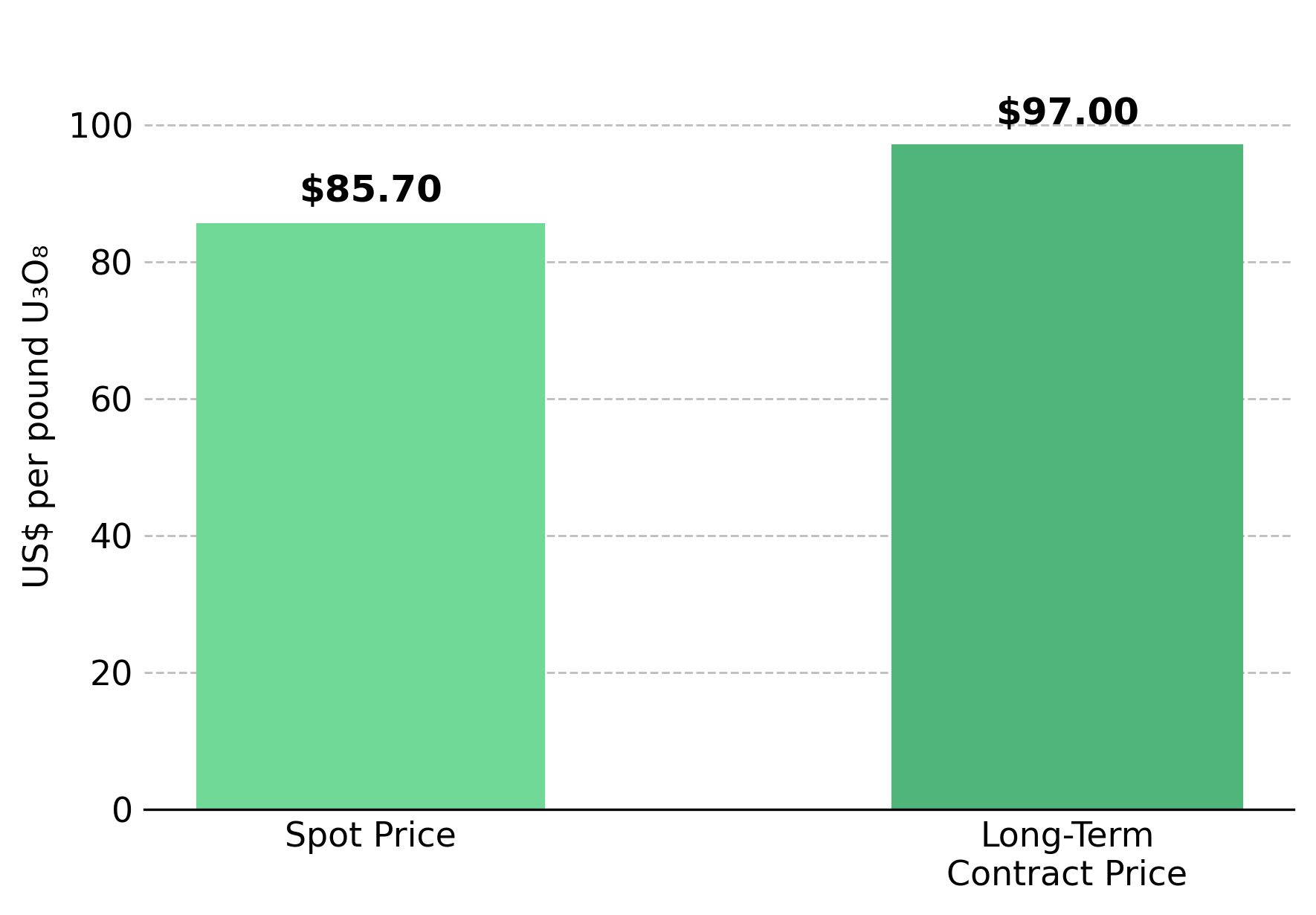
The difference reflects market structure rather than sentiment. Long-term contracts are negotiated directly between producers and nuclear utilities for delivery three to ten years ahead. Utilities have under-contracted relative to reactor requirements for more than a decade, while producers have committed more output under existing contracts, limiting volumes available for new agreements and supporting higher term prices. TradeTech has described the spot market as quiet even as term contracting accelerates, reinforcing that the gap reflects stronger demand for long-term supply.
The key question is whether the widening gap reflects a sustained multi-year supply deficit or temporary supply disruptions that would allow the spread to narrow as conditions normalize.
Growing Uranium Supply Deficit Drives Higher Term Prices as New Mine Supply Becomes Critical
The premium in the term market reflects a measurable supply shortfall. Global uranium production is approximately 150 million pounds annually, compared with nuclear utility demand of roughly 200 million pounds. The deficit is currently being met by drawing down secondary inventories, a source of supply that will eventually be exhausted if primary production does not increase.
Phil Hoskins, Chief Executive Officer of Atomic Eagle, which is advancing the Muntanga uranium project in Zambia, summarized the supply challenge facing the industry:
"Roughly 150 million pounds are being produced at the moment on the supply side, and 200 million pounds are being consumed by the nuclear utilities, and by 2040 that supply of 150 is going to drop to 50, based on current production, and demand will double to 400 million pounds. So where are these new uranium projects going to come from?"
Hoskins projects the supply shortfall widening to roughly 50 million pounds as uranium demand approaches 400 million pounds by 2040. That imbalance supports demand for new uranium projects such as Muntanga, which has a 58.8-million-pound uranium oxide resource, up 24% from its maiden drill program.
Concentrated Uranium Supply Magnifies Mine Disruptions as Spare Capacity Continues to Shrink
Global uranium supply is concentrated in Kazakhstan's in-situ recovery operations and a handful of Canadian mines, allowing disruptions at individual sites to have an outsized impact on global supply. Two events in 2026 have already demonstrated this vulnerability.
Cameco suspended mining at Cigar Lake on July 1 after Orano's McClean Lake mill lost its sulfuric acid plant to a mechanical failure. Production resumed by mid-July, and Cameco maintained its 2026 production guidance of 17.5 to 18.0 million pounds of uranium oxide. The incident followed flooding at the McArthur River and Key Lake operations in May, highlighting the sector's limited spare capacity.
Kazatomprom, which produces roughly one-fifth of global uranium supply, has confirmed a 10% reduction in 2026 output, citing market conditions and higher extraction taxes rather than resource constraints. Meanwhile, about 1,800 tonnes of uranium concentrate remain stranded at Niger's nationalized Somaïr mine pending arbitration between the Niger government and Orano, keeping material off the market despite being available.
Strait of Hormuz Tensions Threaten Sulfuric Acid Supply and Tighten Uranium Markets
The Strait of Hormuz also exposes the uranium market to broader supply-chain risks. International Energy Agency Executive Director Fatih Birol has described the disruption there as the largest in the history of the global oil market. Roughly one-fifth of global sulfur shipments pass through the Strait, and sulfur is the feedstock for sulfuric acid, a critical input for Kazakh in-situ recovery mining and the ore milling process that halted Cigar Lake in July. Disruptions in the Strait could tighten sulfuric acid supply and raise uranium production costs.
Although often overlooked, sulfuric acid is essential to uranium production. A prolonged disruption around the Strait would increase the risk of shortages similar to those that affected McClean Lake, adding another constraint alongside Kazatomprom's production cut and the stranded Niger inventory. Together, these factors reduce uranium available to meet growing long-term contract demand.
US Policy Expands the Nuclear Fuel Cycle as Long-Term Uranium Demand Grows
Demand for long-term nuclear fuel is strengthening. The United States has approved a 30-year civil nuclear cooperation agreement with Saudi Arabia that could support domestic uranium enrichment, with US companies expected to play a central role. The agreement, which remains subject to Congressional review, is expected to generate tens of billions of dollars in nuclear investment.
For the uranium market, the agreement expands the nuclear fuel cycle beyond traditional suppliers. Every new enrichment project requires long-term uranium feedstock secured through the term market, supporting demand for long-term contracts before new reactors begin operating.
US trade policy provides additional support. A Section 232 proclamation directs trade negotiations to reduce dependence on imported processed critical minerals, and the administration is considering adding uranium to the tariff annex alongside copper, silver and potash. If implemented, the tariffs could support higher domestic uranium prices. Energy Fuels, which operates the only licensed and operating conventional uranium mill in the United States, could benefit if the policy encourages greater domestic production and fuel-cycle investment.
Institutional Buying Increases Physical Uranium Demand Before Spot Prices Respond
Sprott's Physical Uranium Trust recorded $562 million in net unit sales during the first quarter of 2026. Because the trust uses new capital to purchase and hold physical uranium oxide, those inflows remove additional material from a market where available inventory is already limited. The trust's market capitalization has grown to roughly $7.4 billion, underscoring its increasing influence on physical uranium demand.
The timing of those inflows is significant because they occurred while spot uranium prices remained largely unchanged, indicating that capital was being deployed in anticipation of higher future prices rather than in response to short-term momentum. Forecasts still vary widely. Scotiabank targets roughly $80 per pound, Goldman Sachs approximately $91 by the end of 2026, and Bank of America $135 per pound. While analysts disagree on the magnitude of future price gains, all three forecasts remain above current spot prices, suggesting broad agreement that uranium prices are likely to move higher over time.
Exploration Financing Accelerates as Investors Back Future Uranium Supply
Early-stage financing provides another indication that capital is becoming more willing to fund future uranium supply. ATHA Energy raised C$63 million during the first quarter of 2026 to advance its Angilak project in Nunavut despite the project not yet having a defined mineral resource. The financing provides at least two years of exploration across two mineralized corridors simultaneously, reflecting a greater willingness to fund earlier-stage uranium projects than has typically been seen in previous commodity cycles.
Troy Boisjoli, CEO of ATHA Energy, said the company's confidence grows with each investment round:
"It gives us an increased level of confidence in each subsequent round of investment, because our objective is to build significant tier-one scale resources going into this cycle."
Raising capital at this stage of project development is consistent with Hoskins' view that the uranium market will require significant new sources of supply over the coming decade. Investors appear increasingly willing to finance that supply before resources are formally defined.
Lower-Cost Brownfield Expansion Provides the Fastest Route to New Uranium Supply
If the uranium market requires sustained production growth, the fastest supply response is likely to come from projects that can use existing licensed infrastructure rather than requiring an entirely new permitting process. enCore Energy is drilling its Alta Mesa East property adjacent to the licensed Alta Mesa central processing plant in Texas, which has operated since the second quarter of 2024 and has a design capacity of 1.5 million pounds with an additional drying capacity of 0.5 million pounds of uranium oxide annually. By expanding around an operating processing facility, the company could bring additional production online more quickly than a greenfield development.
According to company disclosures, in-situ recovery projects require capital expenditures of less than 15 percent of conventional uranium mines. Lower upfront capital and shorter development cycles make ISR one of the most practical sources of incremental uranium supply if the current production shortfall persists.
Uranium Deficit Persists as Supply Constraints Outweigh the AI Narrative
Taken together, the evidence points in the same direction. The gap between term and spot prices reflects market mechanics rather than investor sentiment. Primary uranium supply is concentrated enough that disruptions at Cigar Lake, Kazatomprom or Niger can each tighten the market independently. Conflict in the Middle East has also exposed a direct link between regional geopolitics and uranium production costs through the sulfuric acid supply chain. At the same time, US trade policy and expanding investment in uranium enrichment are increasing demand for long-term uranium supply independently of the spot market. Capital is already flowing into physical uranium, early-stage explorers and near-term producers before higher spot prices have emerged.
Philip Williams, Chief Executive Officer of IsoEnergy, said the company's development strategy reflects a structural uranium supply deficit rather than an AI-driven demand story:
"All of the noise around AI doesn't really impact, in my mind, the work that we've done on the fundamental thesis. There's a supply deficit, exactly how much it is and when it really hits, we can debate, but the deficit is real, and it's going to come and expand, irrespective of how much new power comes on, what AI does, and what data centers do."
That distinction, between a deficit driven by a single demand narrative and one embedded in a decade of under-contracting, concentrated supply and now geopolitical risk, is the difference between a one-quarter blip and a structural repricing.
The Investment Thesis for Uranium
- The gap between the term and spot uranium prices is not simply a pricing anomaly. It reflects the difference between a market securing future supply through long-term contracts and one where relatively small volumes continue to trade in the spot market.
- Concentrated uranium supply in Kazakhstan and Canada means individual mine disruptions can tighten the market, supporting term prices over spot.
- The Strait of Hormuz now provides a direct and measurable link between geopolitical risk and uranium production costs through the sulfuric acid supply chain.
- US critical minerals policy provides another source of support for domestic uranium prices beyond global spot market dynamics.
- Institutional capital is already accumulating exposure through physical uranium trusts ahead of any broad-based increase in spot prices, signaling expectations of tighter future market conditions.
- Capital is flowing across the uranium development pipeline, from early-stage explorers to developers and existing producers, indicating confidence in future supply growth across multiple stages of project risk.
The uranium market's term-spot gap will not resolve quietly. A narrowing of the term premium, a full restoration of Kazatomprom's production, or a de-escalation around the Strait of Hormuz that eases sulfuric acid supply risks would each weaken this thesis. None of those conditions has occurred as of this writing. Until one does, the gap between the roughly $97 per pound term price and the spot price near $86 remains the clearest indication that buyers expect future uranium supply to remain tighter than current spot market activity suggests.
TL;DR
The uranium market is signaling tighter long-term fundamentals than spot prices currently reflect. Term uranium prices have risen to multi-year highs as utilities secure future supply through long-term contracts while spot prices remain largely unchanged. Persistent under-contracting, concentrated production in Kazakhstan and Canada, supply disruptions, sulfuric acid risks linked to the Strait of Hormuz, and supportive US nuclear policy are reinforcing a structural supply deficit. Institutional investors are accumulating physical uranium, financing exploration projects, and backing brownfield expansions before spot prices respond, suggesting capital expects a prolonged period of tighter uranium supply and higher long-term prices.
FAQs (AI-Generated)
Analyst's Notes





Subscribe to Our Channel
















Stay Informed