




West Red Lake Gold’s Hub-and-Spoke Infrastructure & C$315 Million Tax Shield Drive Madsen's Peer-Group Valuation Metrics


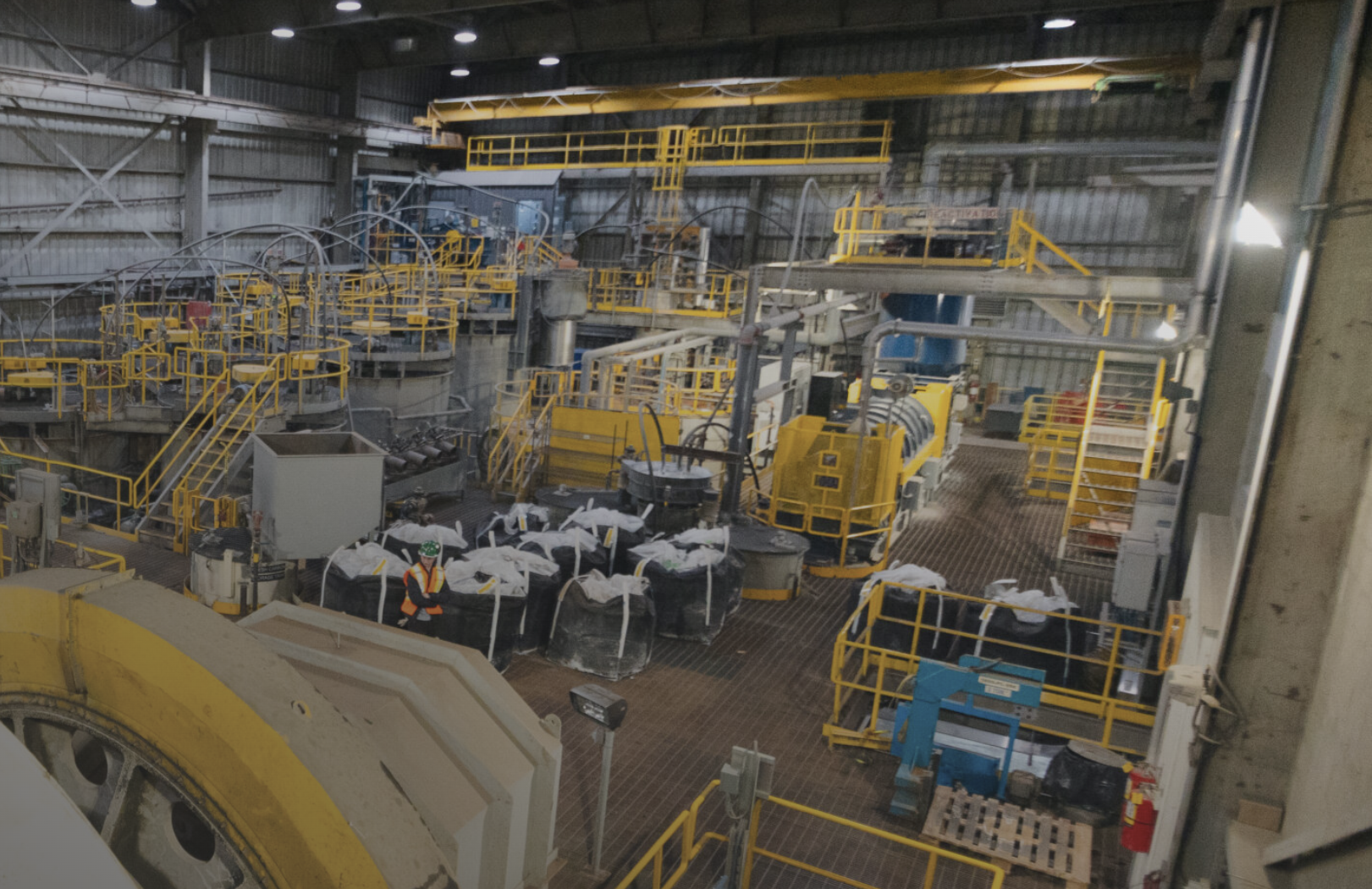
West Red Lake Gold Mines Ltd.'s second quarter operating results show a 51% increase in gold production, de-risking the Madsen Mine ramp-up & forcing a capital pivot.
- West Red Lake Gold Mines Ltd. achieved a 51% quarter-over-quarter increase in gold production to 8,576 ounces during the second quarter of 2026 as underground mining productivity expanded.
- Underground ore production reached 75,524 tonnes at an average grade of 4.3 grams per tonne gold, representing a 73% increase in mined ounces over the first quarter of 2026.
- Underground mining rates surpassed 1,000 tonnes per day from mid-quarter onward, enabling the accumulation of a 10,768-tonne surface stockpile ahead of the processing mill.
- Capital deployment of new underground haulage trucks restored mobile fleet availability to 75% to 80%, resolving a major physical bottleneck that had constrained prior mine operations.
- Operational cash flow transitioned from breakeven in the first quarter of 2026 to active cash generation and debt repayment during the second quarter of 2026.
Infrastructure Optimisation & Capital Arbitrage
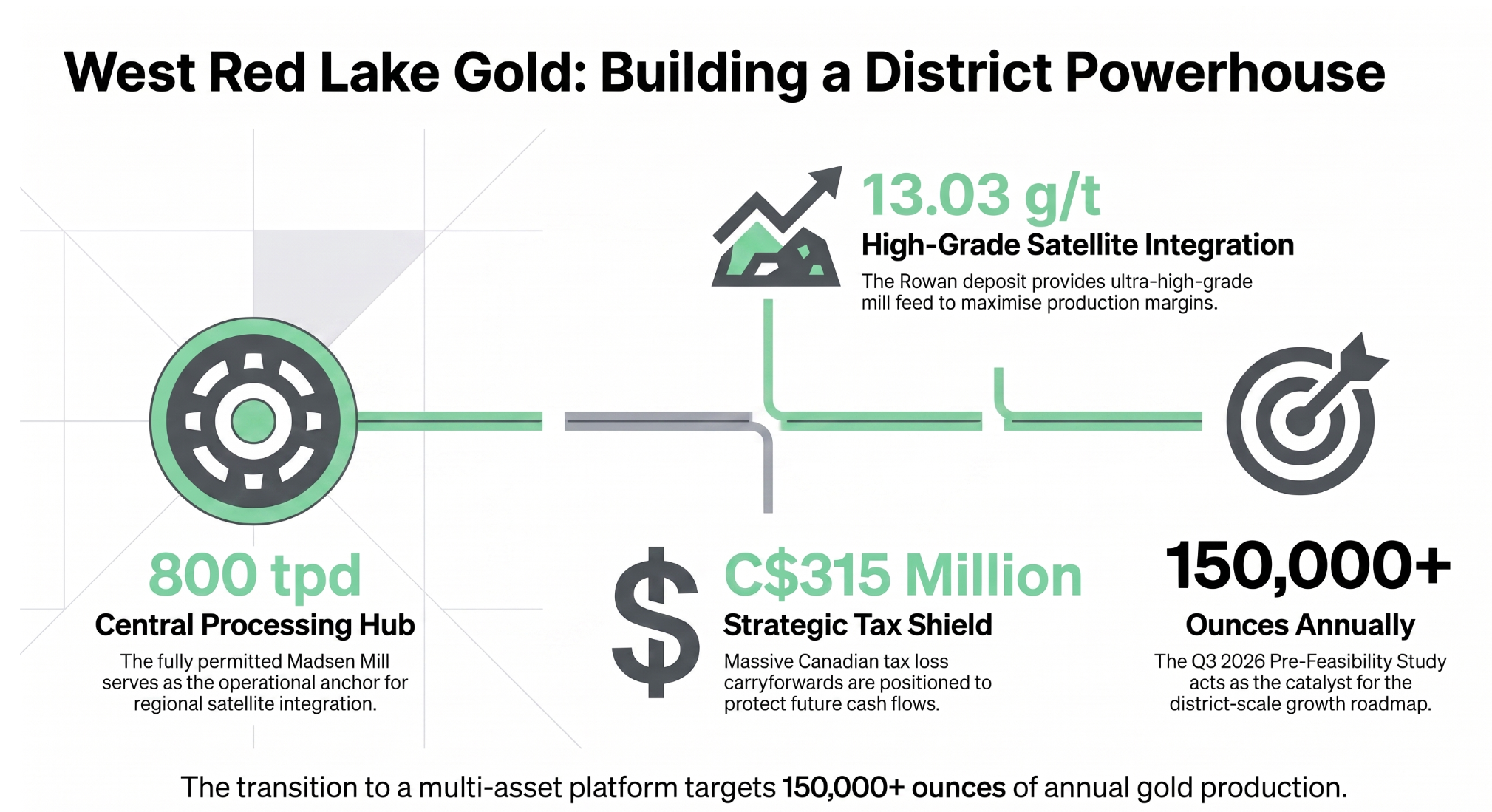
The regional expansion strategy implemented by West Red Lake Gold Mines Ltd. (TSX Venture Exchange: TSXV | OTCQX Best Market: OTCQX) is anchored on utilising a central processing hub to unlock surrounding satellite deposits. This approach is underpinned by a historical capital base of more than $350 million from prior underground and surface investments, supplemented by approximately $150 million in capital deployed by the company since its acquisition of the property. By leveraging this existing $500 million infrastructure footprint, the company minimises initial capital expenditures (capex) and reduces the standard development timeline for bringing new resource zones online.
The primary engine of this capital arbitrage model is the fully permitted Madsen Mill, which has an active throughput capacity of 800 tonnes per day and a nameplate capacity of 1,100 tonnes per day. Management's long-term regional plan is designed to feed this central processing facility with high-grade material trucked from multiple surrounding deposits. This configuration eliminates the capital intensity, permitting delays, and environmental footprint associated with constructing separate milling facilities and tailings storage areas at each individual mining site.
The upcoming Pre-Feasibility Study (PFS) proposed for the third quarter of 2026 represents the first formal integration of this regional hub-and-spoke platform. The study will combine the flagship Madsen Mine reserves with the high-grade Rowan satellite deposit, located 80 road kilometres away, which hosts an Indicated Resource of 334,825 ounces of gold at an average grade of 13.03 grams per tonne. This integration allows Rowan to be developed as a low-cost satellite mining operation, utilising underground longhole retreat mining to truck high-grade material directly to the Madsen Mill.
Capital Structure & the C$315 Million Fiscal Shield
West Red Lake Gold maintains a robust capital structure to fund its ongoing development and exploration programs across its 47-square-kilometre land package. As of July 1, 2026, the company has 412,959,642 common shares issued and outstanding, with a fully diluted share count of 554,515,256. At a share price of C$0.65 as of July 1, 2026, the company's market capitalisation is approximately C$270 million, supported by a strong cash balance of approximately C$36.0 million reported as of March 31, 2026.
An unappreciated asset on the company's balance sheet is approximately $315 million in Canadian tax loss carryforwards. These accumulated tax losses can be applied directly against future taxable income generated from qualifying Canadian operations and projects. For institutional investors, this represents a significant fiscal shield that will defer cash tax payments, drastically improving the post-tax economics of the Madsen and Rowan operations and accelerating the transition to free cash flow generation.
Operational cash flows have already shown a positive inflexion as underground mining rates scaled through the second quarter of 2026. After reaching an operational cash breakeven rate in the first quarter of 2026, the higher mining rates and grade step-ups achieved in the second quarter of 2026 enabled the company to enter active cash accumulation.
President and Chief Executive Officer of West Red Lake Gold Mines Ltd., Shane Williams confirmed the financial transition:
"In the first quarter we were break-even when I had our first quarter results; as we get into the second quarter, we're building up cash in the balance sheet at the moment"
Technical Execution & Geological Model Verification
The operational step-up demonstrates that management is successfully de-risking the physical and technical bottlenecks that constrained legacy operations. During the second quarter of 2026, gold production rose 51% to 8,576 ounces compared to 5,667 ounces in the first quarter of 2026, driven by a 46% increase in mined ore tonnage to 75,524 tonnes. Mined grades also stepped up 23% to 4.3 grams per tonne gold from 3.5 grams per tonne gold in the first quarter of 2026, as mining advanced into the high-grade 4447 non-remnant complex.
This productivity surge is directly linked to the arrival and deployment of a new fleet of mobile equipment, which has restored reliability in underground haulage. Last year, the company directed significant capital toward purchasing new underground trucks and loaders, which has successfully raised mechanical equipment availability to between 75% and 80% in the second quarter of 2026. This availability has allowed daily mining rates to consistently exceed 1,000 tonnes per day from mid-quarter onward, surpassing the mill's current permitted capacity of 800 tonnes per day.
The surplus mining capacity has enabled the creation of a 10,768-tonne surface stockpile containing approximately 1,500 contained ounces of gold. This surface inventory provides approximately half a month of mill feed buffer, insulating processing operations from temporary underground stope sequencing delays. Furthermore, tight model reconciliation has been maintained across the deposit, supported by over 200,000 metres of underground definition drilling, allowing the company to define the deposit well ahead of the mine plan and guaranteeing high predictability of gold recovery rates, which remained stable at 95.0% during the quarter.
Williams explained the mechanics of stope cycling and stockpile management:
"We're working on six or seven stopes in a cycle at a time, between drilling them underground for drilling and then silling them and stoping them and mining them. That sequence takes a long time to get right, as you're probably aware, and we're just getting there now. Another quarter of that to get to there, but that's where we're getting the tonnage. More importantly as well, we have a stockpile on surface as well now; we've developed a 15,000-ton stockpile of material on surface ahead of the mill."
Catalyst Path & Peer Valuation Mechanics
The combination of the Madsen Mine and the Rowan project positions West Red Lake Gold as 1 of the highest-grade gold developers and emerging producers in North America. Madsen’s current Mineral Resource Estimate (MRE) of 1.65 million Indicated ounces of gold at an average grade of 7.4 grams per tonne, combined with Rowan's Indicated Resource of 334,825 ounces of gold at 13.03 grams per tonne, places the company's asset grade well above the average of its North American peer group. This high-grade profile provides exceptional leverage on the gold price while reducing the operating margin's sensitivity to inflationary cost pressures.
The company is executing a clear, milestone-driven roadmap to demonstrate sustained operational consistency and establish peer-group valuation metrics. Following the inclusion of the VanEck Junior Gold Miners Exchange-Traded Fund (GDXJ) index on March 20, 2026, which expanded institutional market access, the primary upcoming technical catalyst is the publication of the joint PFS in the third quarter of 2026. This study will provide the first bankable economic numbers for the combined Madsen and Rowan platform, outlining a clear engineering pathway to target long-term production of 150,000+ ounces of gold per year in the Red Lake district.
As the company demonstrates operational consistency at the Madsen Mill and advances self-funded underground development towards new complexes, it is positioned to align from a developer multiple to a junior producer multiple. With mining rates set above mill capacity, a substantial surface stockpile buffer in place, and development advancing deeper into high-grade, non-remnant complexes such as 904 and 4447, the physical foundation is in place to support full-year 2026 production guidance targeting 35,000 to 45,000 ounces of gold.
Permitting Stability & Jurisdictional Security
A major risk factor in junior mining is political and permitting uncertainty, which often stalls projects regardless of their geological merit. West Red Lake Gold mitigates this risk by operating exclusively in Ontario's Red Lake mining district, a Tier 1 mining jurisdiction that has historically produced over 20.0 million ounces of gold. The district features established transportation corridors, high-voltage electrical grids, and a skilled local mining workforce, which lowers capital requirements and execution risks.
All required operating permits for the Madsen Mine are held in good standing with the Ontario Ministry of Mines and the Ministry of the Environment, Conservation and Parks. The company is committed to open and honest communication with local First Nations, ensuring operational practices reflect community values and local environmental expectations. This proactive consultation approach minimises the potential for social-licensing friction, thereby providing long-term permitting and operational stability for the multi-asset platform.
Technical & Financial Risk Factors
While West Red Lake Gold Mines Ltd. has de-risked several historical bottlenecks, several operational and structural risks remain critical for financial modelling. A primary balance sheet consideration is the capital overhang resulting from the structural delta between the 412,959,642 common shares issued and outstanding and the 554,515,256 fully diluted share count. This dilution risk is concentrated in the 110,473,807 outstanding warrants, which include 38,400,000 warrants expiring in October 2027 at a C$0.90 exercise price, 23,600,000 warrants expiring in February 2028 at C$0.90, and 19,000,000 warrants expiring in March 2029 at C$0.95, representing a potential near-term equity supply that could dilute earnings per share.
Logistical and technical factors also present operational sensitivities under the proposed hub-and-spoke model. The trucking route from the Rowan satellite deposit to the central Madsen Mill spans 80 road kilometres, exposing the high-grade material transport to regional road maintenance delays, winter weather interruptions, and fuel price volatility. Furthermore, maintaining the targeted grades of 6.0 to 8.0 grams per tonne gold during the second-half 2026 ramp-up depends on continuous stope-definition drilling to control mining dilution, as mining adjacent to historical legacy workings carries localised dilution and stope-sequencing risks.
Sustaining underground mining rates above the 1,000 tonnes per day threshold also places continuous pressure on development and backfill schedules. If mobile equipment mechanical availability falls below the second-quarter 2026 range of 75% to 80%, haulage cycle delays could exhaust the 10,768-tonne surface stockpile buffer and constrain mill throughput. Additionally, the capex required to refurbish the shaft during Phase 1 represents a capital-allocation variable that must be managed alongside outstanding debt obligations to prevent near-term liquidity constraints.
Investment Thesis for West Red Lake Gold
- West Red Lake Gold Mines Ltd. leverages a high-value, fully permitted central infrastructure asset base worth approximately $500 million, bypassing the heavy capital requirements and lengthy permitting timelines that typically stall junior gold developers.
- The presence of approximately $315 million in Canadian tax loss carryforwards shields future operational income, maximising free cash flow retention and accelerating the company’s capital-return capability.
- The average grade profile of the Madsen Mine at 7.4 grams per tonne gold and the Rowan project at 13.03 grams per tonne gold positions the company in the top tier of North American gold assets, providing superior operating margin resilience.
- The upcoming integrated Pre-Feasibility Study in the third quarter of 2026 will mathematically combine Madsen and Rowan into a single economic model that will serve as the primary quantitative model for peer-group valuation analysis.
- Second-quarter 2026 results confirm that resolving legacy equipment bottlenecks has raised mine productivity to over 1,000 tonnes per day, enabling the accumulation of a 10,768-tonne surface stockpile that de-risks the processing plant.
West Red Lake Gold Mines Ltd. represents a rare junior gold producer transitioning into a multi-asset regional platform within a world-class Canadian district. By utilising its fully permitted central milling infrastructure to consolidate high-grade regional deposits, the company has established a highly capital-efficient, high-margin growth profile. As the upcoming joint PFS quantifies the economics of the hub-and-spoke model and operations demonstrate consistent throughput, the company is positioned to trade in line with established peer-group valuation multiples.
TL;DR
West Red Lake Gold Mines Ltd. is capitalising on its C$500 million historical infrastructure base and C$315 million in tax loss carryforwards to execute a highly capital-efficient hub-and-spoke consolidation strategy in the Red Lake district. Second-quarter 2026 results confirm a 51% step-up in gold production to 8,576 ounces, driven by equipment fleet recapitalisation and improved stope sequencing, which have pushed daily mining rates above 1,000 tonnes. With an upcoming joint PFS in the third quarter of 2026 that integrates the high-grade Rowan deposit, the company is positioned to transition to peer-group valuation multiples as it builds towards a regional target of 150,000+ ounces of gold per year.
FAQs (AI-Generated)
Analyst's Notes





Subscribe to Our Channel




.png)


Stay Informed






















