




What to Watch Next at Cobra Resources: The Copper & Rare Earth Catalysts Ahead


Cobra Resources has finished drilling at its South Australian copper and rare earth projects. A guide to the dated catalysts due across both through 2026.
- Cobra Resources has concluded a four-hole, 1,465-metre diamond drilling programme at its Manna Hill copper project and formally exercised its option to acquire it.
- Laboratory assays from Manna Hill are anticipated starting in August 2026, with a follow-up reverse-circulation (RC) programme planned for September 2026.
- At the Boland and Head rare earth prospects, resource-definition drilling is complete, with around 80% of assay and permeability results received, and holes still pending at both prospects.
- Cobra is targeting a maiden mineral resource estimate (MRE) of 200 million to 400 million tonnes at more than 1,000 parts per million (ppm) total rare earth oxide (TREO), built to feed a scoping study.
- A capital-light in situ recovery (ISR) field demonstration is planned in the coming months, using the existing well-field and potentially the Australian Nuclear Science and Technology Organisation (ANSTO) pilot facility.
What Has Happened
Cobra Resources (LSE: COBR) has closed the current drilling phase on both of its South Australian projects, shifting the story from fieldwork to results and near-term decisions. At the Manna Hill copper project, a four-hole, 1,465-metre (m) diamond core programme has concluded, and the company has formally exercised its option to acquire the project outright. At the Boland and Head rare earth prospects, resource-definition sonic core drilling is complete, with around 80% of assay and permeability results received, and further holes still pending at both. The optimised heavy rare earth product carries 43% heavy rare earths and less than 0.9% impurities. What follows over the coming months is a sequence of assays, a maiden resource, and a field demonstration that tests each project in turn.
Manna Hill Copper: Observations Awaiting Assay Confirmation
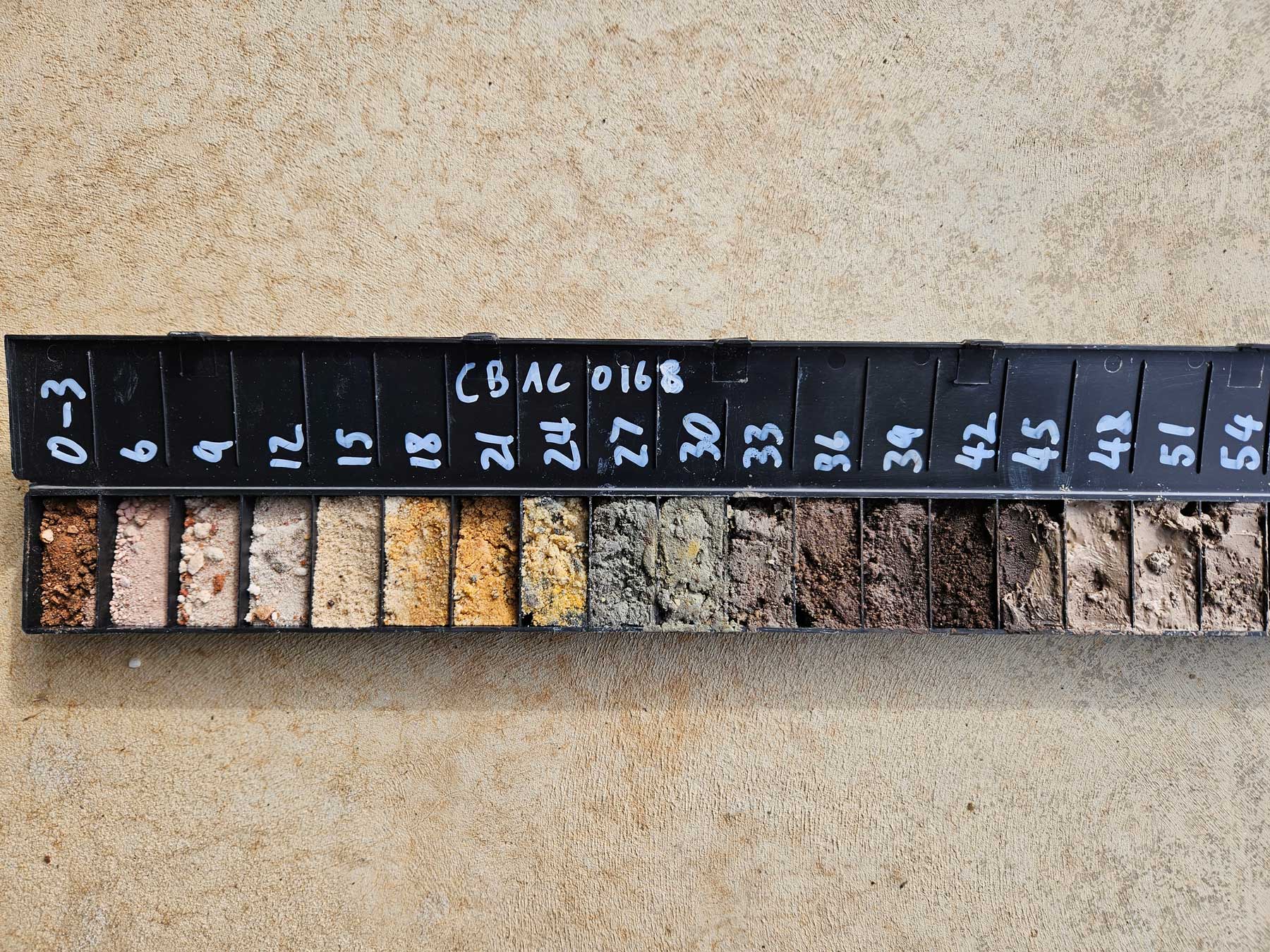
The copper case at Manna Hill now rests on laboratory confirmation of what the diamond core showed visually. Drilling targeted the depth continuity of shallow, high-grade reverse circulation (RC) intersections of 74 m at 1.02% copper and 0.25 grams per tonne (g/t) gold from 72 m depth, and 86 m at 0.60% copper and 0.14 g/t gold from 18 m depth. Below those, the core tracked chalcopyrite before entering a zone of bornite from 220 to 257 m depth, a copper mineral that forms at higher temperatures within the potassic core of a porphyry system.
Other holes added vectors toward that system. One intersected a large fault-bound anhydrite breccia between 190 and 220 m depth, interpreted as the pathway that carried copper-bearing fluids into the overlying skarn. Another logged broad potassic alteration from 265 to 320 m depth, while a further hole returned shallow copper oxide from 14 to 67.5 m depth, outside the previously modelled skarn footprint.
These are visual estimates from core logging, not laboratory grades, and they carry no information on impurities or economic value. Confirmation of the porphyry interpretation depends on assays anticipated from August 2026, which, in turn, will shape the design of the September 2026 RC programme. Until those results arrive, the geological model is a set of ranked targets rather than a measured system.
Boland & Head: Economics Built Into the Maiden Resource
At the rare earth prospects, Cobra is building the drivers of extraction cost into the maiden resource itself rather than leaving them to a later study. The company is targeting a collective maiden mineral resource estimate (MRE) of 200 million to 400 million tonnes at more than 1,000 parts per million (ppm) total rare earth oxide (TREO). Mineralisation sits across three stacked formations at different stages of readiness: the deep Pidinga, where hydrology work is complete, and metallurgy is strong; the Garford, with good ionic recoveries but outstanding permeability work; and the shallow Narlaby, permeable with strong grades but still needing work on the confined nature of its aquifer.
Two physical properties carry as much weight as grade in an in situ recovery (ISR) operation. Permeability governs how quickly the solution moves through the aquifer, while natural acid generation offsets the reagent that is usually a project's highest operating cost. Modelled acid consumption ranges from 1 to 16 kilograms per tonne, compared with potential in-ground generation of up to 60 kilograms per tonne in some zones.
Managing Director of Cobra Resources, Rupert Verco, frames the resource design this way:
"We will build the economics into the model. If you think about reservoir modelling for oil and gas, you input the parameters that really impact your economics, and that will then provide the basis for a scoping study on a higher-rigour resource estimate."
The higher-confidence Pidinga is expected to anchor an indicated component of the resource, with the overlying formations adding an inferred component for scale. That structure is what carries the economic parameters into the study that follows.
The Capital-Light Route to Proving In Situ Recovery
Before committing development capital, Cobra intends to prove the ISR process at the field scale on the infrastructure it has already installed. An emulated tracer test recovered almost 80% of the injected tracer over two days from an adjacent well, indicating well-field spacings of 15 to 25 metres and leach cycles of 30 to 60 days. Those figures set the design parameters for a productive well-field.
The demonstration itself is deliberately light on capital. Rather than build infrastructure in the field, Cobra would run the ISR process on the existing well-field, precipitate a slurry, and ship it to the Australian Nuclear Science and Technology Organisation (ANSTO) pilot facility to complete the flowsheet, at a cost of roughly a couple of million Australian dollars.
Verco is precise on the demonstration path:
"We will be looking to really confirm this in the coming months through a field study where we'll do the ISR process in our existing well-field, and that will really be a proof of demonstration."
The timing of that field study depends on working through options with the state regulator, which places the demonstration on a permitting track as much as a technical one.
Broader Context
South Australia gives both projects an established backdrop. The state holds around 70% of Australia's copper reserves, placing Manna Hill within a recognised copper province served by rail and smelting infrastructure across Broken Hill, Port Pirie, and Adelaide.
For ISR, the precedent sits close at hand. Four ISR pilot studies have run in the state over the past two years, including a recently completed uranium pilot by Alligator Energy, a few hundred kilometres away, alongside long-running commercial ISR uranium operations in the same formations. Liability costs per pound of uranium for aquifer-confined ISR are about 28 times lower than at the open-cut Ranger uranium mine, and the state regulator is familiar with the containment requirements triggered by ISR permitting.
What to Watch Next
The next several months carry a defined sequence of catalysts across both projects. At Manna Hill, laboratory assays are anticipated from August 2026, followed by an RC programme in September 2026 to test the ranked magnetic targets, with follow-up diamond drilling at Desert Rose and a greenfields soil sampling programme also planned.
At the rare earth prospects, the remaining assays feed the maiden resource, which is designed to carry the permeability and acid-generation modelling into a scoping study. The capital-light ISR field demonstration is planned for the coming months, and diagnostic testing and mapping recoveries across the Head continue in parallel.
Verco puts the sequencing trade-off this way:
"The key goal we really want to achieve is that if the resource estimate takes a little bit longer but brings production forward quicker, that's the ultimate achievement. That's what we're working on."
The through-line across the calendar is that sequencing choice: accepting a longer path to a defined resource in exchange for a shorter path to production.
FAQs (AI-Generated)
Analyst's Notes





Subscribe to Our Channel




.jpg)




Stay Informed






















