




7 Things to Know as Marimaca Targets a 2027 Pampa Medina Resource


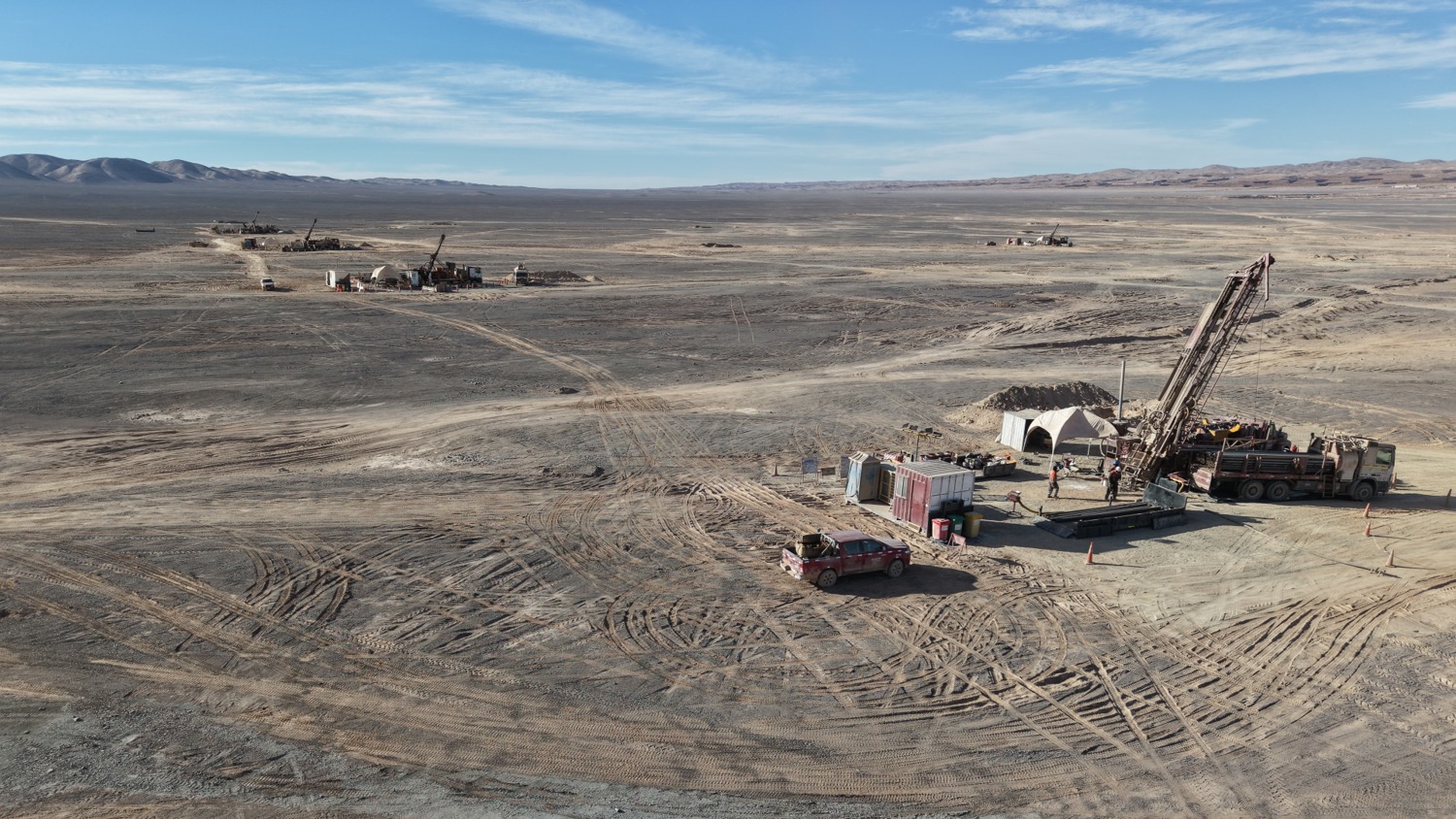
Scout holes north of Pampa Medina stopped above the target horizon. Diamond extensions push the district test into 2027, while the central zone is delineated.
Project Overview
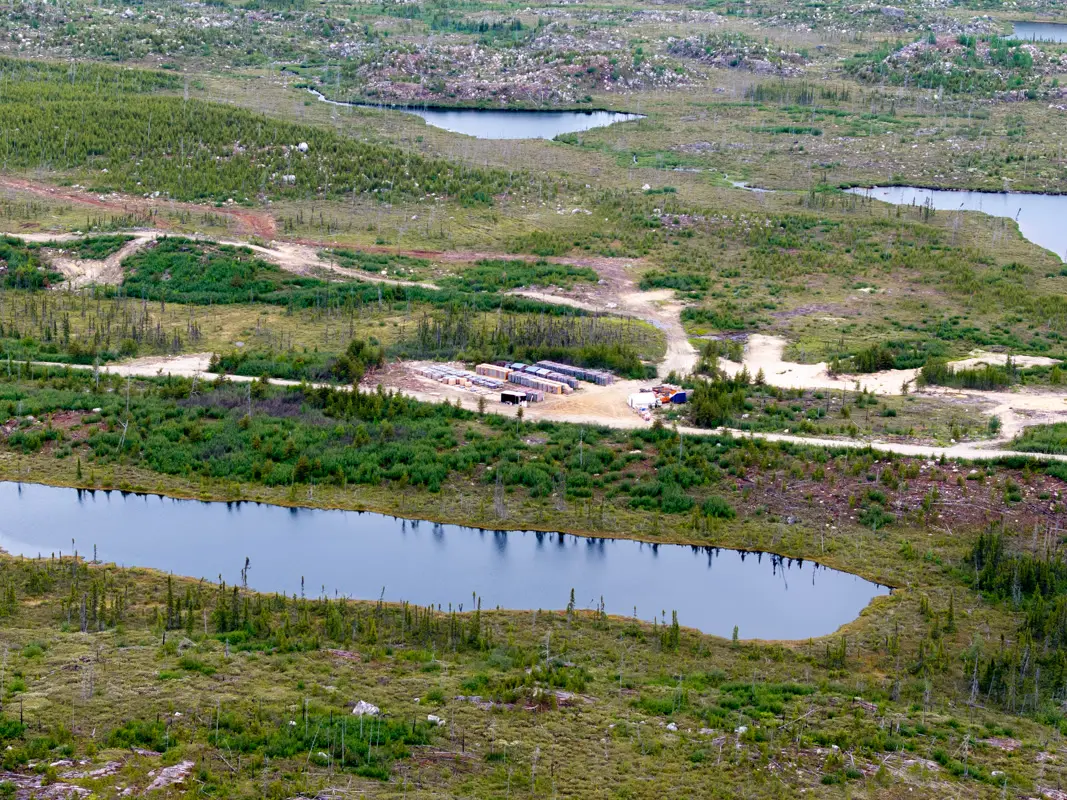
Two drilling campaigns are running at Pampa Medina simultaneously, and they address different questions. The first fills in a defined area of interest measuring 3 kilometers (km) by 1.5km in Chile's Antofagasta Region, about 25km from the processing plant planned for the Marimaca Oxide Deposit. The second collars holes outside that corridor to find out how far the host sediments extend, and it is the campaign that changed shape in the latest results. Marimaca Copper (TSX: MARI | ASX: MC2) is advancing the Marimaca Oxide Deposit toward a construction decision while it drills Pampa Medina.
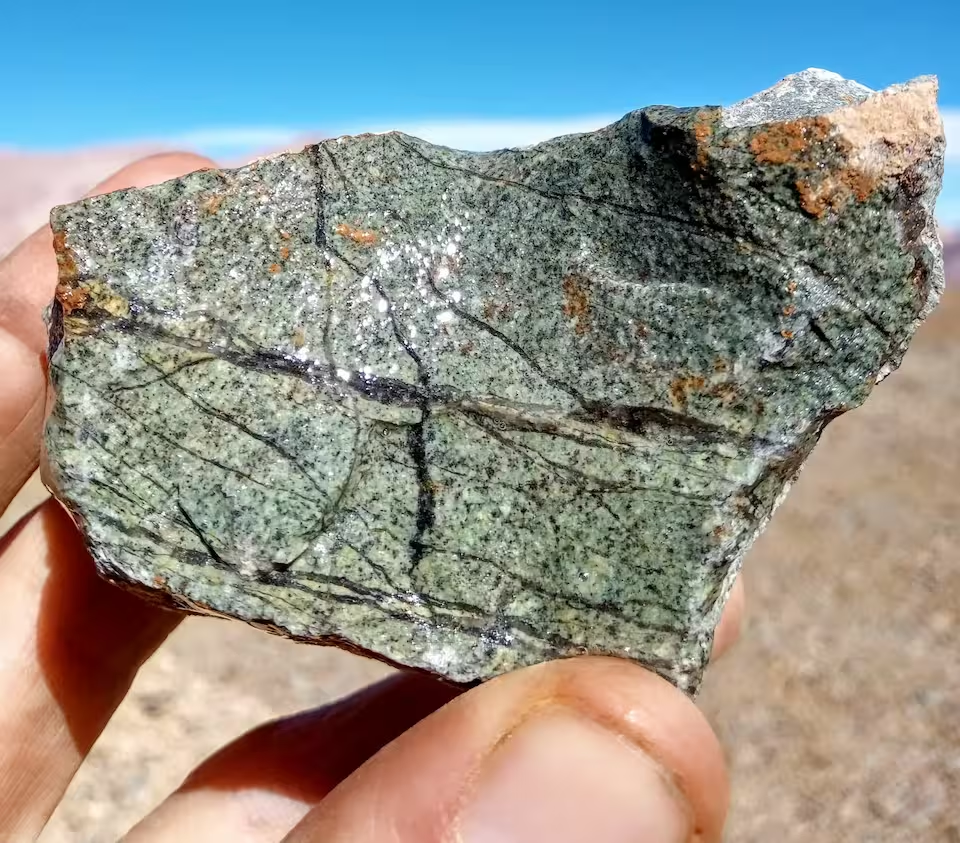
The deposit is a manto-style copper system, meaning sheets of mineralization stacked one above another, hosted in Jurassic-Triassic sedimentary units of sandstone, conglomerate, tuff, and black shale, overlain by volcanic rock and underlain by a basement complex of metamorphosed sediments, volcanics, and intrusions. A 30,000-meter extensional program is underway across the property in 2026, with three stated goals: define the high-grade center, delineate the oxide extensions, and step out to test the broader system outlined by geophysics.
1. The Central Zone Is Being Measured, Not Searched For
Drilling at 150-meter centers through the central zone returned 216 meters (m) of 0.96% copper and 7.2 grams per metric ton (g/t) silver from a depth of 466m, including 62m of 2.20% copper and 21.5g/t silver from 602m.
Spacing at 150m is a delineation grid, and its purpose is to test whether the high-grade sulfide horizons hold their thickness and grade between holes. Within that interval, the grade climbs in steps, through 82m of 1.72% copper and 16.3g/t silver from 600m to 14m of 3.05% copper and 26.7g/t silver from 606m. True widths across the program are estimated at approximately 80% of the reported downhole lengths, and every intersection above is reported downhole.
The same hole demonstrates vertical continuity across the manto horizon, which is the feature that the delineation grid was built to confirm. For an investor, the significance is narrow and real: inside this corridor, the shape of the deposit is becoming a measurable quantity drawn from a grid rather than from scattered intercepts.
2. Four of Five Scout Holes Never Reached the Target Sediments
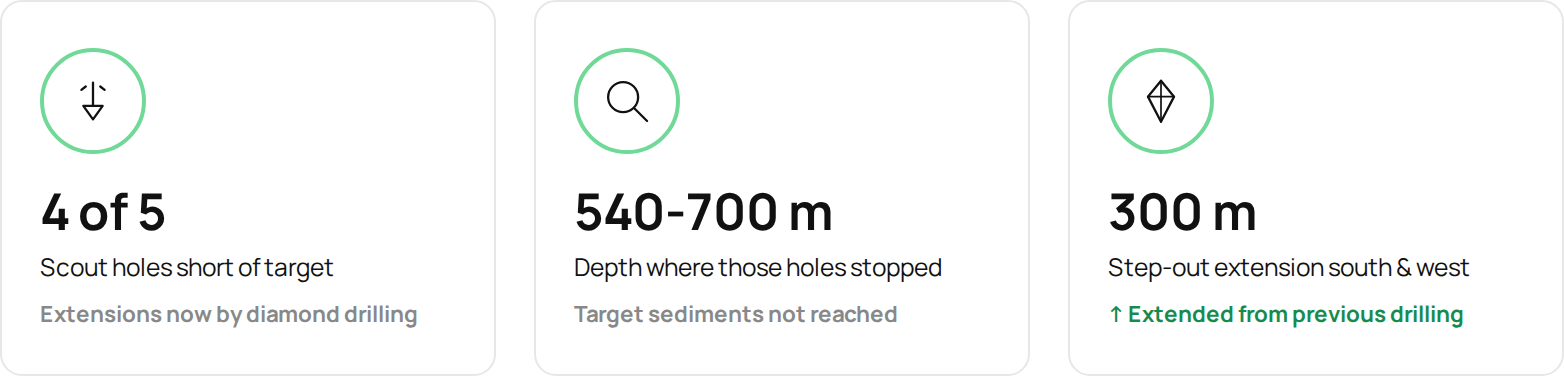
Five scout holes collared north and northwest of the corridor were drilled to find the top of the target sediments, and four of them stopped in the overlying rock at depths ranging from 540m to 700m.
Those four will be extended by diamond drilling. Of the four, one ended in mineralization at the limits of what reverse circulation could reach, returning 8m at 1.47% copper and 7.5g/t silver from a depth of 580m in volcanic rock, interpreted to lie above a sediment contact that the hole never reached. The other three returned no significant intercepts. The fifth hole did reach the sedimentary horizon at greater depth, returning 8m of 1.17% copper and 11.8g/t silver from 578m depth, before drilling was halted at the technical limits of reverse circulation at depth.
Chief Executive Officer of Marimaca Copper Corp., Hayden Locke, explains what the scout program was built to get through:
"We're underway with a scout drilling program, which is all about getting through the gravel cover and again identifying areas where we think this Pampa Medina style sediment-hosted copper mineralization is extensive across a much broader land package."
Gravel and volcanic cover kept four of the five holes above the rocks they were collared to test, so the extension work now falls to the diamond rigs.
3. The Basin Deepens in the Direction With the Most Ground to Test
The target sedimentary horizons appear to deepen northward and northwestward, beyond the practical limits of reverse-circulation drilling.
The largest untested area lies in exactly that direction. Marimaca Copper says the geophysical coverage over the property outlines ground about 10 to 12km north to south and roughly 5km east to west, against a drilled corridor measured in hundreds of meters. A 2024 reinterpretation of the geology named the lower sedimentary package as the priority target horizons, and the scout holes were the first attempt to find that package outside the area already drilled.
Locke puts a dimension on the ground the geophysics has flagged:
"This is the area that we've covered with geophysics, which shows that this area is prospective for this sediment-hosted copper. Now, this area here is about 10 to 12 km north to south."
A drilled corridor, measured in hundreds of meters, within a prospective area measured in kilometers, leaves most of the target untested, and the untested part lies where the host rocks are deepest.
4. The Drilling Method Sets Where the Limit Falls
Every hole is collared with reverse circulation and switched to diamond drilling at the contact between the upper volcanics and the upper sediments, and that contact varies in depth across the property.
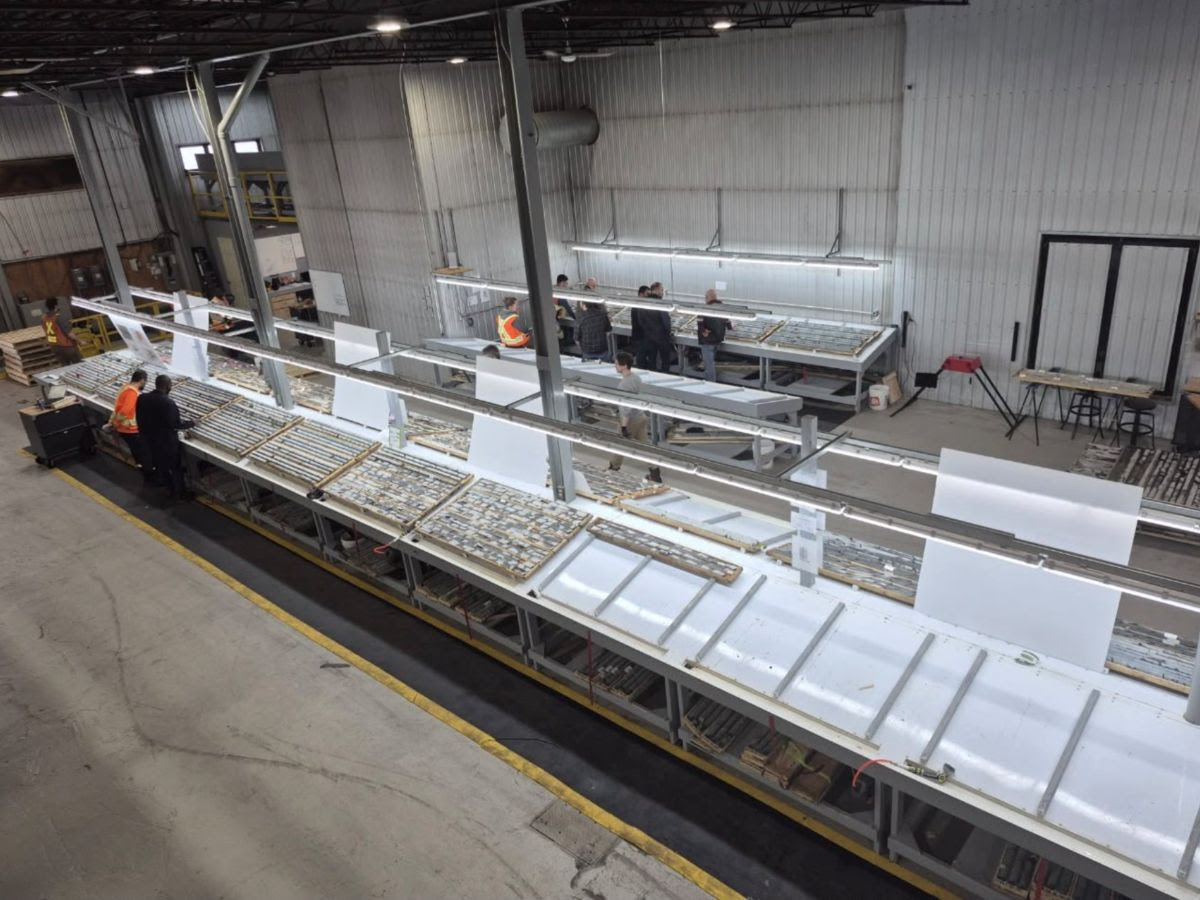
Reverse circulation is a percussion method that returns rock chips, sampled on a continuous 2m basis and split on site to one-eighth of their volume. Diamond drilling cuts a solid core, halved lengthwise on the same 2m interval, and is drilled in two standard core diameters. Reverse-circulation recoveries are measured at above 95%, so the constraint is the reach rather than the sample quality.
Where the volcanic cover thickens to the north and northwest, the switch point moves deeper, and a larger share of each hole falls into the cored half of the sequence. Two older reverse-circulation holes in the corridor have already been extended this way, reaching moderate mineralization in the basement below the previously defined host units.
5. The Extensions Have to Land Before the District Question Can Be Answered
The diamond extensions must reach the sediments before the northern and western edges of the system can be tested, and the current hole spacing does not yet support a resource classification beyond the delineated core.
Hole spacing across the program is highly variable and insufficient to establish the geological and grade continuity required for a resource estimate in the inferred or indicated categories. The qualification applies to the exploration ground. Inside the delineated center, the 150m grid was designed to answer exactly that question.
Structure adds a second variable. Block faulting and a complex of dike swarms are the main structural controls on the deposit, and several holes in and around the central zone were cut by faulting or late dikes that truncated intervals at depth. Those features govern how continuous the horizons are at the scale required by a mine plan, which is a different test from the one grade and thickness have already passed.
6. The Step-Outs Moved the Boundary South and West
Step-out holes outside the central corridor extended the mineralized sediment horizon 300m to the south and west, where drilling did not encounter a depth constraint.
The western step-out, drilled 300m from previous holes, returned 56m of 0.95% copper and 4.2g/t silver from 748m depth in sulfide, including 22m of 1.80% copper and 9.7g/t silver from 750m and 8m of 2.42% copper and 9.0g/t silver from the same depth. Near the southeastern limit of the historical oxide zone, one hole cut 222m of 0.50% copper from 194m depth through oxide, mixed, and sulfide material, with 18m of 1.01% copper from 246m in the oxide, 28m of 1.07% copper from 322m in the mixed zone, and 48m of 1.05% copper from 368m in sulfide. A hole 150m east of earlier drilling returned 104m of 0.65% copper from 522m depth.
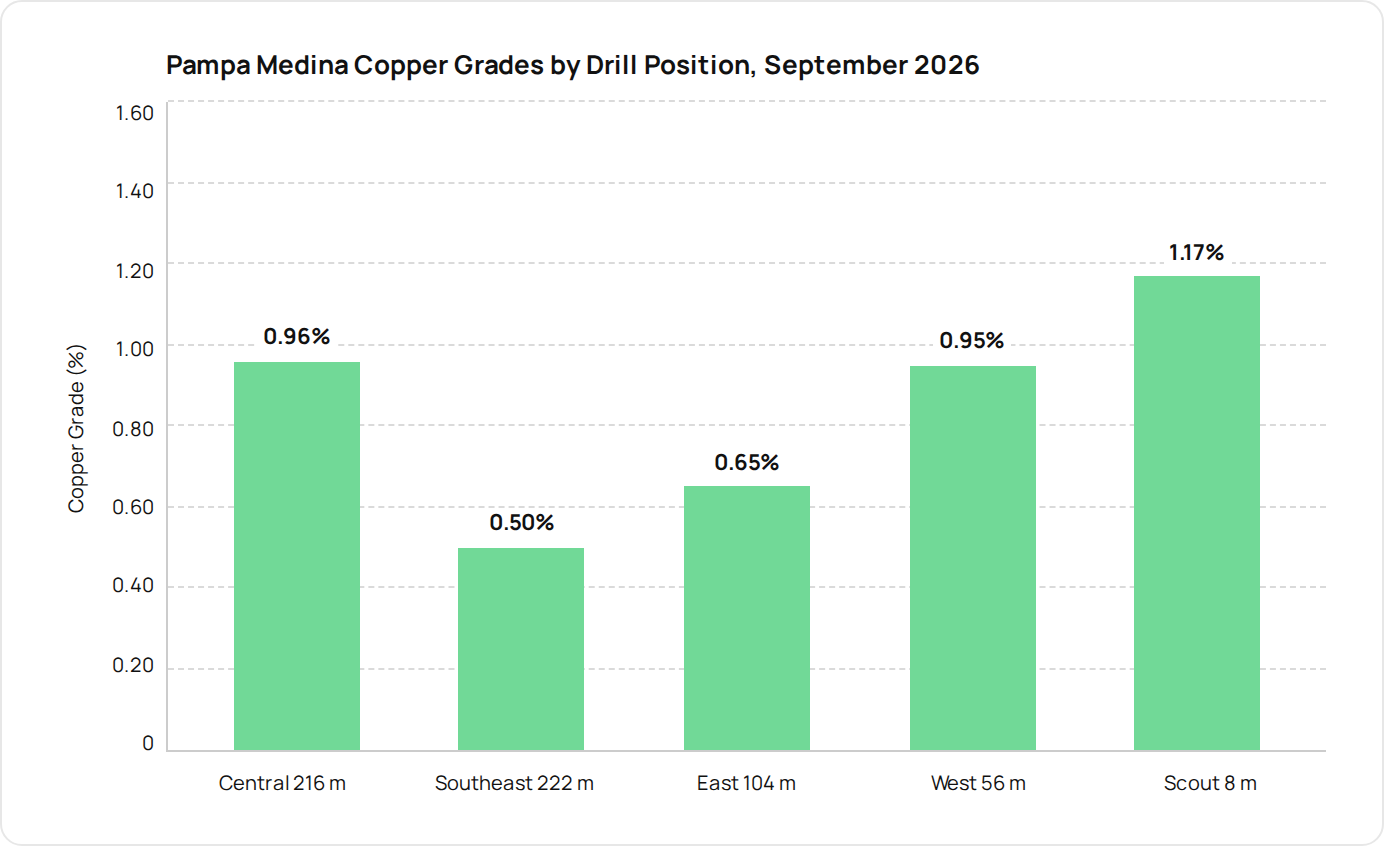
Those results extend the high-grade copper-silver system across ground that reverse circulation can still reach. No equivalent extension has been reported to the north or northwest, and that contrast is the current constraint: the deposit is growing where the sediments are shallow, and the district test waits where they are not.
7. The Schedule Now Depends on the Diamond Rigs
Further geophysical surveys and both reverse-circulation and diamond drilling are planned for the remainder of 2026, with a focus on extensions to the north and west of the deposit.
Management is targeting a first resource covering the Pampa Medina sulfides alongside the oxides in early 2027. The oxide portion of that estimate is the part management describes as already well understood. The two halves of the property now report on different schedules.
On timing, Locke separates what the company is confident in from what it is not:
"In the early part of 2027, we will be putting out our initial maiden resource on the Pampa sulfides with the Pampa oxides, which we already have high confidence in."
For investors, the early-2027 estimate is the first point at which any part of Pampa Medina acquires a stated tonnage and grade.
Key Takeaway for Investors
- Four of five scout holes stopped in overlying rock between 540 and 700 meters depth without reaching the target sedimentary horizon, so the first test of ground beyond the drilled corridor returned depth information instead of extensions.
- The method is the constraint because every hole is collared with reverse circulation and converted to diamond drilling at a volcanic-sediment contact that deepens to the north and northwest.
- The deposit still grew, with step-out holes extending the mineralized sediment horizon 300 meters to the south and west and returning intervals such as 56 meters at 0.95% copper and 4.2 grams per metric ton of silver from a depth of 748 meters.
- The first resource estimate is targeted for early 2027, covering the delineated core where 150-meter spacing has confirmed continuity, not the wider basin, which the diamond extensions are still working toward.
Bottom Line
Pampa Medina has split into two projects on one property. The center is drilled out on a grid that has produced measurable thickness and grade, and it will carry the first resource estimate in early 2027. The ground beyond it is larger and, for now, reachable by one drilling method where the sediments lie deep. The marker to watch is the diamond extensions of the scout holes, which are drilling now and are the first test of whether the sediments host copper outside the corridor. What an investor can price today is the delineated core, on a spacing already drilled tight enough to support an estimate, with the surrounding basin as separate optionality on a later clock.
Analyst's Notes





Subscribe to Our Channel









Stay Informed


