




Alpayana's $45 Million Stake Signals a New Financing Playbook for Cuiú Cuiú


Alpayana’s $45M stake in Cabral Gold adds board rights, mine-building expertise, and equity funding ahead of the Cuiú Cuiú Phase 2 decision.
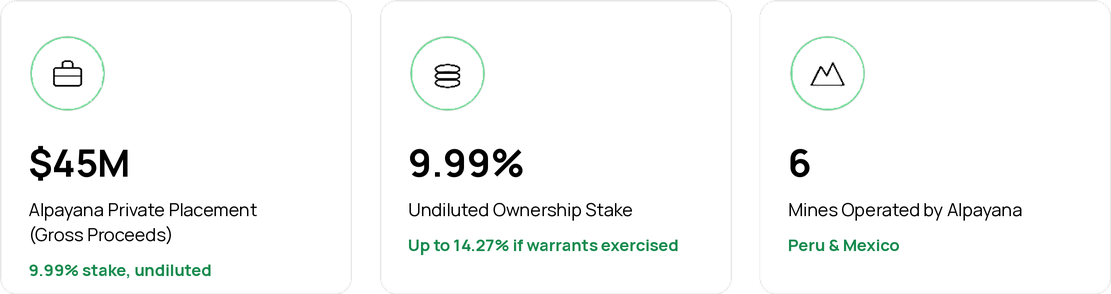
- Cabral Gold Inc. has a new strategic shareholder with board rights. Alpayana S.A.C. closed a $45 million private placement on August 24, 2026, taking a 9.99% stake with nomination and top-up rights.
- The raise marks a departure from the non-dilutive financing model Cabral has used throughout construction, in which a $45 million gold loan was structured specifically to avoid equity dilution.
- Alpayana operates 6 mines across Peru and Mexico, and the deal brings the district's first shareholder with direct hard rock mine-building experience into a governance role ahead of the Phase 2 decision.
- The $45 million gold loan funding Phase 1 carries a 39-month term, with quarterly interest payments and quarterly principal repayments of 39 kilograms of gold beginning on March 31, 2027, under a fixed repayment schedule now aligned with the new equity capital.
- President and Chief Executive Officer Alan Carter says Phase 1's roughly US$1,200-per-ounce life-of-mine cost sits well below gold's current trading level near US$4,300 per ounce, widening the margin available to fund Phase 2 work.
What Has Happened
Cabral Gold Inc. (TSXV: CBR | OTCQX: CBGZF) just brought in an operating miner as a strategic shareholder with board rights. Alpayana S.A.C., a private mining group with 4 decades of continuous operations in Peru and Mexico, closed a non-brokered private placement on August 24, 2026, purchasing the entire raise as a strategic investment: 34,582,754 units at $1.30 per unit, for gross proceeds of $44,957,580. Each unit consists of one common share and half of one warrant, with each whole warrant exercisable at $1.70 per share until February 24, 2028.
The transaction gives Alpayana a 9.99% stake on an undiluted basis and 14.27% on a partially diluted basis if the warrants are exercised in full. It also comes with rights that outlast the closing. Under an accompanying Investor Rights Agreement, Alpayana can participate in future equity financings and top up its position to maintain its pro rata ownership as long as it holds at least 9.00% of Cabral's shares, and can nominate a director, or appoint a board observer, as long as it holds at least 9.99%.
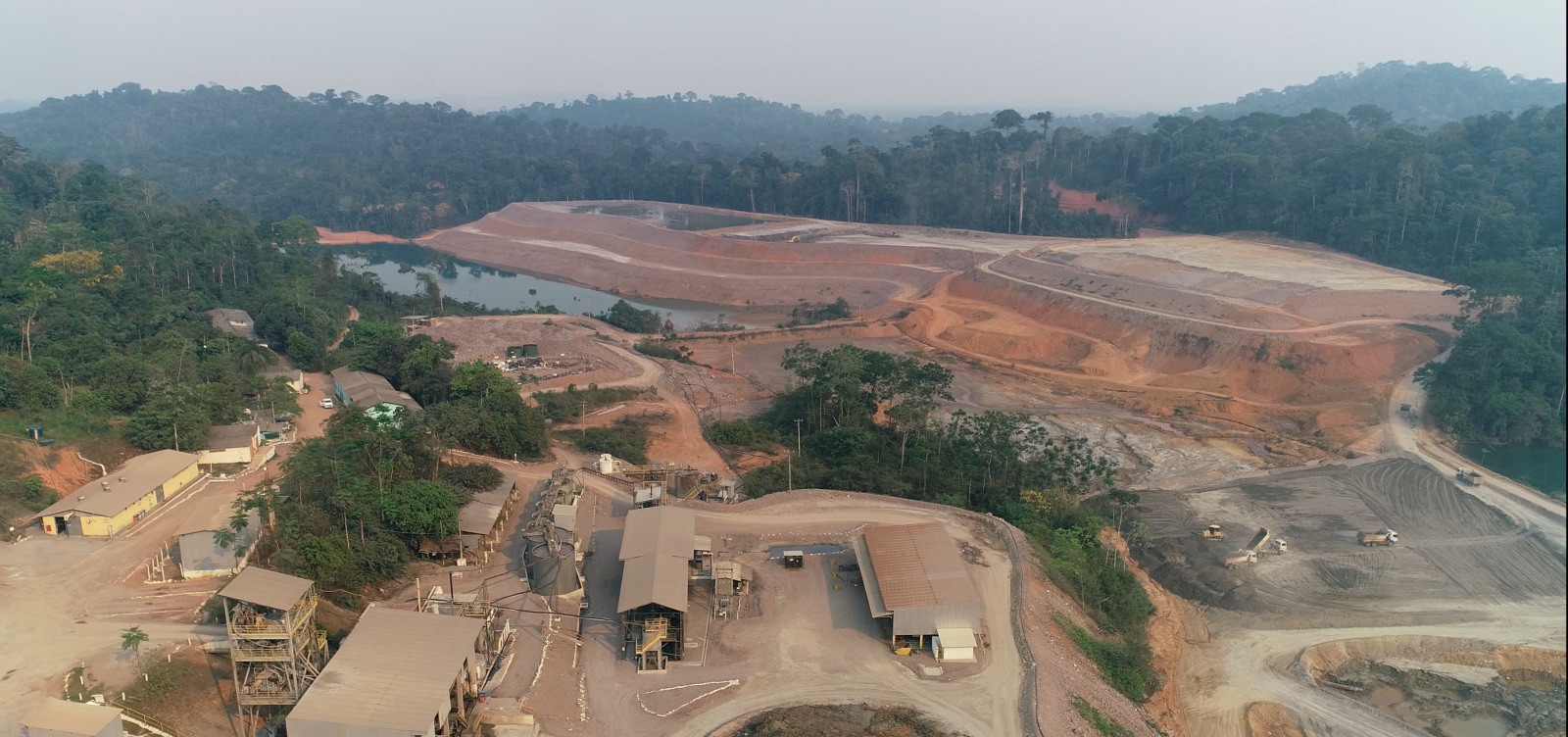
The timing is not incidental. The raise lands weeks before Cabral's targeted first gold pour at the Cuiú Cuiú gold district in Pará state, Brazil, where construction of the Phase 1 gold-in-oxide heap leach operation is in its final stages.
Why Equity, Not Just Debt, This Time
Cabral has financed Phase 1 construction entirely through debt. A $45 million gold loan, not a share issuance, carried the build. That structure has been central to how the company sells itself to investors: a junior producer reaching cash flow without diluting the shareholders who backed it.
The Alpayana placement does not replace that structure. It adds a second, equity-based source of capital, and it arrives at the exact moment that Cabral's own execution record is attracting outside capital.
President and Chief Executive Officer of Cabral Gold, Alan Carter, put that shift in credibility plainly:
"I think we're starting to prove some of those doubters wrong, or at least give them pause for thought, considering where we've come from only a few months ago to where we're at now, which is the cusp of production."
That credibility is exactly what a strategic investor buys with a governance position rather than a lending position. A lender gets repaid on a fixed schedule no matter how Phase 2 unfolds. A shareholder with board rights has a stake in how the larger hard rock resource actually gets built, and that is a different kind of commitment than a gold loan represents.
What Alpayana Brings to Phase 2
Alpayana's profile does not match Cabral's existing institutional base of gold-focused funds. It operates 6 producing mines in Peru and Mexico, making it the first Cabral shareholder with direct, current mine-building and mine-operating experience to hold board nomination or observer rights at the company.
That distinction lands because Cabral has described its own organization as already shifting from explorer to builder, and it is not starting that shift from scratch. Cabral already has that capability in-house, not contracted out. Carter said:
"We've now got a mine building team, which is in-house."
Alpayana's operating background does not replace that team. It sits alongside it, adding an external reference point based on running multiple mines at once, just as Cabral works toward a decision on developing the larger hard-rock resource beneath Cuiú Cuiú's oxide caps. Proceeds from the placement are earmarked for exploration and development of Cabral's mineral properties and general working capital, funding management has said will support both the expansion of the Phase 1 operation and continued work on the district's broader resource base.
The Gold Loan's Repayment Clock
The $45 million gold loan that funded Phase 1 construction, provided by the Precious Metals Yield Fund, closed on November 26, 2025, with a 39-month term. It carries a 10% interest rate paid quarterly, with the first interest payment due at the end of 2026. Principal repayments of 39 kilograms of gold per quarter begin March 31, 2027, when the first payment folds in both interest and principal.
That schedule is fixed in gold, not dollars, whatever the metal price does. It puts a floor under how much of Phase 1's future cash flow is already spoken for. Construction is running roughly 6 weeks ahead of plan, but that head start has not reduced the budget shortfall.
Carter was direct about what the early schedule does not mean:
"We're going to come in very close to the actual Capex that was in the PFS, but just because we're 6 weeks early doesn't necessarily follow that we've cut dollars off the capital cost."
Set a fixed repayment schedule against a budget holding firm near its original estimate, and the appeal of capital with no repayment obligation becomes obvious. That is what the Alpayana placement supplies: funding that management can direct toward Phase 1 expansion and Phase 2 exploration without competing with the loan's quarterly gold deliveries.
Margin Context: AISC Against Today's Gold Price
The Pre-Feasibility Study (PFS), led by Ausenco Brazil, modeled Phase 1 at a life-of-mine all-in sustaining cost (AISC) of US$1,210 per ounce. Carter set that number against the market as it stands today:
"This mine should be producing gold at around $1,200 an ounce over its life of mine, and gold today is about $4,300 an ounce."
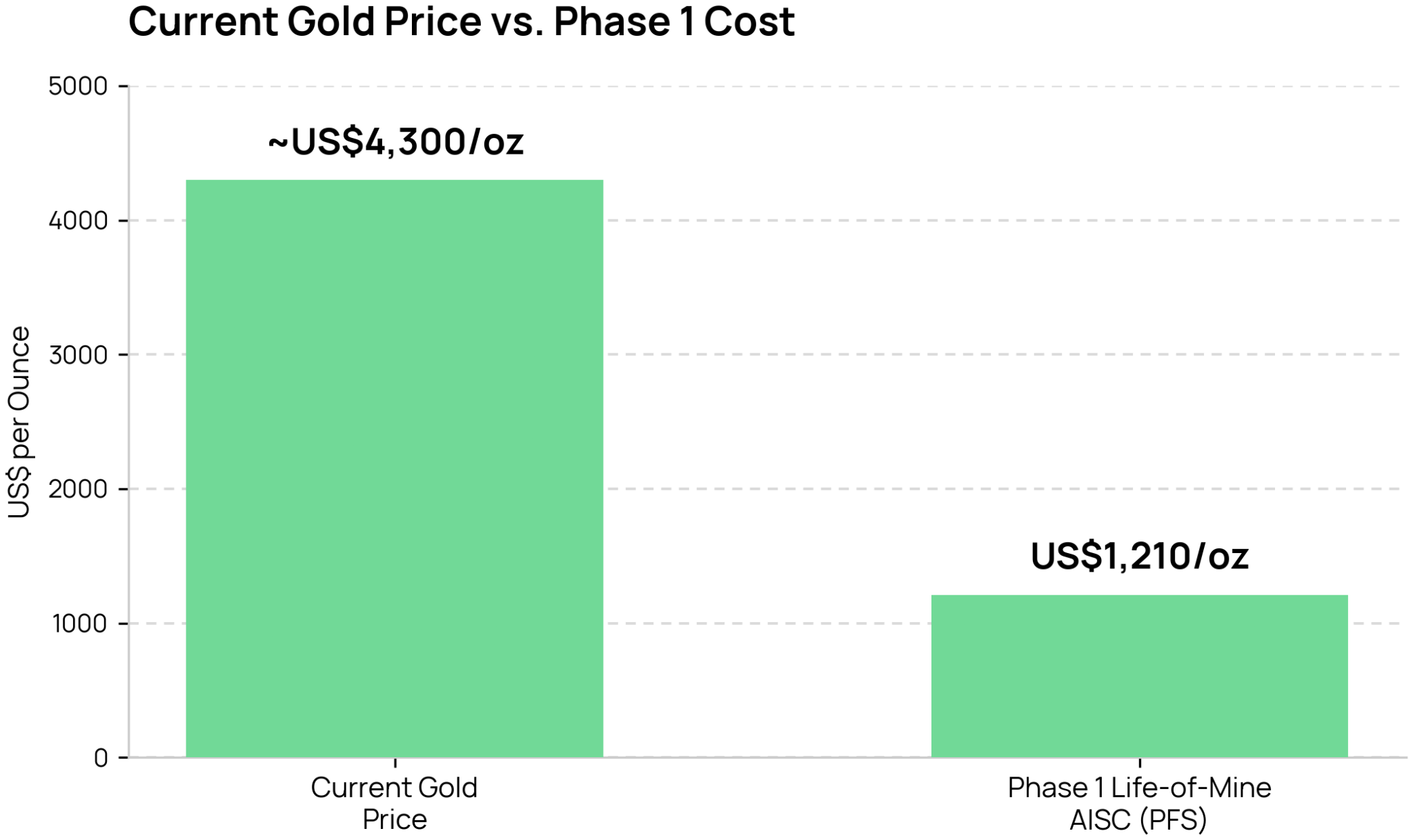
That gap between cost and price is the engine behind Cabral's self-funding strategy for Phase 2. Wider margin on every ounce sold means faster coverage of the loan's fixed obligations. It also means more cash left over for exploration across the district's remaining targets, the same cash flow management wants to use to prove up the larger hard rock resource before committing to a bigger, costlier build.
What to Watch Next
Alpayana's participation and top-up rights are designed to keep its 9.99% stake steady through future financings rather than allowing it to erode, so the next equity raise, whenever it comes, will show whether Alpayana exercises those rights. Whether Alpayana nominates a director or takes an observer seat instead, and how quickly the placement proceeds move toward Phase 1 expansion versus Phase 2 exploration, are the details that will separate a passive strategic stake from an operating partner actively shaping what Cuiú Cuiú becomes next.
FAQs (AI-Generated)
Analyst's Notes





Subscribe to Our Channel





Stay Informed






















