IsoEnergy Extends Its Uranium Development Pipeline Through Toro Energy Acquisition


IsoEnergy completed its acquisition of Toro Energy, adding the Wiluna Uranium Project in Australia to expand its staged development pipeline alongside North American assets.
- IsoEnergy completed its acquisition of Toro Energy and issued 4,359,568 common shares to former Toro Energy shareholders.
- The transaction adds the Wiluna Uranium Project, extending the company's uranium asset base across Canada, the United States and Australia.
- Management intends to advance Wiluna within a broader project sequence rather than repositioning it as the company's immediate development priority.
- The Lake Maitland deposit includes an agreement granting Japanese partners the right to acquire a 35% interest in the deposit for US$39.6 million.
- IsoEnergy reported C$130.5 million in cash and cash equivalents and an approximately C$46.0 million equity portfolio.
Toro Acquisition Extends IsoEnergy's Development Pipeline
IsoEnergy (NYSE American: ISOU | TSX: ISO) completed its acquisition of Toro Energy on June 25, 2026, through a court-approved scheme of arrangement. Toro Energy shareholders received 0.036 IsoEnergy common shares for each Toro Energy share held, resulting in the issuance of 4,359,568 new shares.
The transaction adds the Wiluna Uranium Project in Western Australia, including the Lake Maitland, Centipede-Millipede and Lake Way deposits. According to the company's corporate presentation, the deposits occur at depths of approximately 10 metres, supporting the potential for open-pit mining.
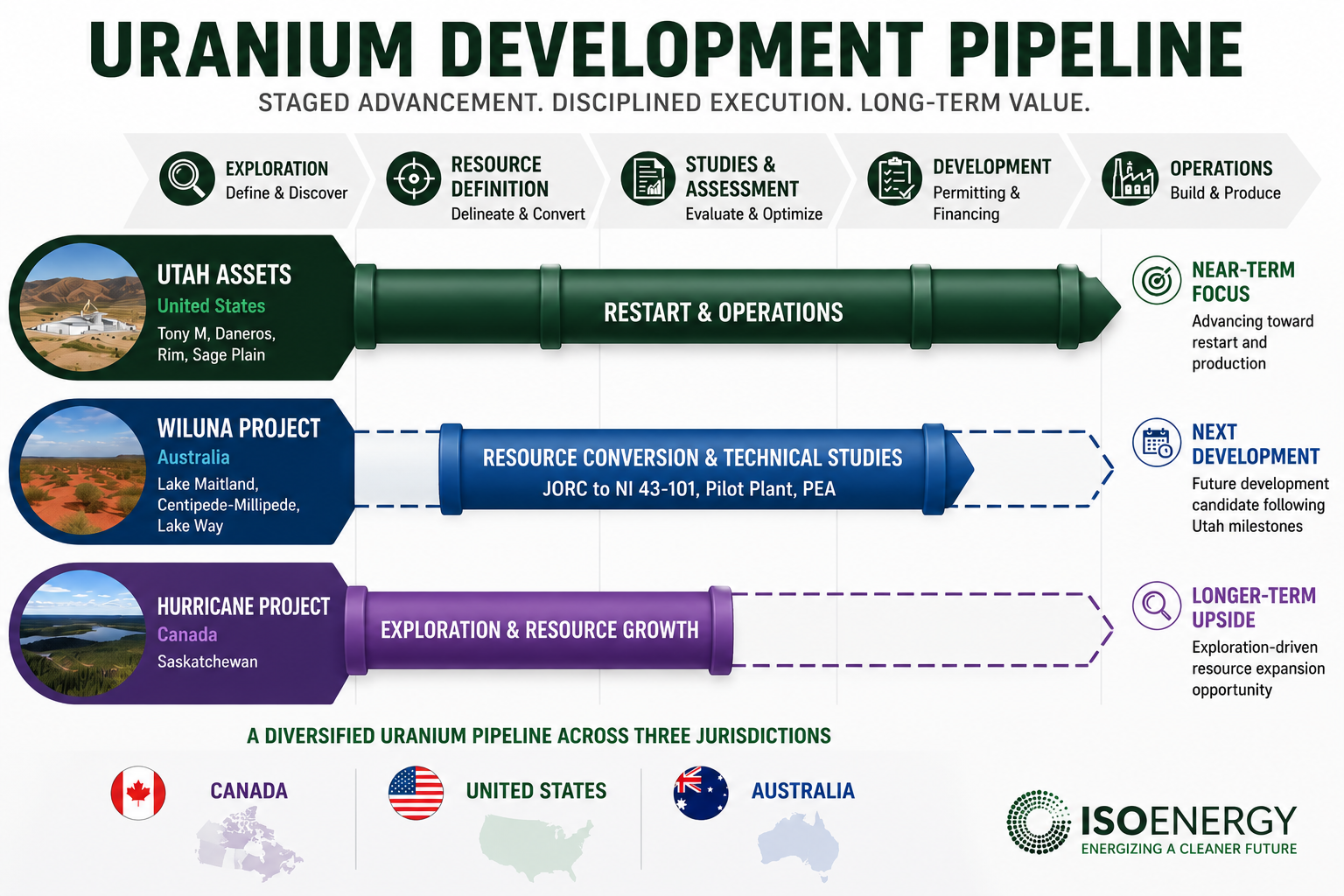
Before the acquisition, IsoEnergy's principal sources of project advancement were exploration at the Hurricane deposit in Saskatchewan and restart activities at its Utah uranium operations. Wiluna introduces a third stream of development work operating on a different timeline. While Utah remains the company's operational priority and Hurricane remains its primary exploration asset, Wiluna becomes the next major development candidate in the portfolio. Because the projects occupy different stages of the development cycle, progress at one asset does not depend on progress at another.
Sequential Development Strategy Reduces Execution Bottlenecks
The acquisition reflects a broader management strategy focused on sequencing project development rather than advancing multiple major assets through identical stages simultaneously. The approach is designed to concentrate technical expertise on the highest-priority project at a given point in time.
Chief Executive Officer of IsoEnergy, Phil Williams, explained how technical resources can be redeployed as priorities evolve:
"That team will be able to not physically move, but the technical team can move their sort of brain power and expertise to, ‘Okay, now we're looking at, we think Australia is going to be the next project, so we're going to go and look at the Australian assets.'"
The strategy is supported by the company's balance sheet. IsoEnergy held C$130.5 million in cash and cash equivalents and approximately C$46.0 million equity portfolio. Those resources support ongoing exploration at Hurricane, advancement activities in Utah and initial integration work at Wiluna. Near-term progress across the portfolio is therefore tied primarily to technical and operational execution rather than immediate financing requirements.
Wiluna Adds Both Funding & Jurisdictional Advantages
The acquisition includes an existing commercial arrangement attached to the Lake Maitland deposit. Japan Australia Uranium Pty Ltd and Itochu retain rights to acquire a 35% interest in Lake Maitland for US$39.6 million. If exercised, the arrangement would contribute project-level funding as Wiluna advances through future development stages.
The project also expands IsoEnergy's exposure to Australia, creating a uranium portfolio that now spans Canada, the United States and Australia. Western Australia ranked 6th globally for investment attractiveness in the Fraser Institute's 2025 Annual Survey of Mining Companies, placing Wiluna within one of the world's highest-ranked mining jurisdictions. Management also views the project in the context of growing cooperation on critical minerals between Australia and the United States.
Discussing that trend, Williams stated:
"What I'm excited about is is a partnership that's forming between Australia and the United States around critical minerals and so I think we could be caught up in that and and it could be the sort of potentially one of the uh one of the sort of carrots that inspires the Australian government to get a little bit more uh bullish and and supportive of uranium mining in the country."
The significance of those developments will ultimately depend on whether future policy initiatives extend to uranium projects and development-stage assets such as Wiluna.
What Comes Next for Wiluna
With the acquisition complete, management's next objective is advancing Wiluna through the technical milestones required to evaluate its development potential. The company is targeting the conversion of the existing Joint Ore Reserves Committee (JORC) resource into National Instrument 43-101 (NI 43-101) compliant disclosure. Completion would establish a common reporting framework across IsoEnergy's Australian and North American asset base.
Additional planned work includes drilling programs associated with pilot plant activities and advancing the existing scoping study toward a Preliminary Economic Assessment (PEA). These milestones will determine how quickly Wiluna progresses from an acquired uranium asset into a development project supported by economic analysis.
Investment Thesis for IsoEnergy
- The acquisition of Toro Energy adds the Wiluna Uranium Project to IsoEnergy's portfolio, extending the company's uranium development pipeline beyond its existing exploration assets in Canada and restart opportunities in the United States.
- Wiluna enters the portfolio as a future development candidate rather than an immediate capital priority, allowing IsoEnergy to expand its project pipeline without materially changing near-term capital allocation priorities.
- Management's sequential development strategy is designed to redeploy technical expertise across projects as they advance, reducing the need to build multiple development teams simultaneously.
- The Lake Maitland deposit includes an agreement allowing Japanese partners to acquire a 35% interest for US$39.6 million, creating a potential source of project-level funding as the asset advances.
- According to the company's May 25, 2026 corporate presentation, IsoEnergy held C$130.5 million in cash and cash equivalents and approximately C$46.0 million in equity holdings, providing funding flexibility across its Canadian, United States and Australian asset base.
The Toro Energy acquisition expands IsoEnergy's future development inventory while preserving its existing operational priorities. Rather than advancing multiple major projects simultaneously, management is targeting a staged development model that moves assets through different phases of the development cycle over time.
TL;DR
IsoEnergy has completed its acquisition of Toro Energy, adding the Wiluna Uranium Project in Western Australia to a portfolio that already includes the Hurricane uranium deposit in Saskatchewan and permitted past-producing uranium mines in Utah. The transaction extends the company's development pipeline into a third jurisdiction while allowing management to maintain its existing focus on Utah restart opportunities and Canadian exploration activities.
FAQs (AI-Generated)
Analyst's Notes





Subscribe to Our Channel








Stay Informed