Energy Fuels Reports Second Quarter of 2026 Results & Advances Western Mine-to-Magnet Platform


Energy Fuels advances its Western mine-to-magnet strategy with $996M in working capital, Utah rare-earth construction, and key 2026 catalysts for investors now.
- Energy Fuels ended the second quarter of 2026 with $996 million in working capital, including $58.4 million in cash, $878.3 million in marketable securities, and $75 million in product inventory.
- Construction of the $104 million Phase 1B expansion began on July 29, 2026, with the goal of achieving commercial-scale separation of terbium and dysprosium by late 2027.
- Energy Fuels produced 865,000 pounds of finished uranium oxide in the second quarter at a weighted-average cost of $23 per pound.
- Australian Strategic Materials (ASM) and Vacuumschmelze (VAC) transactions would extend the platform into metals, alloys, and permanent magnet manufacturing, with VAC's Sumter facility currently capable of producing 2,000 tonnes per annum.
- Investors are watching the ASM and VAC transactions, the Donald Project Final Investment Decision (FID), White Mesa construction and commissioning, and the potential Phase 2 expansion.
What Has Happened
Energy Fuels Inc. (NYSE American: UUUU | TSX: EFR) reported its second-quarter 2026 results on August 5, 2026, with a net loss of $34 million driven primarily by transaction costs and $996 million in working capital. Construction of the $104 million Phase 1B heavy rare earth element separation expansion at the White Mesa Mill began on July 29, 2026, with the goal of achieving commercial-scale separation of terbium and dysprosium oxides by late 2027. The expansion makes White Mesa a central processing link in Energy Fuels' planned mine-to-magnet strategy, alongside proposed downstream acquisitions extending into metals, alloys, and permanent magnet manufacturing.
The company's natural uranium business remains the financial foundation, producing 865,000 pounds of finished uranium oxide in the second quarter at a weighted-average cost of $23 per pound, of which 310,000 pounds were sold. The broader transition is supported by a conditional $725 million loan commitment from the US government's Office of Strategic Capital (OSC), as well as the proposed acquisitions of Australian Strategic Materials (ASM) and Vacuumschmelze (VAC). The investment significance is that Energy Fuels is using its existing uranium platform and liquidity to build an integrated critical-materials supply chain rather than simply adding another rare-earth processing operation.
Building the Western Mine-to-Magnet Platform
Energy Fuels' Phase 1B expansion is focused on adding commercial-scale heavy rare earth separation to White Mesa's existing capabilities. Terbium and dysprosium are particularly important because they improve the high-temperature performance of permanent magnets. While light rare earth elements such as neodymium and praseodymium provide magnetic strength, terbium and dysprosium increase coercivity and help prevent demagnetisation under extreme temperatures. These properties make them important inputs for electric motors, industrial robotics, wind turbines, and defence systems.
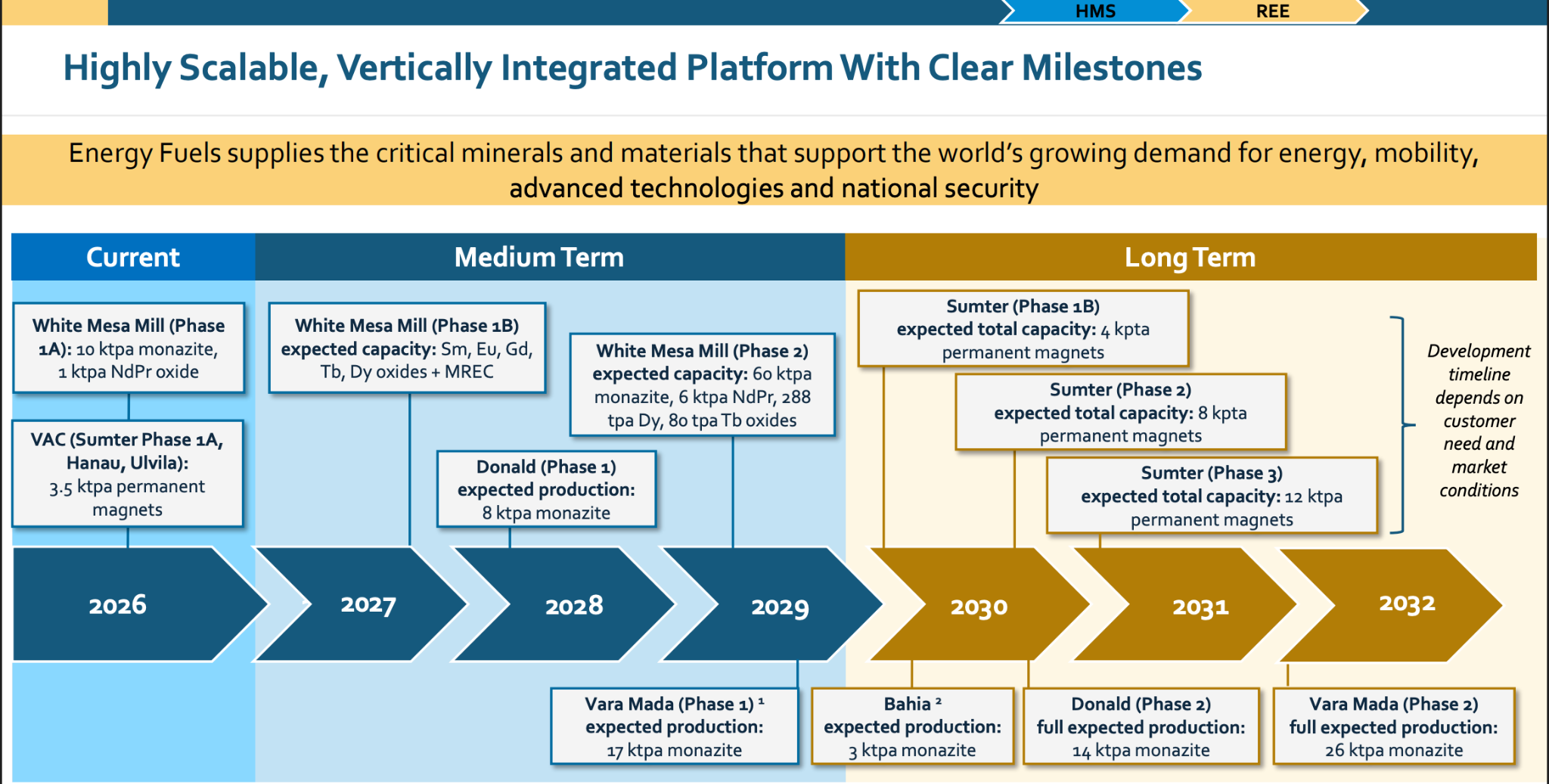
The Phase 1B project is designed to produce approximately 20 tonnes of terbium oxide and 120 tonnes of dysprosium oxide annually. The terbium and dysprosium separation circuits are targeted for completion and commissioning by the end of 2027, while additional circuits for samarium, europium, and gadolinium are targeted for completion by the end of 2028.
The technical foundation is a new mixed rare earth carbonate (MREC) circuit. Historically, rare earth and uranium processing could require separate facilities or alternating campaigns due to distinct chemical and operational requirements. The new circuit is designed to enable White Mesa to process diverse carbonate-rich feedstocks while simultaneously producing separated rare-earth oxides and natural uranium concentrate at commercial scale. This matters because the strategy is not simply to add another processing stream to White Mesa. The MREC circuit is intended to improve plant utilisation, spread fixed facility costs across multiple critical material streams, and allow the mill to maintain its position as a major US producer of natural uranium while adding rare earth processing capabilities.
Energy Fuels' President and Chief Executive Officer Ross Bhappu described the VAC transaction as “a transformational acquisition” that gives the company the ability to “go from the mine all the way to the magnet.”
Securing Feedstock & Downstream Value
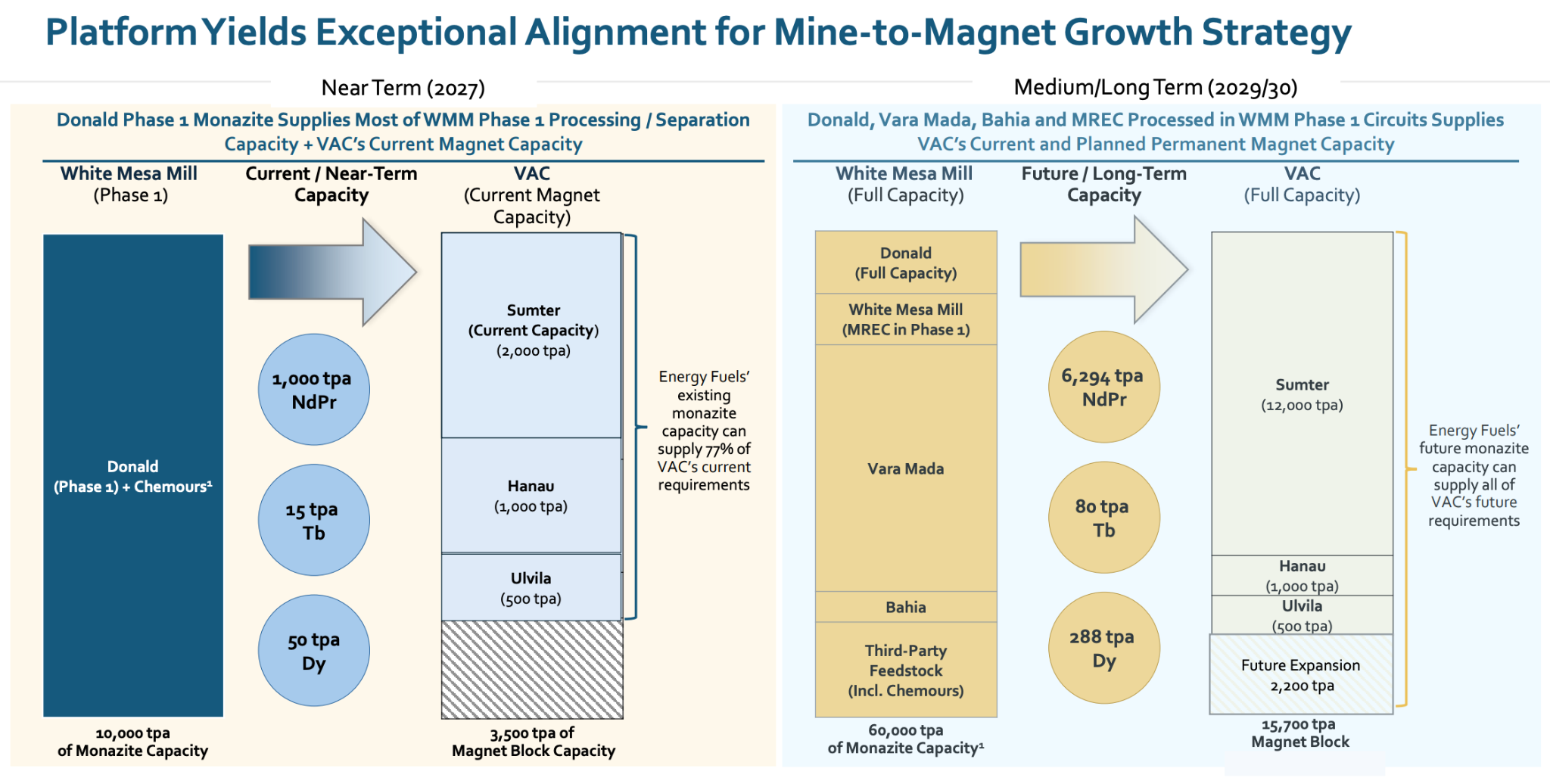
The mine-to-magnet strategy depends on securing both upstream feedstock and downstream manufacturing capacity to convert separated materials into finished products. Energy Fuels holds a 12.7% joint venture interest in the Donald Project mineral sands project in Victoria, Australia, with an option to increase its ownership to 49%. The company has secured a 100% offtake agreement for monazite concentrate from the project. Donald is targeted to supply 8,500 to 9,500 tonnes of monazite annually beginning in 2028, subject to a Final Investment Decision (FID) in the third quarter of 2026.
Energy Fuels is also developing the 100%-owned Vara Mada Project in Madagascar and the 100%-owned Bahia Project in Brazil to diversify potential future feedstock sources. Monazite is a phosphate mineral rich in valuable heavy rare earth elements and is produced as a byproduct of titanium and zirconium mineral sands extraction. At the downstream end, Energy Fuels has entered into a definitive agreement to acquire 100% of VAC for a transaction equity value of $1.9 billion. VAC's permanent magnet manufacturing facility in Sumter, South Carolina, currently has a capacity of 2,000 tonnes per annum and is designed to scale to 12,000 tonnes per annum.
The planned Utah oxide production is expected to supply roughly 70% of the feedstock required for ASM's South Korean metal-and-alloy plant. Those alloys are then planned to meet 100% of VAC's internal requirements. This would connect Energy Fuels' upstream feedstock and Utah separation operations with metals, alloys, and permanent magnet manufacturing further downstream. Energy Fuels is attempting to capture value across multiple stages of the supply chain, reducing its reliance on selling intermediate products and positioning White Mesa as the midstream link within the proposed mine-to-magnet platform.
Balance Sheet Strength & Execution Risks
Energy Fuels is pursuing this strategy from a position of strong liquidity. As of June 30, 2026, the company held $996 million in working capital, consisting of $58.4 million in cash and cash equivalents, $878.3 million in marketable securities, and $75 million in product inventory. The company has also received a conditional $725 million loan commitment from the US government's OSC. The 20-year facility is intended to support expansions at White Mesa and downstream metals plants, providing an additional source of non-dilutive capital for the planned growth platform.
The uranium business provides another layer of financial support. Energy Fuels produced 865,000 pounds of finished uranium oxide during the second quarter at a weighted-average cost of $23 per pound. This low-cost production base remains an important cash-generating component of the company's existing business, funding its expansion into critical materials. However, a strong balance sheet does not eliminate execution risk.
The proposed acquisitions of ASM and VAC remain subject to regulatory, court, and shareholder approvals. Delays or failure to close either transaction could disrupt the planned downstream processing flow and leave Energy Fuels more dependent on third-party metallization capacity. Feedstock security also remains dependent on the Donald Project. Its FID is expected in the third quarter of 2026 and depends on successfully negotiating an A$220 million project debt facility with Export Finance Australia and other lenders. In addition, the construction of complex metallurgical separation circuits poses a risk of capital overruns and commissioning delays.
What to Watch Next
Near-term catalysts are closely tied to execution, with the proposed ASM acquisition targeted to close by the end of August 2026, followed by regulatory and shareholder approvals for VAC. The Donald Project's FID in the third quarter of 2026 is another key milestone, supporting the planned monazite feedstock pipeline for White Mesa and linked to an A$220 million project debt facility. Investors should then track the construction and commissioning of the Phase 1B heavy rare earth circuits, with terbium and dysprosium separation targeted for the fourth quarter of 2027, and samarium, europium, and gadolinium circuits planned for completion in late 2028.
In the longer term, the potential Phase 2 expansion could increase Utah's mill processing capacity to 60,000 tonnes of monazite per annum and VAC's permanent magnet capacity to 12,000 tonnes per annum. The key investment question is whether Energy Fuels can bring the interconnected White Mesa, Donald, ASM, and VAC components together on schedule and at the planned scale. Its substantial liquidity, uranium cash generation, and conditional government-backed financing provide the financial foundation, but successful execution across acquisitions, feedstock, construction, and commissioning will determine whether the mine-to-magnet strategy translates into the planned platform.
FAQs (AI-Generated)
Analyst's Notes





Subscribe to Our Channel







Stay Informed