IsoEnergy & Toro Energy: Why Wiluna's Addition Changes The Financing Equation For Uranium Development


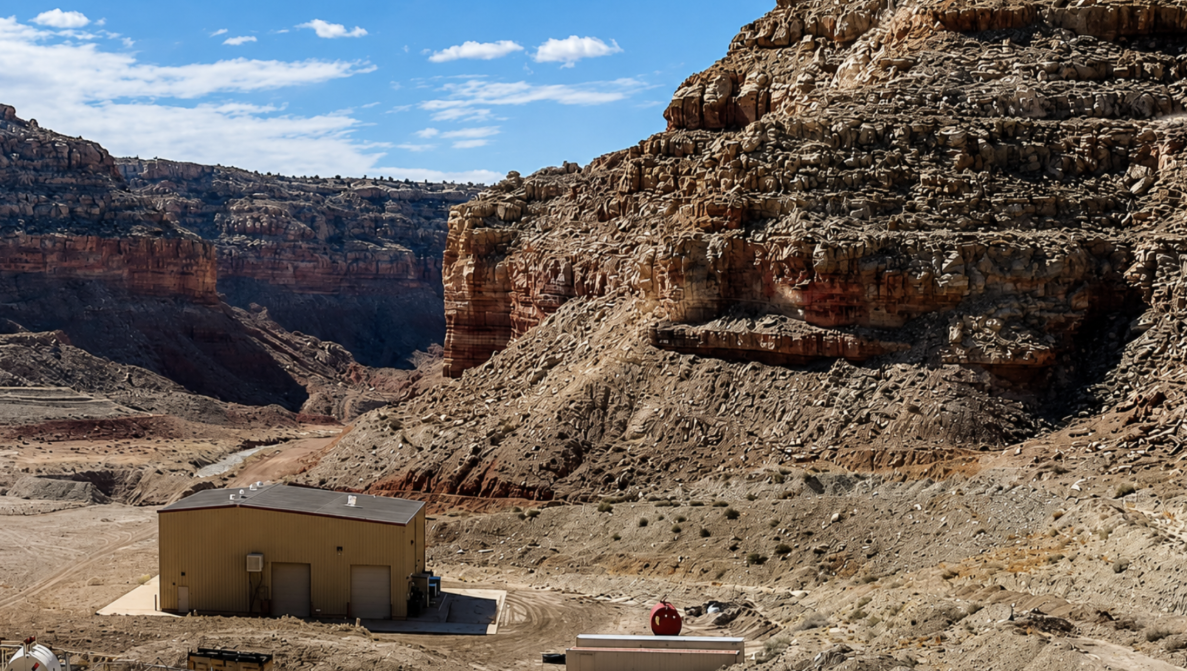
IsoEnergy's Toro Energy acquisition adds the Wiluna Uranium Project, expanding its uranium portfolio and advancing a multi-asset de-risking strategy.
- IsoEnergy completed the acquisition of Toro Energy Limited, adding the Wiluna Uranium Project in Western Australia and approximately 75 million pounds of uranium resources to its portfolio.
- Wiluna contains approximately 69.1 million pounds of measured and indicated uranium resources and 4.5 million pounds of inferred uranium resources, while IsoEnergy's approximately C$132 million cash position provides greater financial capacity to advance the project.
- At Tony M, beneficiation testing from a 2,000-tonne bulk sample programme removed 75% of the mined material while retaining more than 90% of the contained uranium, with the results feeding into an updated Preliminary Economic Assessment (PEA).
- Management is advancing the Joint Ore Reserves Committee (JORC) to National Instrument 43-101 (NI 43-101) resource conversion, additional drilling and updated economic studies at Wiluna before evaluating larger development decisions.
- IsoEnergy is allocating capital according to project maturity, with Tony M focused on economic validation, Wiluna on technical studies and resource conversion, and Hurricane on exploration and resource growth.
What Has Happened
IsoEnergy Ltd. (TSX: ISO | NYSE American: ISOU) has completed its acquisition of Toro Energy Limited, adding the Wiluna Uranium Project in Western Australia to a portfolio that already includes the Tony M uranium mine in Utah and the Hurricane uranium deposit in Saskatchewan. The acquisition adds approximately 75 million pounds of uranium resources and expands the company's development pipeline across three established uranium jurisdictions.
Financial De-Risking Through Portfolio Scale
Wiluna was already one of Australia's larger undeveloped uranium projects before the acquisition, containing approximately 69.1 million pounds of measured and indicated uranium resources and 4.5 million pounds of inferred uranium resources across the Lake Way, Lake Maitland and Centipede-Millipede deposits. The project had secured state and federal approvals and benefited from near-surface mineralisation, but its development pathway remained constrained by the financing requirements of a large-scale project under a single-asset company.
Chief Executive Officer of IsoEnergy, Phil Williams, discussed the rationale for the acquisition:
"I think the first thing the investors didn't see is that they couldn't see a credible path for a single asset small company that Toro was. I give the management of Toro all the credit in the world for keeping it together and advancing it the way they were, but the market just couldn't reconcile that they would be able to move the project ahead. It's a 300 million capex, which is very manageable for a company of our side, but a stretch for a company, a microcap uranium company."
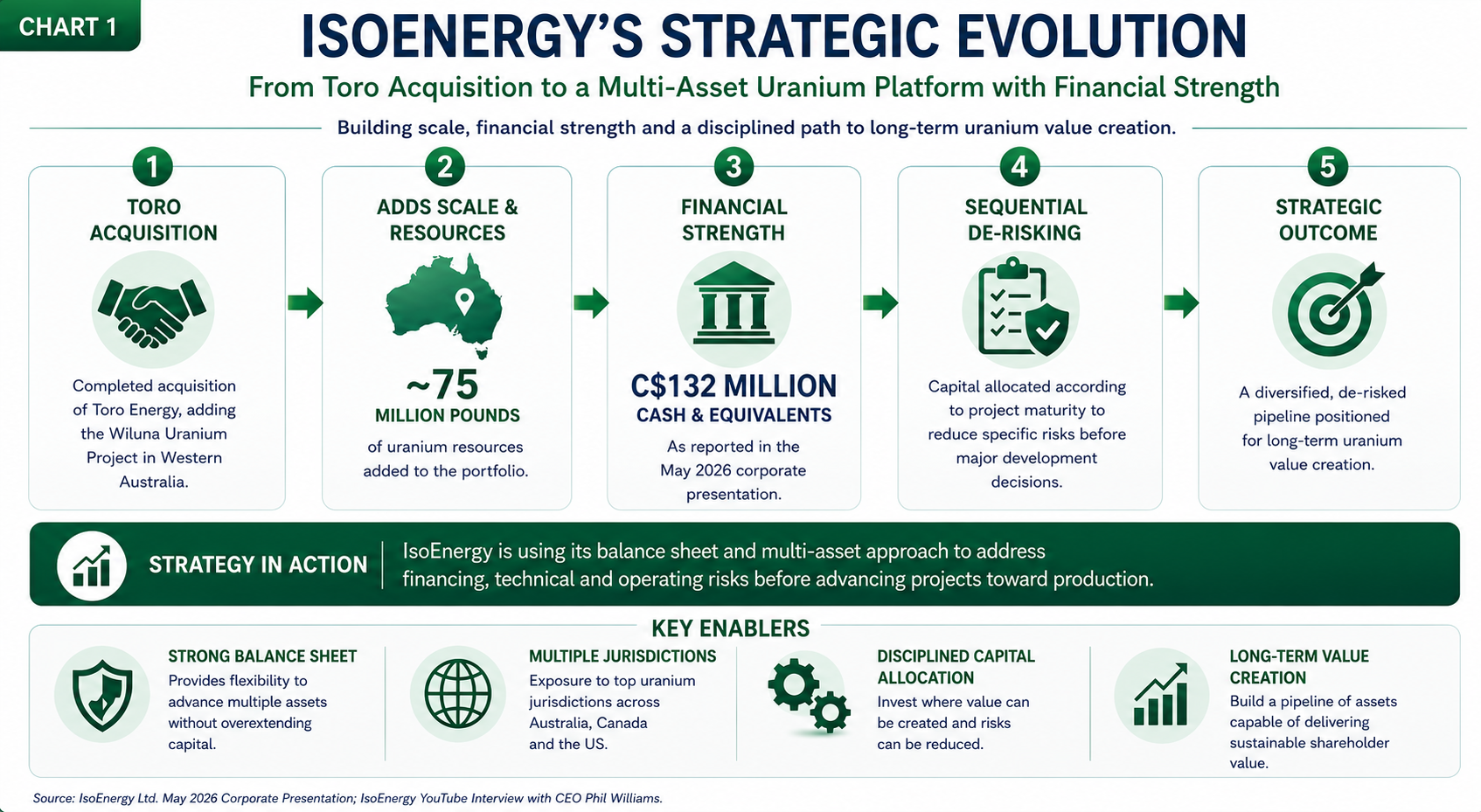
The acquisition places Wiluna within a company that reported approximately C$132 million in cash and equivalents and operates multiple uranium assets at different stages of development. The immediate focus is not construction but on advancing technical work, including converting Joint Ore Reserves Committee (JORC) resources to National Instrument 43-101 (NI 43-101) compliance, additional drilling, and upgrading the existing scoping study to a PEA. These programmes are intended to establish an updated technical and economic baseline before larger capital allocation decisions are considered.
Technical De-Risking At Tony M
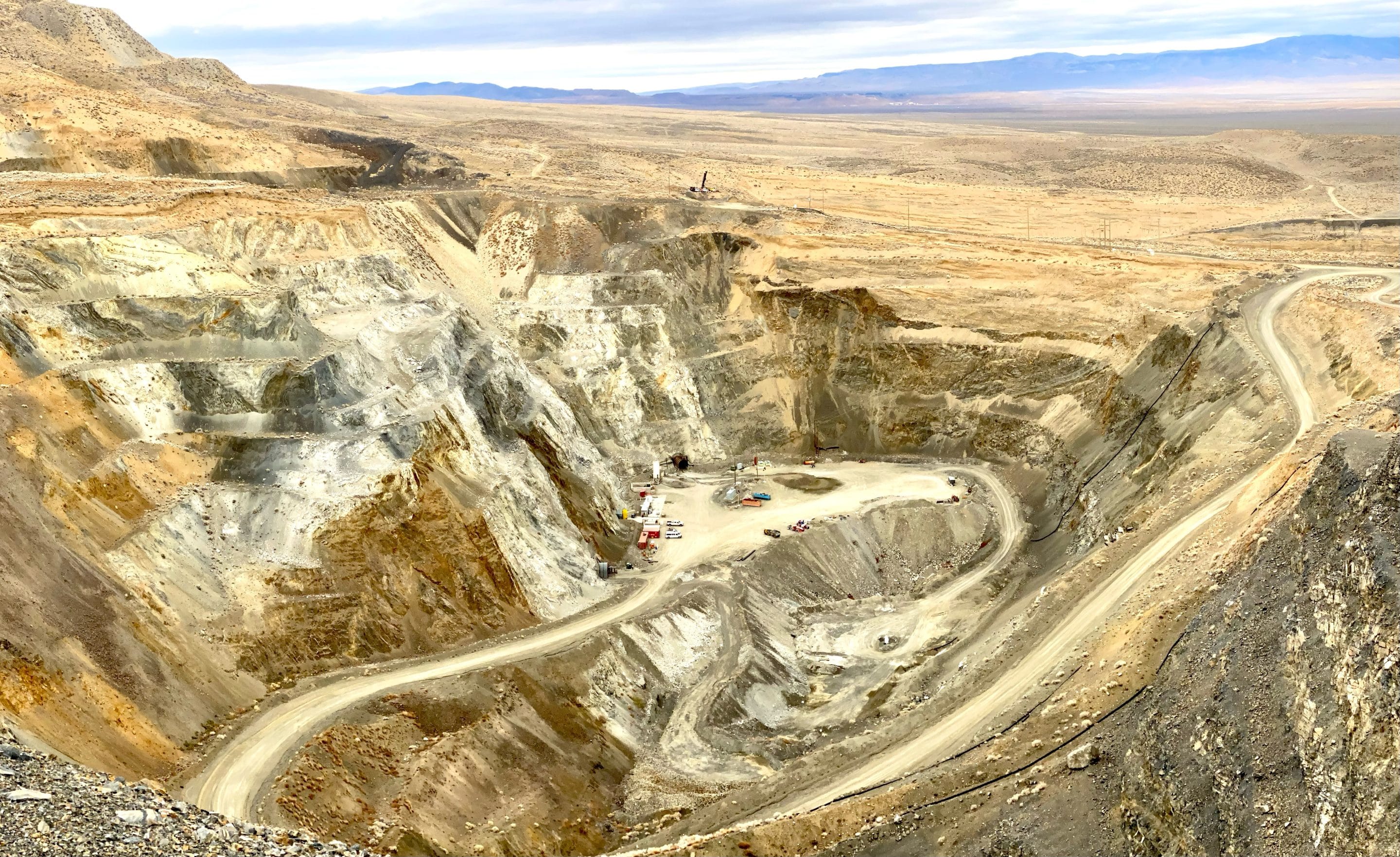
Tony M is currently IsoEnergy's most advanced potential production asset, with existing permits, infrastructure and toll milling access already in place. Rather than relying on those advantages alone, the company is using a 2,000-tonne bulk sample programme to generate operating data for an updated PEA. The work is focused on beneficiation testing, which evaluates whether waste material can be removed before transportation and milling to improve project economics.
Williams described the outcome of the initial test work:
"This beneficiation technology was able to remove 75% of the volume and keep over 90% of the uranium."
The result has direct implications for haulage, handling, and milling costs because it reduces the volume of material transported while retaining most of the uranium it contains. The bulk sample programme is intended to determine whether these results can be replicated under conditions that more closely resemble commercial operations, providing a stronger basis for restart economics and capital allocation decisions.
Williams explained the company's position:
"Rushing to fail, I don't think, is the answer. I think patience is a great answer, which is why we're not rushing to turn Tony M on. We're permitted, we have a toll milling agreement, we have the infrastructure there, we can move it, put it into production very quickly, but we want to maximise the value of that asset and make as much as we can per pound."
A restart decision determines not only production timing but also the commercial terms attached to future uranium sales. By completing technical studies before committing to production, IsoEnergy is preserving flexibility around both operating assumptions and future contracting arrangements while reducing execution risk.
Sequencing Changes Capital Allocation
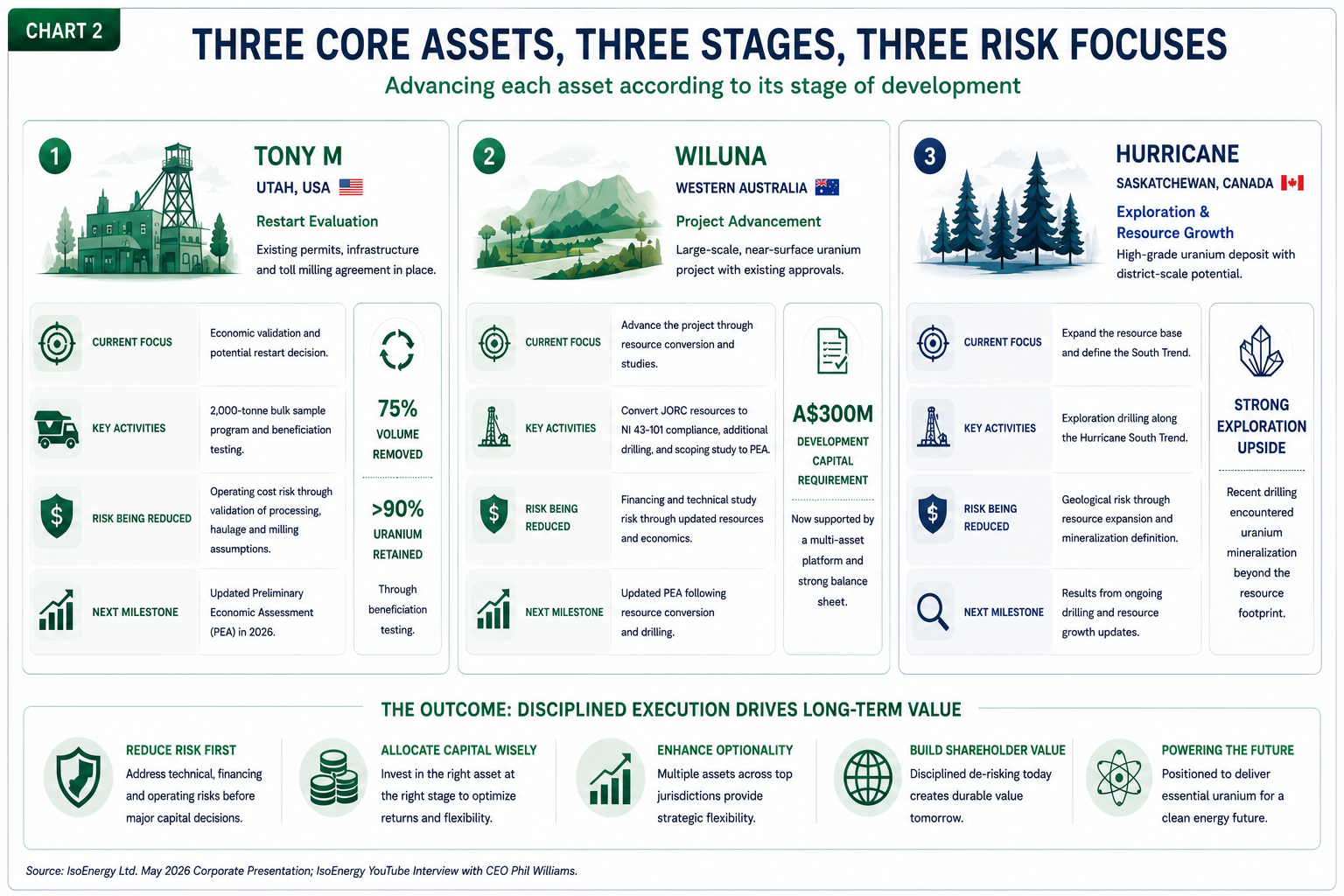
Managing a multi-asset portfolio allows IsoEnergy to allocate capital according to project maturity rather than advancing every asset through the same development stage simultaneously. Tony M is currently focused on economic validation and a potential restart decision, Wiluna is progressing through resource conversion and economic studies, and Hurricane remains an exploration and resource-growth asset. Each project, therefore, has a different technical objective, risk profile and capital requirement.
The result is a development strategy that spreads capital commitments across multiple years rather than concentrating them into a single construction cycle. Financing has become a key challenge for many uranium developers as projects advance toward development, and IsoEnergy's approach is to address technical, financing and execution risks before larger capital decisions are required. By advancing studies, resource work and exploration in parallel, management is attempting to remove potential constraints before they affect project advancement.
What To Watch Next
The next key milestones span all three of IsoEnergy's core assets. At Tony M, the updated PEA targeted for 2026 will test whether beneficiation results from the 2,000-tonne bulk sample programme improve operating cost assumptions and project economics. At Wiluna, investors will be monitoring NI 43-101 resource conversion, additional drilling and updated economic studies as the project is integrated into the portfolio. Meanwhile, exploration at Hurricane remains focused on the Hurricane South Trend, where recent drilling has encountered uranium mineralisation beyond the current resource footprint, with future results expected to clarify the potential for additional resource growth.
FAQs (AI-Generated)
Analyst's Notes





Subscribe to Our Channel




Stay Informed