




Made in America Article Series 3/5: The Great Basin Mined for 160 Years, Still Ranks First for Investment



Nevada ranks #1 globally for mining investment after 160 years, as new technology access deposits earlier operators missed.
- Nevada's mining history spans more than 160 years, and the state still ranked first globally on the Fraser Institute's 2025 Investment Attractiveness Index even after its exploration budget saw the largest single-jurisdiction dollar decline S&P Global tracked anywhere in the world.
- That longevity traces to a specific mechanism: Basin and Range extension has repeatedly reactivated the same deep fault systems over tens of millions of years, so districts identified a century ago often still hold undiscovered ore nearby.
- Companies in this series are converting that history into new discoveries through structural targeting beneath covered ground, deeper drilling into higher-grade sulfide zones, and modeling and geochemical techniques that reinterpret historic data at a resolution earlier operators lacked.
- The resulting investment case rests on lower geological uncertainty, infrastructure and data inherited from prior operators, and technology that extends the productive life of century-old districts.
The Great Basin's Century and a Half of Mining History Still Outranks Every Rival Jurisdiction
The Great Basin is a roughly 200,000-square-mile province spanning most of Nevada along with parts of Utah, California, Oregon, and Idaho, with Nevada at its geographic and mineral-producing core and where this series' companies operate. Nevada's mining history began with the 1859 Comstock Lode silver strike and continued with the 1962 discovery of gold, a find that opened the Carlin Trend and made Nevada the country's second-largest gold producer by 1965. Nevada remained the world's top-ranked jurisdiction on the Fraser Institute's 2025 Investment Attractiveness Index, even as its exploration budget saw the largest single-jurisdiction dollar decline in 2025.
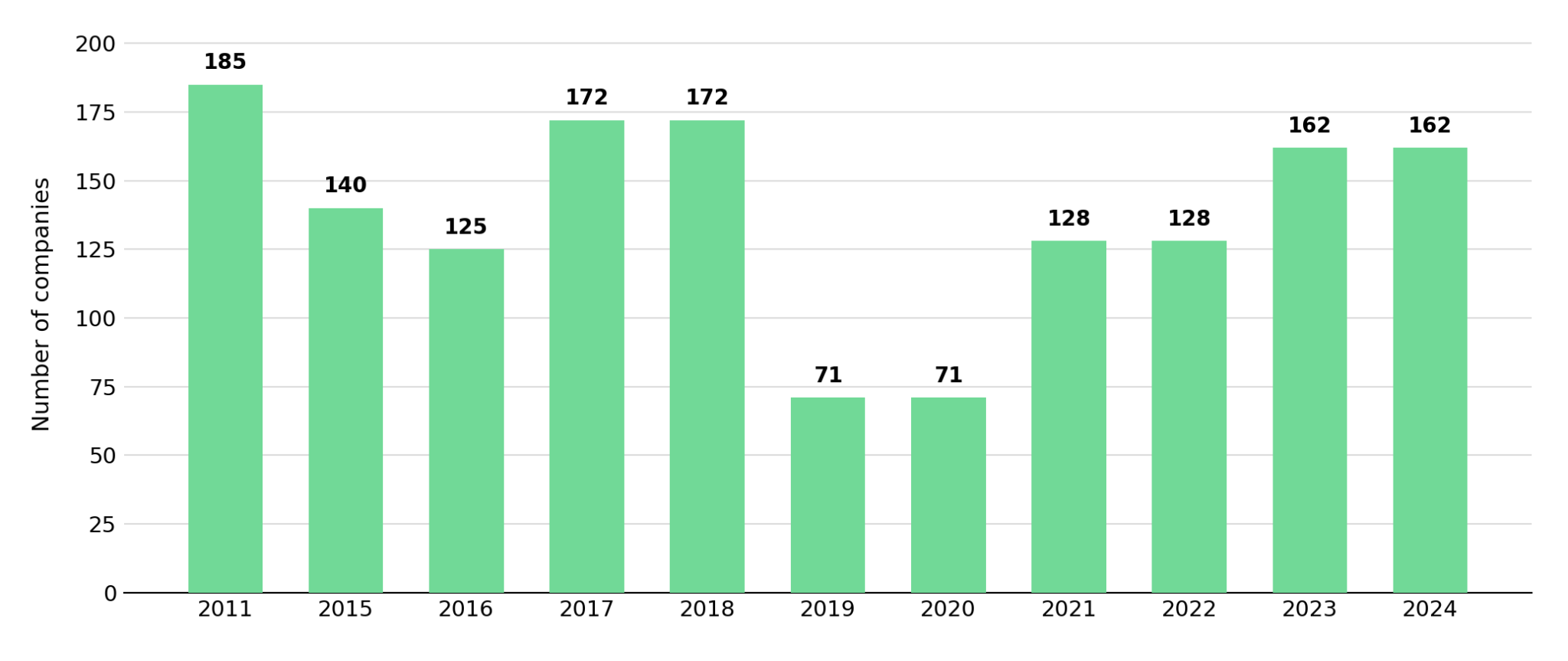
That single-year decline sits inside a longer pattern of expansion and contraction. The number of companies actively exploring in Nevada peaked at 185 in 2011, fell to a low of 71 during the 2019–2020 downturn, and has since climbed back to 162 by 2023–2024.
That longevity traces back to tectonic processes that have repeatedly reactivated the same fault systems over tens of millions of years, so districts identified a century ago often still hold undiscovered ore nearby.
Against a 2025 average gold price of $3,300 an ounce, the same historic dataset Winters describes becomes substantially more valuable than when it was generated. Ken McNaughton, Chief Exploration Officer of P2 Gold, describes a related pattern at Gabbs, where earlier operators lacked the technology to make a joint gold-copper deposit viable:
"With the advent of SART technology we're able to extract both the gold and the copper and produce a very viable mine... Back with the old-timers in the late 1800s, and in modern history in the '80s and '90s, a number of companies came through, and because they didn't have this SART technology, they were focused on either the gold or the copper, and it didn't really work as separate deposits."
From Past-Producing Assets to Present-Day Cash Flow
A mine that has already produced ore carries less risk and a shorter runway to revenue than a new discovery, because the two hardest problems in mining - proving the deposit is real and building the infrastructure to access it - are already solved.
Integra Resources acquired Florida Canyon, a mine with 35 years of production history and more than 3 million ounces of gold already recovered, specifically to generate immediate cash flow without diluting shareholders through equity raises. That cash flow is now being reinvested to extend the mine life from the five years of reserves it purchased toward eight or more years by testing historical low-grade stockpiles and unmined laybacks that prior operators left behind.
Past operators at Hycroft Mining left an entire high-grade zone unaddressed, with a resource base exceeding 16 million ounces of gold and 500 million ounces of silver, defined in part by methods that weren't suited to the higher-grade silver at depth. The company is now redirecting capital toward those deeper high-grade targets to capture project economics the prior operation's methods couldn't access.
The Geological Story Behind the Great Basin
Nevada's mineral endowment is the product of a tectonic process known as Basin and Range extension, in which the Earth's crust stretched and thinned across what is now Nevada and neighboring states, fracturing into the alternating mountain ranges and valleys that give the region its name.
Those fractures created deep fault networks that became pathways for hydrothermal fluids, hot, mineral-bearing groundwater, to rise toward the surface. Where those fluids cooled or reacted with surrounding rock, they deposited gold, silver, and associated metals in economically significant concentrations. Joy Lester, Project Manager and Geologist at P2 Gold, describes how extensional history shaped the Gabbs deposit:
"During the geologic destruction of western Nevada, and the tectonic events, the crust was stretched apart and that deposit rolled onto its side. They are mining it from the side down, so we have a complete cross-section of the deposit."
Why Structural Controls Matter
Ore deposition tends to concentrate where multiple faults intersect, since intersecting structures create the highest-permeability pathways for hydrothermal fluids. Teddy Berg, a geologist with Scorpio Gold, describes how the Manhattan district sits within a specific structural corridor:
"We are kind of on the edge of the Walker Lane, so we've got a lot of those same characteristics you might see in those sort of deposits… We have some strike-slip action going on, and we're also clearly in Nevada, so we have the Basin and Range influence as well."
Why Nevada Is Still Producing Discoveries
A significant portion of Nevada's prospective geology sits beneath younger sediment or volcanic cover, meaning mineralized structures exist that earlier prospectors had no way to detect. Dr. John Decker, Vice President of Exploration at Blossom Gold, explains how the company applies strategies identified at Rosebud to target drilling elsewhere in the district:
"We are in the same volcanic rock package, and there are series of parallel structures, the Oscar Fault being one, that trend northwest and are parallel to some of the cross structures we see over at Rosebud. That's really what we're looking for: the same sets of structures and similar orientations to Rosebud as well as Hycroft, and looking for intersections between those structures."
Gregory Crowe, President & CEO of Silver One Resources, describes a third driver at Candelaria, deeper drilling revealing higher grades than historic oxide-focused mining ever accessed:
"The mineralization changes at depth as well, and what we're seeing as we go from oxide at the surface to mixed oxide-sulfide, and eventually solid sulfide, grades are increasing as we go to depth. The average grade is 90 to 110 grams at Northern Bell, whereas as we get down you're looking at between two and three hundred grams."
Silver One's historic open pits reached only 200 to 250 meters, but the company's down-dip drilling now extends to 1,000 meters, with silver grades increasing from 90–110 grams per tonne near-surface to 200–300+ grams per tonne in deeper zones. The company aims to produce 5 to 6 million ounces of silver annually, a scale that could position Candelaria among the largest silver producers in the United States.
Exploration Has Changed More Than Geology
Three-dimensional modeling software now lets geologists integrate drilling, geophysical, and structural data into a single interpretive model. Dr. John Decker describes how Blossom Gold layered two geophysical datasets to identify structures beneath surface cover at Rosebud:
"We flew an aeromagnetic survey as well as a surface-based gravity survey, so we were able to identify several structures that have been mapped as extending from high country here, and several of these magnetic anomalies line up with that interpretation… We've got a 12,000-foot program planned for later this year and that's really where the geophysical survey comes into play."
For a district with as much historical data as the Great Basin, this shift disproportionately benefits companies working on brownfield sites, since these tools scale with the volume of existing data available for reinterpretation.
The Investment Thesis for the Great Basin
- Mature districts reduce geological uncertainty because prior operators have already established that economically significant mineralization exists.
- Historic datasets improve exploration efficiency because companies can prioritize drill targets using decades of existing information rather than funding discovery from a standing start.
- Existing infrastructure lowers development costs because roads, power, and water rights inherited or purchased from prior operators reduce the capital a company must raise separately.
- Modern technology extends the productive life of historic districts because three-dimensional modeling and geochemistry allow companies to identify mineralization earlier than methods could detect.
- Discovery quality increasingly matters more than discovery quantity because contracting exploration budgets reward companies that convert existing data into defined ounces on shorter timelines.
Geology Creates Opportunity, People Build Mines
Nevada's tectonic history explains why mineralization exists in the concentrations it does, and the exploration data explains why capital rewards companies operating in districts like it. Neither factor alone converts a deposit into a mine; execution, permitting, financing, and construction determine whether that potential is realized. Every mechanism, from drilling and modeling to interpreting geologic data, still depends on a technical team capable of executing it and a management team capable of financing and building around it.
Part 4 of this series, "The Next Wave," shifts from the geological setting to the management teams and operational strategies that convert data into production.
TL;DR
The Great Basin's mining districts keep producing new discoveries because the region's deep fault systems have been reactivated repeatedly over millions of years, leaving undiscovered ore even in ground mined for 160 years. That gives companies operating there a structural edge over greenfield explorers: inherited infrastructure, decades of historical data to prioritize drill targets against, and modern 3D modeling and geochemical tools that can locate mineralization earlier than operators physically could. The result is lower geological risk and a faster path from historical data to defined ounces, a case strong enough that Nevada still ranked first globally on the Fraser Institute's 2025 Investment Attractiveness Index despite a sharp decline in exploration budgets.
FAQs (AI-Generated)
Analyst's Notes





Subscribe to Our Channel








Stay Informed






















