Undervalued? West Wits Mining: Bank-Backed, Pouring Gold, Priced Below Peers


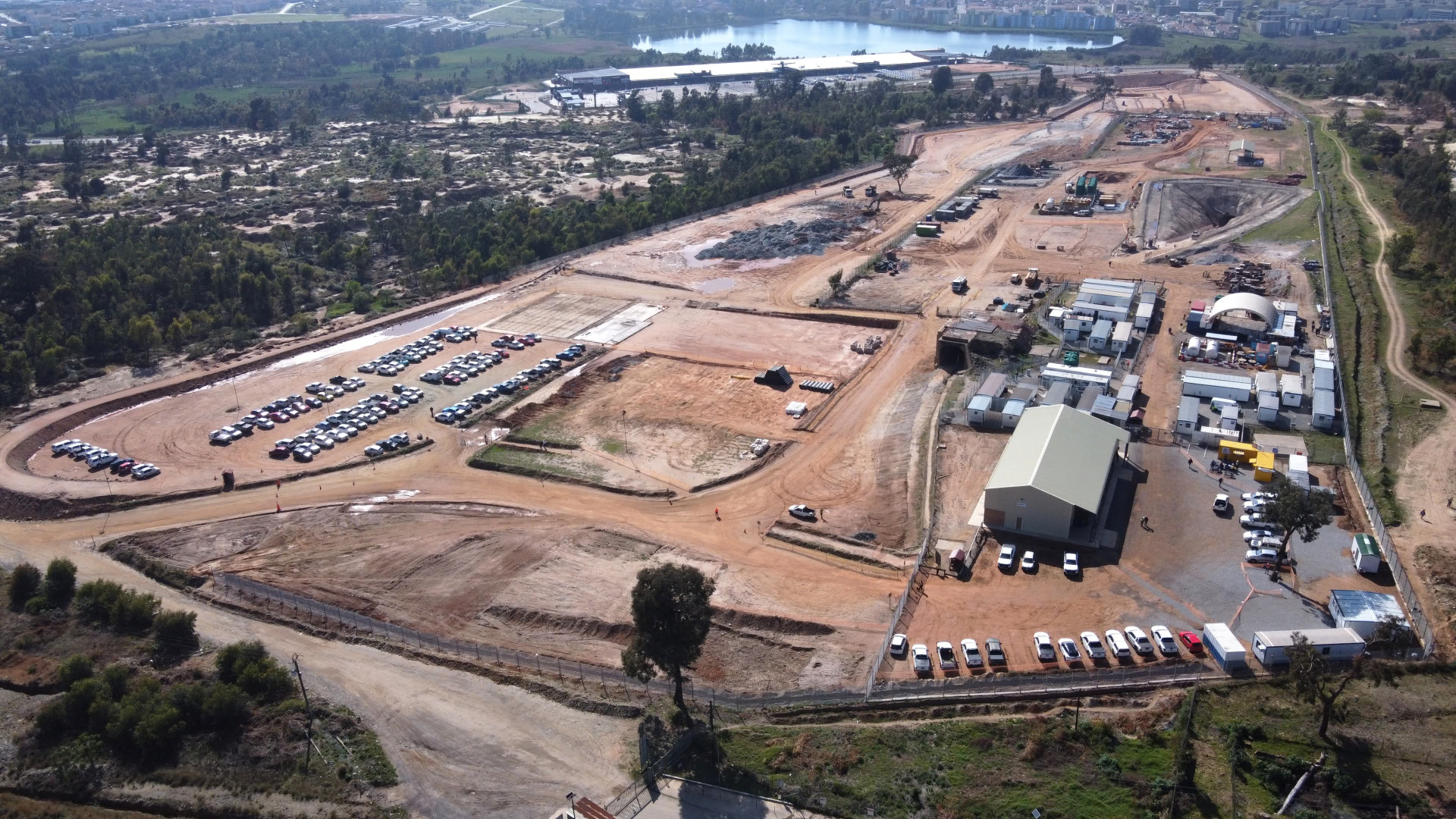
West Wits Mining (ASX:WWI) is pouring gold at Qala Shallows and is funded to 70,000oz p.a., yet trades near A$21/oz in the ground versus A$44-118 for peers.
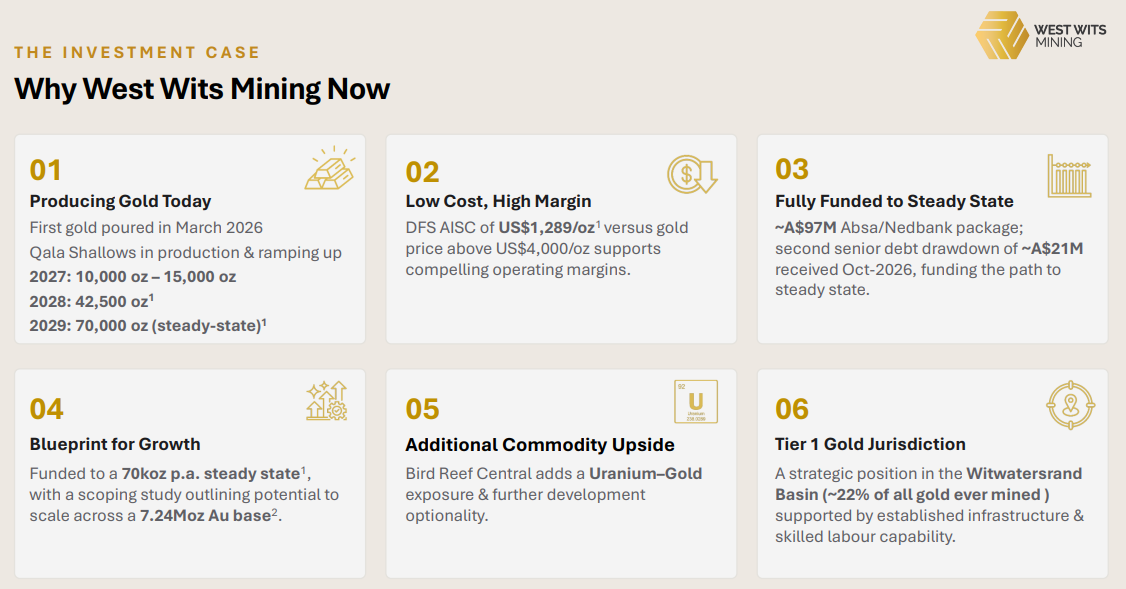
- West Wits Mining poured first gold at Qala Shallows in March 2026 and is ramping towards 70,000 ounces per annum by the first quarter of 2029.
- CEO Rudi Deysel puts the company's enterprise value at around A$21 per resource ounce, against an ASX peer range of A$44 to A$118.
- An A$97 million Absa and Nedbank package funds the mine to steady state, with two drawdowns totalling about A$50 million already independently tested.
- DFS AISC of US$1,289/oz against gold near US$4,100/oz implies roughly US$200 million of annual margin at steady state before corporate costs, finance and tax.
- About 6.2 million ounces of the 7.24-million-ounce resource sit outside the current mine plan, with the Project 200 study examining 200,000 ounces per annum.
Rudi Deysel, CEO and Managing Director of West Wits Mining (ASX:WWI), argues that the market has yet to price in how far his company has come. West Wits poured first gold at its Qala Shallows Project on Johannesburg's Witwatersrand Goldfield in March 2026. It is now ramping towards a steady state of 70,000 ounces per annum. Speaking with Crux Investor, Deysel contends that investors are paying a fraction of what ASX peers command per resource ounce for a producer that is funded, permitted and already mining.
A Producer Priced Like a Developer
Deysel describes Qala Shallows as the first new gold mine in South Africa in 15 years. The operation poured first gold in March 2026, months after the company made the transition from developer to producer with its first ore. Underground development is now accelerating. Monthly advance rose from 73 metres in July 2026 to 183 metres in August and a record 200 metres in September. Surface infrastructure stands at 61% complete.
Deysel stresses that the cost base is not theoretical. He told Crux Investor that all-in sustaining costs (AISC) below US$1,300 per ounce reflect executed contracts, with the project almost a year into development. The updated Definitive Feasibility Study (DFS) puts life-of-mine AISC at US$1,289/oz, falling to US$1,181/oz at steady state.
Processing runs through toll treatment rather than an owned plant. Ore is treated at Sibanye-Stillwater's Ezulwini plant. This removes plant construction and commissioning risk from the development budget.
Why the Market May Be Mispricing West Wits
Valuation sits at the centre of Deysel's argument. West Wits has a market capitalisation of about A$165 million on 435 million shares, based on an A$0.38 share price on 7 October 2026. It held A$36 million in cash on the same date. The company holds a JORC (Joint Ore Reserves Committee) Mineral Resource of 7.24 million ounces at 4.0 g/t gold. On that base, Deysel puts the enterprise value (EV) at around A$21 per resource ounce at the latest share prices. The company's October presentation cites A$25/oz, calculated on the 7 October share price.
Deysel compared West Wits with a group of ASX-listed gold companies with assets in Australia, Mali and South Africa. He said that group trades at between A$44 and A$118 per ounce. By his comparison, one Mali-focused peer is valued at roughly six times West Wits on this measure. He added that several peers, including top-tier assets in Western Australia and South Australia, remain far from production.
When asked whether African projects are discounted until cash starts to flow, Deysel accepted that a jurisdictional discount may exist. He argues that West Wits now sits at the point on the Lassonde Curve where speculative investors tend to leave and institutional capital starts to arrive. He also attributed much of the share price decline of recent years to external factors rather than the asset.
"I think the market didn't catch up yet with the story. It's a valuation gap and not a value gap. So the ounces, the funding, production are already there."
Funding Under Independent Scrutiny
While many chief executives describe their projects as fully funded, Deysel's response rests on the debt package from Absa and Nedbank, two of South Africa's major commercial banks, and the oversight that comes with it. The package totals about A$97 million comprising of senior debt facility of approximately A$76 million, an A$13 million working capital facility and an A$8 million cost overrun facility. Deysel said the company's current financial models do not draw on the overrun facility at all. Together with equity already invested, the package covers construction and the ramp-up to 70,000 ounces per annum.
West Wits has completed two senior debt drawdowns totalling about A$50 million. The second, of R236 million (approximately A$21 million), was received in October 2026. Each drawdown requires a cost-to-complete test signed off by the banks' independent technical adviser, who tracks the project month by month.
"The fact that we've got that second drawdown on our [debt] facility means that you've got external independent technical advisers to the bank signing off that this project is on track. That's proof to the investors itself that we are doing what we say we are doing in the market."
Deysel said the facility carries an 18-month holiday on interest and principal payments. He also noted that the funding case is based on Ore Reserves only. Inferred material in the production profile sits outside that base and offers additional revenue headroom. West Wits owns 74% of the project through West Wits MLI (Pty) Ltd. Black Economic Empowerment (BEE) partner Lilitha Resources holds the remaining 26%. Under a shareholder loan agreement, project costs must be repaid before dividends can flow to the partner.
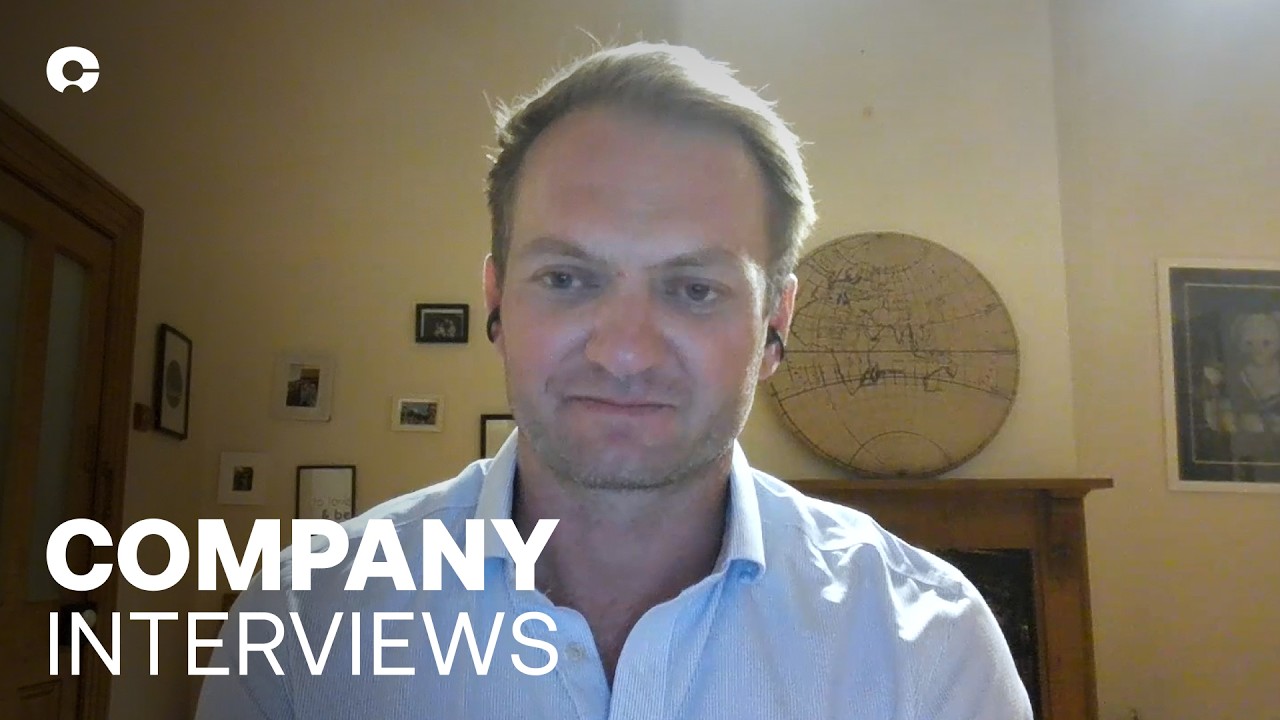
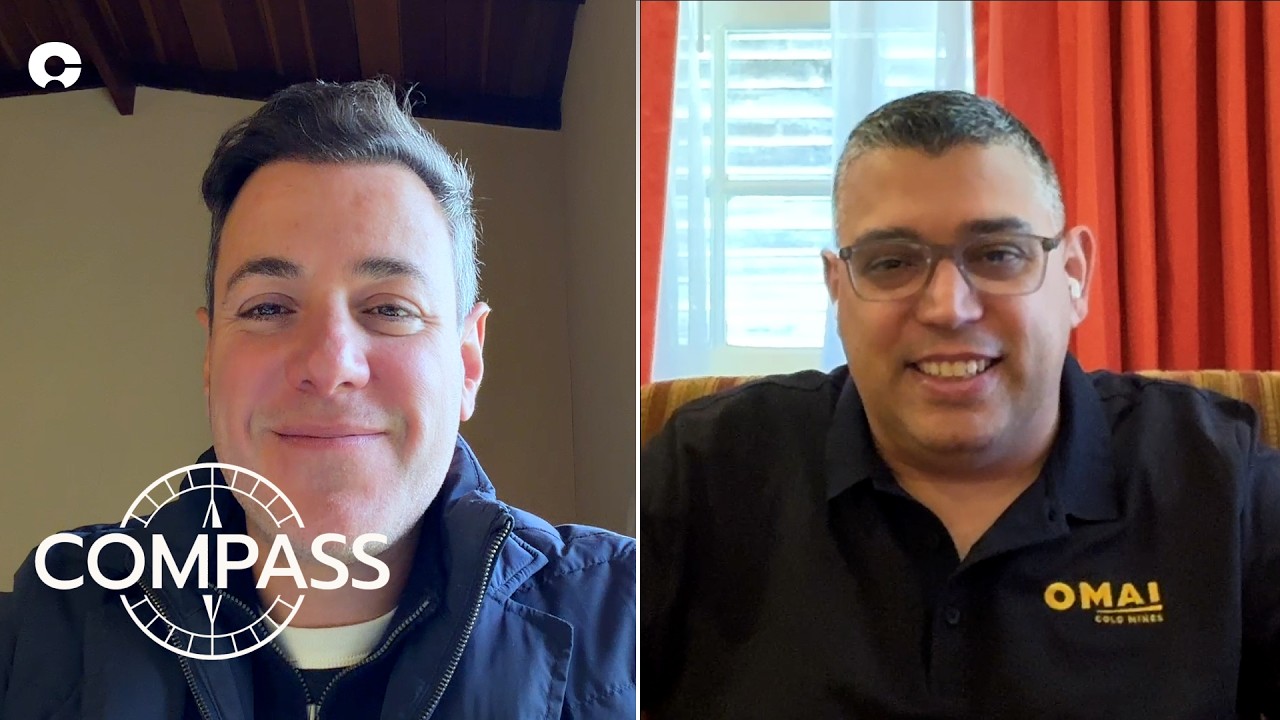
Interview with Rudi Deysel, CEO & Managing Director of West Wits Mining
The Path to 70,000 Ounces
Deysel set out a clear sequence of milestones. Primary stoping is scheduled to begin in February 2027 through Level 2 access. He called the first commercial stope the key milestone because it will confirm ore volumes against the revenue base. Grid power is due to connect in early 2027. Surface infrastructure is scheduled for completion in the third quarter of 2027. Commercial production, with free cash flow from operations, is targeted for the fourth quarter of 2027.
Production guidance is 10,000 to 15,000 ounces in 2027. The company's outlook shows 42,500 ounces in 2028, within the 40,000 to 50,000 ounce range Deysel cited. Steady state of 70,000 ounces per annum is targeted for the first quarter of 2029.
The DFS assumed a gold price of US$2,850/oz. It returned a post-tax net present value (NPV) of US$500 million at a 7.5% discount rate and a post-tax internal rate of return (IRR) of 81%. With gold around US$4,100/oz, Deysel's rough calculation points to about US$200 million of annual margin at steady state. That figure is before corporate costs, finance, tax and other adjustments.
Asked why the climb to steady state runs into 2029, Deysel said the ramp-up reflects capital being deployed carefully as new infrastructure is built. He added that West Wits does not intend to grow its market capitalisation simply by adding assets. The priority is profitable operations with strong cash flow.
Orebody Confidence & Inherited Infrastructure
Deysel identifies the orebody as the biggest risk in any mining project. He argues the Witwatersrand Basin offers unusual certainty. The basin has produced more than 1.5 billion ounces, about 22% of all gold ever mined. Decades of data from worked-out areas and neighbouring operations, including a mine run by Harmony Gold, inform the company's geological models. Deysel said resource-to-reserve conversion is extremely high in the Witwatersrand because grade is evenly distributed through the orebody. He added that reconciliations from mining to date are tracking well against the resource models.
Qala Shallows is also unusually shallow for the region. Mining currently takes place on the first level, about 40 metres below surface. The company reached the orebody quickly through existing declines. These were widened and modernised for mechanised equipment, with new service infrastructure installed. A new decline into the virgin block is well advanced and is being built as a modern mine. Deysel said it gives the operation twin access points to the orebody. That flexibility helps the mine plan absorb stoppages caused by difficult geology or geotechnical issues.
The site sits next to Johannesburg, close to suppliers. Deysel said using only South African original equipment manufacturers (OEMs) also secures access to spare parts during breakdowns.
Growth Beyond Qala Shallows
The current Qala Shallows mining inventory covers about 1.03 million ounces of the 7.24-million-ounce resource. That leaves roughly 6.2 million ounces outside the existing mine plan. Deysel expects the resource to grow as prospecting rights over virgin ground are added. Those prospecting rights are approved and are being incorporated into the existing mining right.
The Project 200 scoping study examines lifting production capacity from 70,000 to 200,000 ounces per annum. Deysel said the study came out very positive. It has not yet been published because of ASX reporting requirements, and optimisation work is under way. He said moving to DFS level would require further drilling and study work over about two years. He suggested expansion could follow within the next five years, with funding made easier by a producing asset.
Bird Reef Central adds uranium-gold optionality. It carries an existing JORC resource of 120,000 ounces of gold at 2.66 g/t. Uranium remains an exploration target, and funded work is aimed at a maiden uranium resource. Deysel noted that the gold and uranium reefs sit close enough together to be mined from shared infrastructure. He argues the gold has not yet been evaluated at current prices.
Conclusion
The West Wits case rests partly on the view that perceptions of South Africa lag reality. Deysel argues the country remains underestimated as a mining jurisdiction and an investment destination. He points to a peaceful multi-party democracy that has never experienced a coup, a strong legal system and a free press.
Power was long the most visible concern. Load shedding, the rotational power cuts imposed by state utility Eskom, weighed on investor confidence for years. Deysel said private generators entering the grid and a proper Eskom maintenance programme have changed the picture.
"There was a lot of work where the private sector also got involved, a lot of private power suppliers that also came into the [grid]. We are now almost two years without any load [shedding] in South Africa. So in terms of power supply, it's a non-discussion."
Financial indicators point the same way. S&P Global Ratings has moved its outlook on South Africa to positive. The country was removed from the Financial Action Task Force (FATF) grey list in October 2025. With gold above US$4,000/oz, any narrowing of the perceived country discount would matter for South African producers. Deysel contends that West Wits, as a funded producer, is positioned to benefit directly if that re-rating takes hold.
TL;DR
West Wits Mining poured first gold at Qala Shallows on Johannesburg's Witwatersrand in March 2026 and is ramping towards 70,000 ounces per annum by the first quarter of 2029. CEO Rudi Deysel argues the company trades at around A$21 per resource ounce against an ASX peer range of A$44 to A$118. A A$97 million Absa and Nedbank package funds the mine to steady state, with two drawdowns already signed off by the banks' technical adviser. DFS AISC of US$1,289/oz sits far below a gold price near US$4,100/oz. Primary stoping from February 2027 and commercial production in the fourth quarter of 2027 are the next milestones, with Project 200 and Bird Reef Central uranium offering growth beyond the base case.
FAQs (AI Generated)
Analyst's Notes





Subscribe to Our Channel





Stay Informed