Uranium Supply Security Drives Strong 2026 Fundamentals



Uranium investment shifts from price speculation to execution focus as producers exceed guidance, explorers confirm district-scale discoveries, and utilities prioritize supply security through 2040.
- Global uranium markets face sustained supply deficits through 2040 driven by decades of underinvestment meeting accelerating reactor demand from restarts, life extensions, and new construction programs across Asia, Europe, and North America.
- Uranium exploration delivers material results across multiple jurisdictions with companies demonstrating systematic discovery capability rather than isolated successes, featuring high-grade deposits, lower all-in sustaining costs, and footprint expansions across multi-kilometer mineralized corridors reducing geological risk whilst increasing strategic relevance.
- The distinction between resource holders and actual producers has become increasingly pronounced in capital markets as United States uranium producers demonstrating consistent delivery against guidance compress operational risk premiums with proven track records, experienced technical teams, and capital discipline outweighing resource-stage optionality.
- Limited conventional uranium milling capacity in the United States functions as a strategic asset extending beyond current throughput, creating optionality for toll arrangements and consolidation premiums whilst jurisdictional advantages through transparent regulatory frameworks, established permitting pathways including Fast-41 coordinated review, and utility preference for supply security over cost justify premium valuation multiples.
- Management quality separates sustainable uranium operators from struggling juniors, with approximately 80% unable to articulate clear business models or multi-year funding plans, while well-positioned companies secure larger exploration budgets, strategic partnerships, and adequate capital runways positioning them for execution success amid accelerating market bifurcation.
What began as policy rhetoric around nuclear energy independence has crystallized into concrete procurement behavior, with utilities applying jurisdictional filters and prioritizing delivery certainty over historical cost optimization. This uranium market shift creates investment opportunities concentrated among companies demonstrating operational credibility, permitting velocity, and capital discipline.
The macro backdrop supporting this transformation remains compelling. Global uranium demand continues rising through reactor restarts, life extensions, and new construction programs across Asia, Europe, and North America. Industry forecasts project sustained supply deficits through 2040, driven by decades of underinvestment meeting accelerating demand.
Philip Williams, CEO of IsoEnergy, emphasized the structural imbalance:
"The demand is going to far outstrip supply on any period that you want to look at even from the near-term to go out to 2040, so there's a major issue on the supply side."
Exploration Success in Premier Jurisdictions
Uranium exploration is delivering material results across multiple jurisdictions, with companies demonstrating systematic discovery capability rather than isolated successes. These discoveries arrive as high-grade deposits command premium attention due to superior project economics and lower all-in sustaining costs.
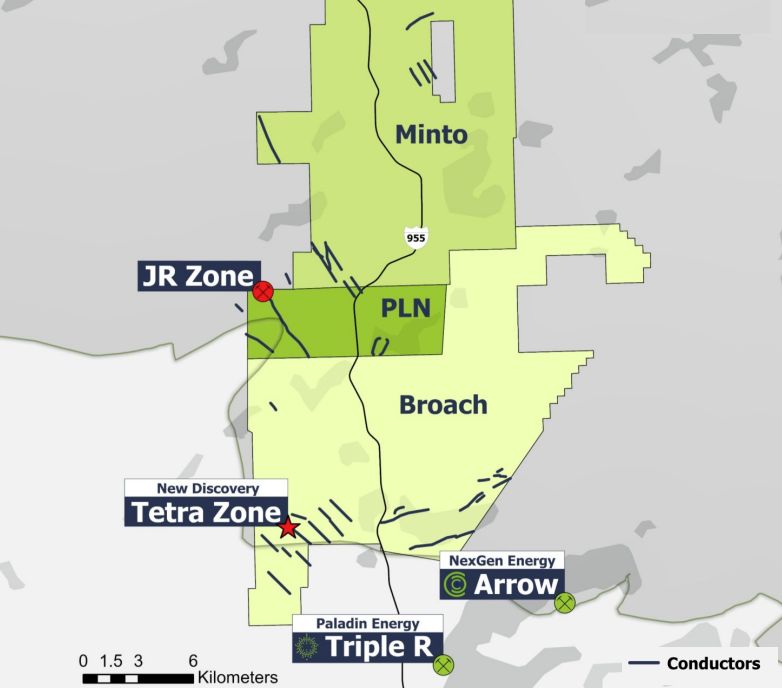
F3 Uranium's strategic pivot to its Tetra Zone discovery exemplifies this dynamic. CEO Dev Randhawa explained the resource allocation decision:
"The JR zone it's a beautiful little pocket. It's got a peak of 4.5 meters of 50% uranium and it's along a very large conductor [...] Because the Tetra Zone is so much bigger, potentially significantly larger than JR, we take the money we have, we have to focus it on where we get the best bang for the money for our investors."
The Tetra Zone presents compelling scale indicators, with initial drilling encountering 60 meters of mineralization—three times the maximum found at the JR Zone. F3's $20 million financing provides approximately one year of drilling funding, addressing a critical investor concern. Randhawa emphasized the strategic importance:
"The thing is dilution, we have enough money for a year of drilling. And more importantly, I think it relaxes the concept of having to go back to the market because as soon as the market knows you need to raise money, they're underwriters, not overwriters."
Interview with Dev Randhawa, Chairman & CEO, and Sam Hartmann, VP Exploration of F3 Uranium Corp.
IsoEnergy's 2025 Athabasca Basin drilling delivered material footprint expansions at the Hurricane deposit and identified the strongest intersection recorded outside the main resource zone to date. The company completed 15,597 metres across 39 drill holes, with hole LE25-202 intersecting 1.05% U₃O₈ over 0.5m approximately 2.8 kilometres east of Hurricane Main. This result materially expands the geological search space beyond current resource boundaries.
Williams highlighted the Hurricane asset's strategic value: "
We're focusing on the highest grade uranium resource in the world in Canada at the Hurricane deposit. The bulk of the value for the business today is in Canada the Hurricane deposit. The characteristics that we have there is a top-tier asset, it will be developed into a mine."
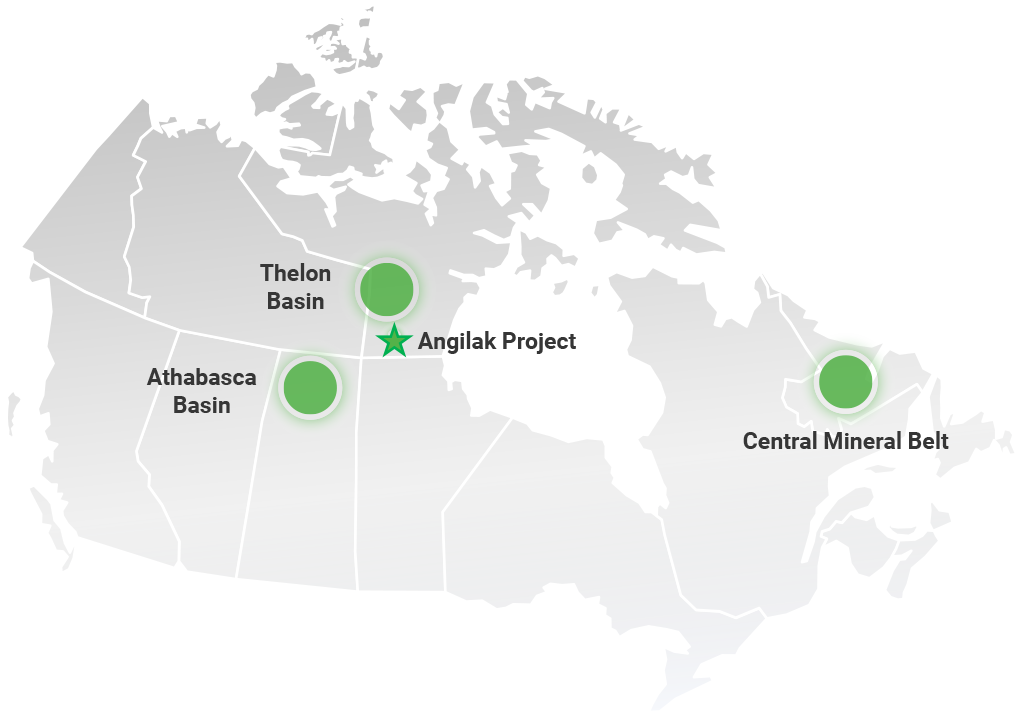
ATHA Energy's discoveries at Angilak in Nunavut represent another dimension of Canadian uranium potential. The company achieved 100% success intersecting uranium mineralization across the RIB East, West, North, and South discoveries along a 12-kilometer corridor. CEO Troy Boisjoli quantified the systematic nature of results:
"This is our fourth discovery in one single drill program within that Angikuni Basin. RIB in particular now has conductive corridors that are mineralized over 12 kilometers. We have not missed yet."
Grades up to 5.55% U₃O₈ and intersections including 13.6 meters grading 0.53% U₃O₈ with peak values of 8.16% U₃O₈ over 0.5 meters demonstrate Athabasca-style mineralization in an underexplored basin. Boisjoli articulated the forward trajectory:
"The objective here is not exploration for the sake of exploration. It's exploration for discovery's sake to move projects forward, to be extremely relevant in this cycle... Moving into delineation, infill, and project advancement is a natural progression based off of where we're at."
Execution Credibility Commands Valuation Premiums
The distinction between resource holders and actual producers has become increasingly pronounced in capital markets. US uranium producers demonstrating consistent delivery against guidance compress risk premiums while unproven developers face widening discounts regardless of resource quality.
Energy Fuels exceeded 2025 production and sales guidance, producing more than one million pounds of finished U₃O₈ during the year, with December alone contributing over 350,000 pounds. This execution trajectory reinforces forward sales visibility during a critical utility contracting window. Chalmers underscored the financial foundation this creates:
"The uranium side of the business is self-sustaining and actually is in a turning point. We're starting to generate material cash. That cash will fund all our G&A as a company, also funds our rare earth aspirations and strategy as well as our heavy mineral science side of the business."
The White Mesa Mill is currently averaging approximately 250,000 pounds of U₃O₈ per month and is expected to maintain this rate through the first half of 2026. Low-cost Pinyon Plain ore is expected to begin processing in Q1 2026, at which point cost of goods sold is expected to trend lower. Chalmers characterized the company's position:
"We'll continue to be the largest producer of uranium in the United States and will continue to be the lowest cost producer."
Processing infrastructure scarcity represents a strategic asset that extends beyond current throughput. The White Mesa Mill functions as America's only operating conventional uranium mill, creating optionality for toll arrangements and consolidation premiums. Chalmers addressed the jurisdictional dimension:
"If you can produce non-China material, people are paying a premium for that today... If the United States wants to reshore the ability to be independent of China, particularly on rare earth, or reduce dependency on Russia, we have a facility in the United States that's constructed, permitted, and operating to do that."
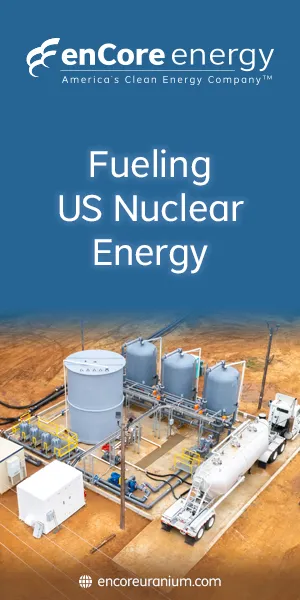
enCore Energy is strengthening governance as it transitions from asset consolidation to multi-plant optimization. The December 2025 appointment of Wayne Heili to the Board of Directors addresses a critical industry constraint: scarce ISR production expertise enCore operates as the only United States uranium company with multiple Central Processing Plants in operation, with uranium recovery currently underway at two South Texas facilities. Executive Chairman William Sheriff confirmed the regulatory progress:
"Our South Dakota project got Fast-41. It gives you a much more certain and much more acceptable timeline to get through all of your filings... You cut your timelines dramatically and increase your certainty."
The company has demonstrated operational scaling capability, with over 227,000 pounds extracted in Q3 2025, cash balance exceeding $100 million, and 24 drill rigs operating across South Texas operations with plans to increase to 30 rigs. Sheriff articulated the urgency driving execution: "It's just a matter of urgency, it's the matter of the day, and it's every day for us."
High-Grade Economics Meet Near-Term Production
Development-stage projects with near-term production visibility offer leveraged exposure to strengthening uranium fundamentals while avoiding the extended timelines and permitting uncertainties associated with earlier-stage exploration.
Global Atomic's Dasa Project in Niger remains one of the highest-grade undeveloped uranium deposits globally, with reserve grades averaging approximately 4,113 parts per million U₃O₈. The 2024 Feasibility Study outlined robust project economics, reporting an after-tax NPV (8%) of US$917 million and an IRR of 57% at a uranium price of US$75/lb U₃O₈, rising to an NPV of US$1.62 billion and IRR of 92.9% at US$105/lb.
In December 2025 disclosures, management clarified that while recent equity financing contributes toward the company’s required equity portion for project financing, it does not constitute confirmation of full funding for the remaining capital requirements. As CEO Stephen Roman explained, the company must fund approximately 40% of the equity component as part of the broader financing structure, with discussions ongoing regarding the balance of project funding.
Separately, Global Atomic has communicated that earlier commissioning targets have shifted due to financing and logistics challenges. In a December 11 news release, management indicated that first uranium shipments from Dasa could be delayed to 2028, reflecting updated project sequencing and execution realities.
Capital strength provides competitive advantages during volatile cycles. Energy Fuels completed a $700 million senior convertible note with the offering oversubscribed more than seven times. Chalmers described the outcome:
"The appetite and timing was perfect and we're really excited with the outcome... It was oversubscribed more than seven times. We've got this convert with a three-quarters of a percent coupon. We really are in an absolutely strong position from a balance sheet and revenue generation looking forward for the next several years."
Management Quality Separates Survivors from Casualties
The uranium sector's structural challenges create significant differentiation opportunities for investors who can identify management teams demonstrating capital discipline and strategic clarity. Chris Frostad, CEO of Purepoint Uranium, provided an unvarnished assessment of financing realities facing exploration companies.
Frostad systematically dismissed alternative capital sources as realistic financing avenues for most uranium explorers. Despite uranium's elevation to strategic metal status, private capital operates with risk management frameworks incompatible with exploration timelines and uncertainty. He characterized sovereign fund probability as "near zero" for exploration.
Two fundamental questions separate sustainable businesses from unsustainable ones. Frostad emphasized:
"What is your business model? And how are you going to fund this thing for the next 2-4 years? And those are two questions that nine out of 10 companies don't have an answer for."
This inability to articulate basic strategic and financial planning reflects fundamental unseriousness about operating actual businesses versus maintaining vehicles for extracting salaries and fees. Frostad's perspective is shaped by experience outside mining, particularly in technology venture capital where greater discipline was required:
"You had to go out and find people and convince them that you could make them money if they cut a check, then you had to report back to them on a regular basis and you were watched. You weren't allowed to continuously raise and spend money in a bad way. When it wasn't working the machine stopped and you got slapped for it and you went away."
Market bifurcation is accelerating, with well-positioned companies securing larger budgets and partnerships while struggling juniors face increasing desperation. Frostad's own experience illustrates this dynamic, as Purepoint secured a larger 2026 budget from IsoEnergy based on encouraging drill results requiring follow-up work.
2026 Catalysts & Execution Milestones
The 2026 catalyst calendar provides multiple inflection points across exploration results, production ramp-ups, and development milestones.
- Purepoint Uranium and IsoEnergy Joint Venture has approved an expanded exploration program for 2026 following strong results from this year’s drilling at the Dorado Project. Chris Frostad, President and CEO of Purepoint Uranium Group.
“The joint venture’s approval of the 2026 program reflects the significance of the Nova Discovery [...] The coming year allows us to advance Nova with purpose and begin evaluating additional high priority zones across the Dorado Project.”
- F3 Uranium's systematic drilling campaign will focus on delineating the Tetra Zone discovery while testing for expansion potential, with results expected regularly throughout the year.
- ATHA Energy anticipates disclosing remaining assay results from the KU Discovery, Mushroom Lake, and Lac 50 Deposit area. Additional MMT surveys paired with 3D EM Inversion modeling is planned for 2026 to define the true scale of the Mineralized RIB Corridor.
- Energy Fuels expects continued production scaling as low-cost Pinyon Plain ore begins processing in Q1 2026, supporting margin expansion and cash flow generation.
- enCore Energy's operational expansion continues with plans to increase drilling activity while advancing the Dewey Burdock Project through Fast-41 coordinated permitting.
- Global Atomic's targeted Q1 2026 production commencement and H2 2026 plant commissioning represent critical execution milestones for demonstrating the transition from developer to producer. Roman emphasized the market positioning: "The price is sort of bumping along here at 80 plus dollars a pound," while anticipating further upward pressure due to tightening supply conditions.
The Investment Thesis for Uranium
- Structural Supply Deficits Create Multi-Year Tailwind: Decades of underinvestment meet accelerating reactor demand through 2040 from restarts, life extensions, and new construction. Utilities secure supply through longer-term contracts with jurisdictional filters, creating sustained demand visibility beyond spot price movements.
- High-Grade Deposits Command Premium Economics: Projects exceeding 1% uranium trioxide grades deliver superior all-in sustaining costs, internal rates of return, and margin resilience. Athabasca-style mineralization in established jurisdictions benefits from infrastructure proximity and compressed development timelines.
- Execution Credibility Drives Valuation Re-Rating: Producers meeting or exceeding guidance compress operational risk premiums, while those missing targets face widening discounts regardless of resource quality. Proven track records, experienced technical teams, and capital discipline outweigh resource-stage optionality.
- US Jurisdictional Advantages Justify Premium Multiples: Transparent regulatory frameworks, established permitting pathways, and utility preference for supply security over cost create valuation premiums. Processing infrastructure scarcity generates competitive moats extending beyond current throughput.
- Management Quality Separates Survivors from Casualties: Approximately 80% of uranium juniors cannot articulate clear business models or multi-year funding plans. Management capability to raise capital on reasonable terms, establish strategic partnerships, and maintain balance sheet flexibility determines survival.
- District-Scale Discoveries Offer Asymmetric Upside: Systematic exploration success across multi-kilometer mineralized corridors reduces geological risk while increasing strategic relevance. Consistent drill success across extensive strike lengths outweighs isolated high-grade intercepts.
- Near-Term Production Timing Aligns with Peak Demand: Development projects targeting 2026-2028 commissioning enter production as utility contracting intensifies and inventories decline, establishing market credibility during peak demand conditions.
- Capital Strength Enables Counter-Cyclical Positioning: Well-capitalized operators fund growth internally, pursue strategic acquisitions, and preserve shareholder optionality during market volatility without forcing dilutive equity issuances at inopportune moments.
- Diversification Across Development Stages Reduces Portfolio Risk: Combining exposure to cash-generating producers, near-term commissioning projects, and systematic explorers captures different risk-return profiles while maintaining alignment with structural fundamentals.
- Governance Quality Functions as Leading Indicator: Board-level production experience, technical advisory structures preserving institutional knowledge, and management accountability to shareholders correlate with delivery credibility and execution success.
TL;DR
The uranium sector has transitioned from price speculation to execution-focused value creation, with structural supply deficits projected through 2040 creating sustained demand visibility. US producers are exceeding production guidance while explorers are confirming district-scale, high-grade discoveries across multi-kilometer mineralized corridors in premier jurisdictions. The distinction between proven operators and resource-stage companies has become pronounced, with capital markets rewarding execution credibility, infrastructure ownership, and management teams demonstrating capital discipline. Approximately 80% of uranium juniors cannot articulate clear business models or multi-year funding plans, driving market bifurcation toward well-capitalized companies securing strategic partnerships and larger exploration budgets. Development projects targeting 2026-2028 commissioning align with peak utility contracting demand, while US jurisdictional advantages through transparent regulatory frameworks and processing infrastructure scarcity justify premium valuations. Investors should prioritize companies with proven track records, adequate capital runways, high-grade deposits in established jurisdictions, and governance structures preserving institutional knowledge as the sector matures toward operational delivery.
Frequently Asked Questions (FAQs) AI-Generated
Decades of underinvestment during the post-Fukushima downturn combined with accelerating reactor demand from restarts, life extensions, and new construction programs across Asia, Europe, and North America have created structural supply-demand imbalances. Utilities are responding by securing supply through longer-term contracts with jurisdictional filters, prioritizing delivery certainty over historical cost optimization. As Philip Williams, CEO of IsoEnergy, emphasized: "The demand is going to far outstrip supply on any period that you want to look at even from the near-term to go out to 2040, so there's a major issue on the supply side."
Projects with grades exceeding 1% uranium trioxide deliver superior all-in sustaining costs, internal rates of return, and margin resilience across commodity price cycles. High-grade deposits in established jurisdictions benefit from infrastructure proximity and compressed development timelines. Recent exploration results demonstrate Athabasca-style mineralization with grades up to 8.16% U₃O₈, significantly outperforming lower-grade alternatives. These grade advantages translate directly into lower production costs and enhanced profitability, particularly important as capital intensity increases across the mining sector.
US production benefits from transparent regulatory frameworks, established permitting pathways including Fast-41 coordinated review, and utility preference for supply security over marginal cost. Processing infrastructure scarcity—particularly America's only operating conventional uranium mill—creates competitive moats extending beyond current throughput. Utilities seeking to diversify supply away from Russian and Kazakh sources face limited domestic alternatives, supporting premium pricing for US-origin material and strengthening the contracting position of operational producers.
Chris Frostad, CEO of Purepoint Uranium, identified two fundamental questions that separate sustainable businesses from unsustainable ones: "What is your business model? And how are you going to fund this thing for the next 2-4 years? And those are two questions that nine out of 10 companies don't have an answer for." Investors should screen for management teams demonstrating ability to raise capital on reasonable terms, establish strategic partnerships, maintain balance sheet flexibility without serial dilution, and articulate clear multi-year funding plans. Board-level production experience, technical advisory structures preserving institutional knowledge, and proven track records in exploration or operational execution correlate with delivery credibility.
The 2026 catalyst calendar includes multiple inflection points across exploration results, production ramp-ups, and development milestones. Key events include systematic drilling campaigns at high-grade discoveries with results expected regularly throughout the year, expanded exploration programs at joint venture projects following strong 2025 results, production scaling as low-cost ore begins processing in Q1 2026 supporting margin expansion, operational expansion with increasing drilling activity and Fast-41 coordinated permitting advancement, and critical execution milestones for development projects targeting Q1 2026 production commencement and H2 2026 plant commissioning demonstrating the transition from developer to producer.
Analyst's Notes





Subscribe to Our Channel











Stay Informed