




West Red Lake Gold Hits High-Grade at Madsen: Definition Drilling Advances 955 & 904 Complexes Toward Production


West Red Lake Gold Mines reports high-grade definition drill results from the Austin 955 and 904 complexes at Madsen, advancing H1 2027 production timelines.
- West Red Lake Gold reported new definition drilling results from the Austin 955 and Austin 904 complexes at the Madsen Mine, supporting the company's first-half-of-2027 mine-planning timeline.
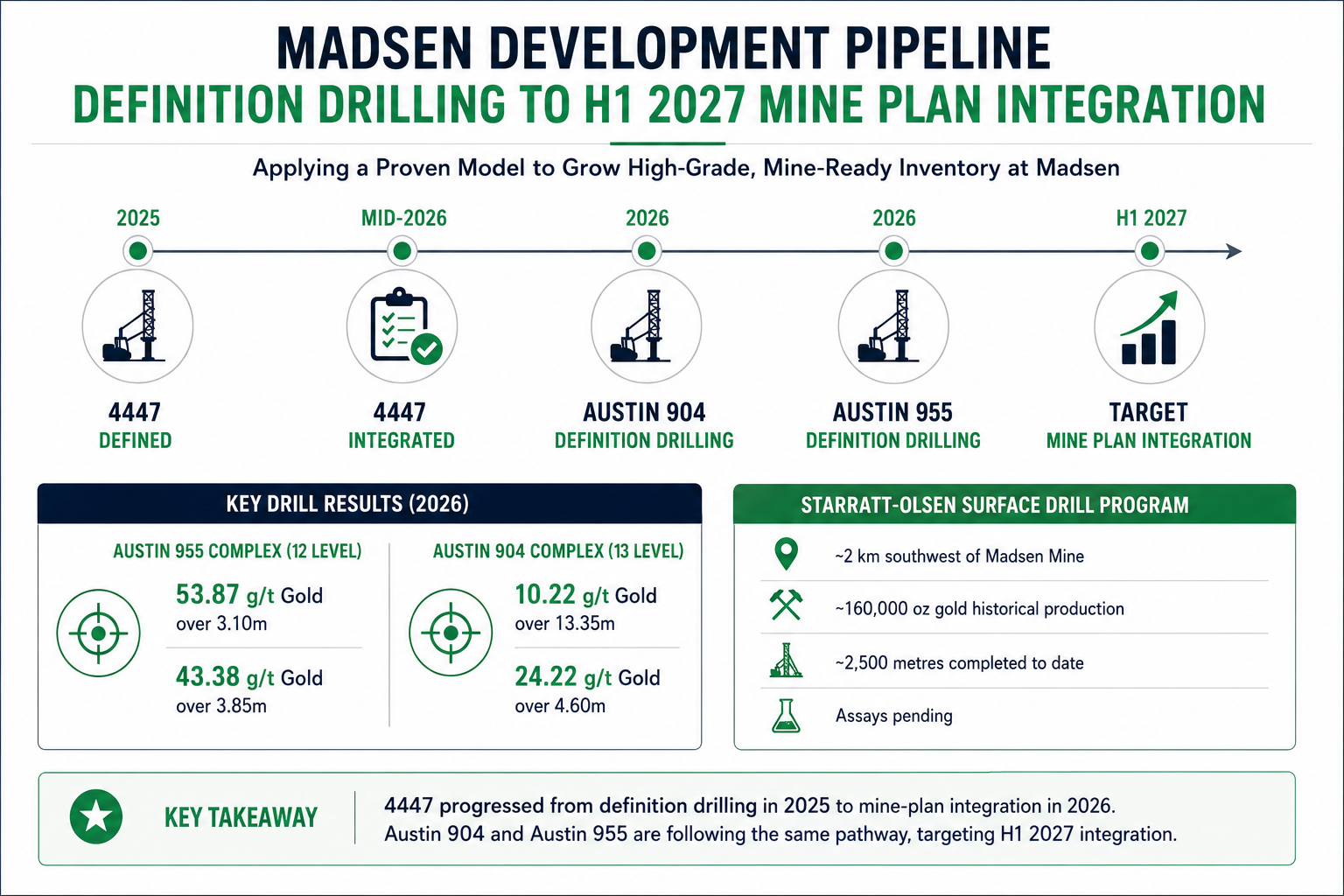
- Austin 955 returned high-grade intercepts, including 53.87 grams per tonne gold over 3.10 metres and 43.38 grams per tonne gold over 3.85 metres from underground definition drilling.
- Austin 904 returned 10.22 grams per tonne gold over 13.35 metres and is being advanced as a large non-remnant mineralised panel with a potential size of approximately 200 metres by 200 metres.
- Management compared the Austin 904 program with the 4447 area, which was drilled during 2025 and is being incorporated into the mine plan during 2026.
- Surface drilling at the Starratt-Olsen mine has completed eight holes totalling approximately 2,500 metres, with assay results pending from the planned 4,000-metre program.
What Has Happened
West Red Lake Gold Mines (TSXV: WRLG | OTCQX: WRLGF) has reported new high-grade definition drilling results from the Austin 955 and Austin 904 complexes at its 100%-owned Madsen Mine in Red Lake, Ontario. The underground program is designed to convert non-remnant mineralisation into mine-ready inventory for incorporation into future production schedules. Drilling from the 12 Level and 13 Level, at approximately 600 metres and 650 metres below surface, is supporting the company’s objective of advancing additional mining panels toward inclusion in its planned first-half-of-2027 mine sequence.
High-Grade Intercepts Support Definition Drilling Objectives at Austin 955
The latest results from the Austin 955 Complex were generated from underground definition drilling completed from the 12th level. The program targeted mineralisation outside previously mined stopes to reduce geological uncertainty in future mining areas and increase confidence in mine-planning decisions.
The strongest reported intercepts included 53.87 grams per tonne gold over 3.10 metres, including 322.89 grams per tonne gold over 0.50 metres, and 43.38 grams per tonne gold over 3.85 metres, including 291.94 grams per tonne gold over 0.50 metres. Additional results included 29.52 grams per tonne gold over 3.50 metres and 24.03 grams per tonne gold over 5.25 metres.
The high-grade intervals were associated with quartz veining, silicification and visible gold. The significance of the drilling lies not in the discovery of a new zone, but in converting existing mineralisation into mine-ready inventory for incorporation into future production schedules. By increasing confidence in the continuity and grade distribution of mineralisation within targeted mining panels, the program is intended to support future production planning.
Austin 904 Advances a Large Non-Remnant Mining Panel
The Austin 904 Complex represents a larger-scale mine-planning opportunity within the Madsen deposit. Unlike isolated remnant areas, the target comprises a broad panel of non-remnant mineralisation that the company is seeking to define and sequence for future mining activities.
Key results from the 904 Complex included 10.22 grams per tonne gold over 13.35 metres, including 69.85 grams per tonne gold over 1.10 metres and 30.65 grams per tonne gold over 0.55 metres. Additional intercepts included 24.22 grams per tonne gold over 4.60 metres and 11.98 grams per tonne gold over 10.20 metres.
Vice President of Exploration at West Red Lake Gold Mines, Will Robinson, provided context on the scale of the target:
“We've been working our way laterally across the top portion of the 904 complex, and as development advances at depth, when the decline continues to advance down, we'll be getting deeper in the 904 complex and continuing drilling within this panel, which is mostly non-remnant and has the size potential of around 200 by 200 meters.”
The panel’s size is significant because it could provide a larger continuous mining area than isolated remnant stopes. A larger non-remnant panel may offer greater flexibility when sequencing future mining activities and support the efficient development of additional production inventory.
Applying the 4447 Development Model
The current drilling campaign follows an approach that the company has already applied elsewhere within the Madsen deposit. The company compared the Austin 904 Complex with the 4447 area in the South Austin zone, which was drilled during 2025 and is now being incorporated into the mine plan during 2026.
Robinson highlighted that comparison:
“So again, the 904 area continues to deliver. We're really excited about the 904 complex because it's showing the potential, similarly to what we defined in the triple 47 area, which is a high-grade panel mineralisation in the South Austin zone that we drilled off in 2025.”
The comparison provides an operational precedent for the company’s current strategy. The 4447 area progressed from definition drilling into mine planning, and West Red Lake Gold is now applying the same process to both the 904 and 955 complexes. The relevance lies in whether these areas can follow a similar path from drilling to scheduled mining inventory.
Robinson also outlined the company’s timeline for advancing the zones, stating:
“The goal is to take areas like this that we're drilling in the 955 and, of course, in the 904 drill those off in 2026 and then get those integrated into our mine plan during the first half of 2027.”
The company’s underground drilling program therefore serves two purposes: reducing geological uncertainty within planned mining areas and expanding the volume of mineralisation available for future production sequencing. Both objectives are directly tied to the first half of the 2027 mine-planning timeline referenced by management.
Starratt-Olsen Adds Regional Exploration Optionality
Alongside underground definition drilling at Madsen, West Red Lake Gold is conducting a surface drilling program at the Starratt-Olsen mine, located approximately 2 kilometres southwest of Madsen. The past-producing mine is the second-largest historical producer on the property, having produced approximately 160,000 ounces of gold at grades of 6-7 grams per tonne. Eight holes totalling approximately 2,500 metres have been completed as part of a planned 4,000-metre drill program. Assay results remain pending, although all completed holes have intersected Madsen-style alteration and mineralisation.
The Starratt-Olsen program is testing whether geological models and exploration concepts developed at Madsen can be applied elsewhere across the property. All completed holes have encountered mineralisation styles similar to those observed at Madsen, providing an early indication that the geological framework may extend beyond the current mining areas.
While the immediate focus remains on advancing the Austin 955 and 904 complexes toward inclusion in the future mine plan, the Starratt-Olsen program offers a parallel opportunity to identify additional mineral inventory within the broader Madsen land package. Near-term catalysts include pending assay results from Starratt-Olsen and continued definition drilling at both Austin complexes, as the company advances its first-half-of-2027 mine-planning objectives.
FAQs (AI-Generated)
Analyst's Notes





Subscribe to Our Channel






Stay Informed






















