Energy Fuels & ASM: Securityholders Approve Acquisition to Bridge Western Metallization Gap


Energy Fuels & Australian Strategic Materials clear key transaction milestone with 98.23% share scheme approval to complete midstream metallization link.
- Australian Strategic Materials (ASM) Limited securityholders approved the acquisition at the Perth Scheme Meetings on August 12, 2026, with 98.23% of Share Scheme votes and 99.97% of Option Scheme votes cast in favor, and scheme consideration of 0.053 Energy Fuels Chess Depositary Interests (CDIs) plus AUD$0.13 cash per share is targeted for implementation on August 28, 2026.
- The acquisition adds ASM Limited's operating Korean Metals Plant in Ochang, South Korea, with an installed capacity of approximately 1.3 thousand tonnes per annum of neodymium-iron-boron alloy across four furnaces and one alloy strip caster, targeting expansion to approximately 3.6 thousand tonnes per annum in Phase II and 5.6 thousand tonnes per annum in Phase III.
- Energy Fuels is targeting a planned American Metals Plant with an initial capacity of approximately 2,000 tonnes per annum of alloy, with scalable potential to 4,000 tonnes per annum, to address the lack of Western infrastructure to convert separated oxides from the White Mesa Mill in Blanding, Utah, into magnetic metals.
- The construction-ready Dubbo Project in New South Wales holds all major regulatory permits with a planned 42-year mine life, targeting life-of-mine production of approximately 1,000 tonnes per annum of neodymium-praseodymium, 11 tonnes per annum of terbium, and 49 tonnes per annum of dysprosium alongside the Donald Project joint venture's targeted 8,000 tonnes of monazite concentrate annually.
- The pending acquisition of permanent magnet manufacturer Vacuumschmelze (VAC) for a total transaction value of nearly $2 billion, targeted to close in early 2027, would connect the metals plants to VAC's Sumter, South Carolina, facility, which operates approximately 2,000 tonnes per annum of permanent magnet capacity with a scalable design targeting 12,000 tonnes per annum.
ASM Securityholders Approve Acquisition & Scheme of Arrangement Parameters
Energy Fuels Inc. (NYSE American: UUUU | TSX: EFR) has reached a decisive transaction milestone in its acquisition of 100% of ASM through its wholly owned subsidiary, EFR Critical Materials Pty Ltd. At the Scheme Meetings held in Perth, Australia, on August 12, 2026, securityholders voted overwhelmingly to approve the transaction, advancing the company's objective to construct a vertically integrated mine-to-magnet rare earth supply chain in the Western world. This transaction secures the midstream processing link needed to convert separated rare-earth oxides from the Utah facility into commercial-grade metals and alloys.
Under the court-approved Share Scheme, each Australian Strategic Materials (ASM) Limited shareholder is targeted to receive 0.053 new Energy Fuels Chess Depositary Interests (CDIs) plus AUD$0.13 cash for each share held. Simultaneously, under the Option Scheme, option holders are targeting AUD$0.50 in cash per option. The transaction is targeting a final court-sanctioned closing on August 28, 2026, which will integrate ASM Limited's operating metallurgical assets in South Korea and its development-stage critical mineral deposits in Australia into the company's global operating platform.
Securityholder Approval Thresholds & Legal Timelines
The voting results exceeded both the statutory requirements of Australian courts and the company's implementation thresholds. Specifically, 98.23% of the votes cast by ASM Limited shareholders supported the Share Scheme, representing 83.62% of those present and voting in person or by proxy. In parallel, the Option Scheme was approved by 99.97% of the votes cast, representing 87.78% of option holders present and voting. These margins easily surpassed the Australian statutory minimums of more than 75% of the total votes cast and more than 50% of the individual securityholders present and voting.
To finalize the corporate combination under its base-case transaction schedule, ASM Limited is targeting to apply to the Federal Court of Australia for approval of the schemes on August 18, 2026. Following the anticipated court approval, the order will be lodged with the Australian Securities and Investments Commission (ASIC) on August 19, 2026, making the schemes legally effective. Trading of ASM Limited securities on the Australian Securities Exchange is planned to be suspended at the close of trading on August 19, 2026, with the formal settlement and distribution of the CDI scheme consideration targeted for final implementation on August 28, 2026.
Bridging the Metallization Gap: South Korean & American Metallurgy
The strategic mechanism of this acquisition is the immediate addition of commercial-scale midstream rare-earth metal and alloy-making capabilities to the company's existing refining assets. While the company's White Mesa Mill in Blanding, Utah, features operating commercial light rare-earth separation capacity and is targeting commercial heavy rare-earth separations by late 2027, the West lacks the physical infrastructure to alloy separated oxides into magnetic metals. The acquisition directly addresses this Western metallurgy gap by integrating ASM Limited's operating Korean Metals Plant in Ochang, South Korea, which currently features an installed capacity of approximately 1.3 thousand tonnes per annum of neodymium-iron-boron alloy.
Under the company's vertical integration plan, the Korean Metals Plant provides a scalable metallurgical platform with existing infrastructure comprising four operating furnaces and one alloy strip caster. The facility is targeting an expansion to a capacity of approximately 3.6 thousand tonnes per annum in Phase II and 5.6 thousand tonnes per annum in Phase III, while simultaneously developing heavy rare-earth metallization capabilities for terbium and dysprosium. To establish a domestic metallurgical footprint within allied borders, the company is targeting the development of a planned American Metals Plant, with an initial capacity of approximately 2,000 tonnes per annum of alloy and scalable expansion potential to 4,000 tonnes per annum.
Sourcing Diversification: Dubbo, Donald & Global Feedstock
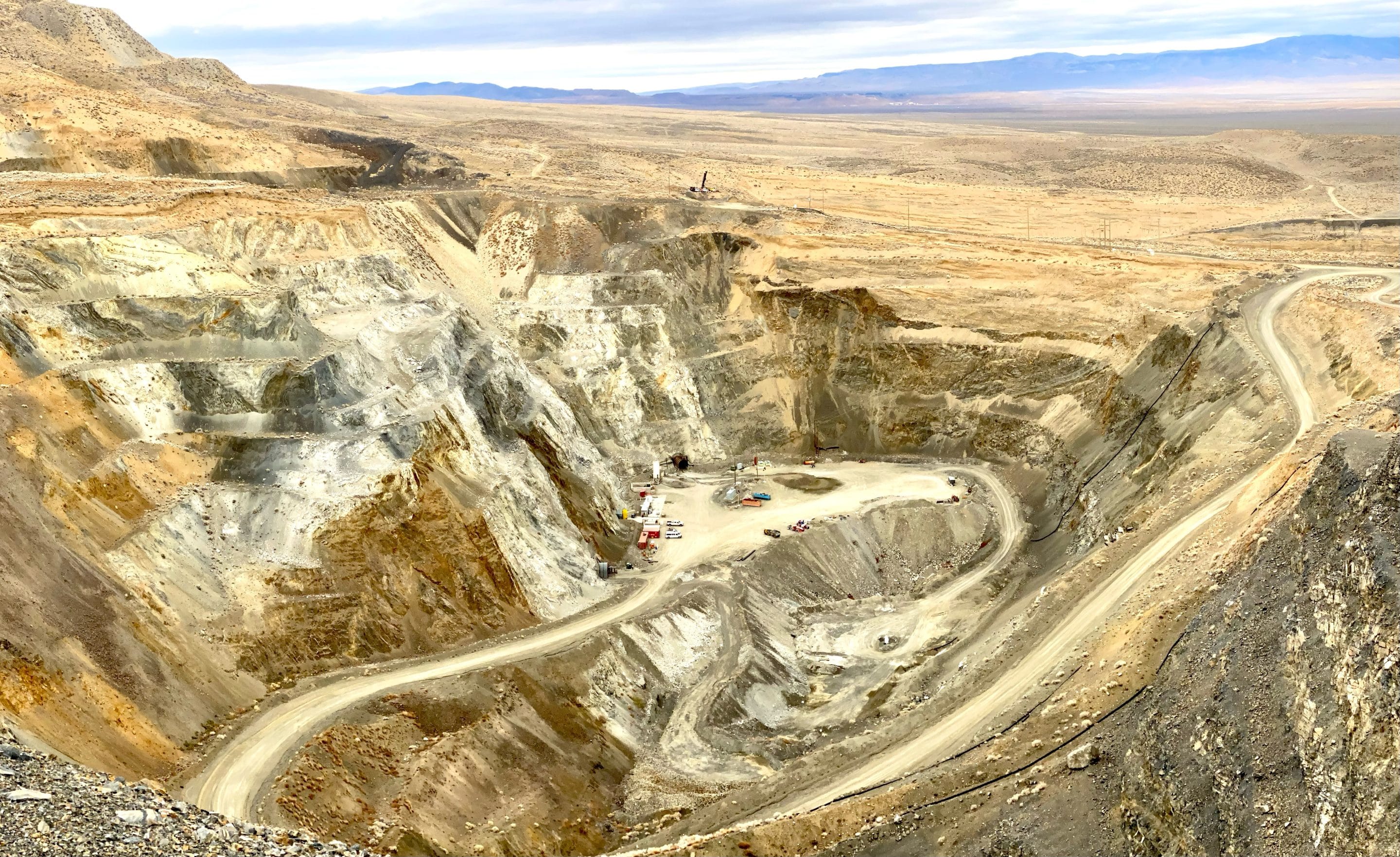
The transaction also integrates ASM Limited's flagship Dubbo Project in New South Wales, Australia, which secures long-term feedstock diversity, insulating the company's refining assets from single-source supply disruptions. The Dubbo Project is construction-ready, having received all major regulatory permits, and has a planned mine life of 42 years. Under its pre-feasibility design, Dubbo is targeting life-of-mine production of approximately 1,000 tonnes per annum of neodymium-praseodymium, 11 tonnes per annum of terbium, and 49 tonnes per annum of dysprosium to guarantee an independent supply of critical minerals.
This Australian deposit complements the company's existing joint venture (JV) with Astron Limited at the Donald Project in Victoria, Australia, in which the company holds the right to earn up to 49% interest. Sized specifically to match the White Mesa Mill's Phase 1B separation circuits, the Donald Project is targeting Phase 1 production of approximately 8,000 tonnes of monazite concentrate annually.
President & Chief Executive Officer of Energy Fuels Inc., Ross Bhappu, discussed the competitiveness of this global feedstock sourcing strategy:
"I think we can be competitive with China. We're developing a mine in Madagascar called Mada. That mine is going to be a low-cost mine. We'll bring that rare earth concentrate. We call it monazite. That material will come to our mill in Utah, and we will be cost competitive with China."
Completing the Downstream Loop: Bypassing Open-Market Feedstock Markups
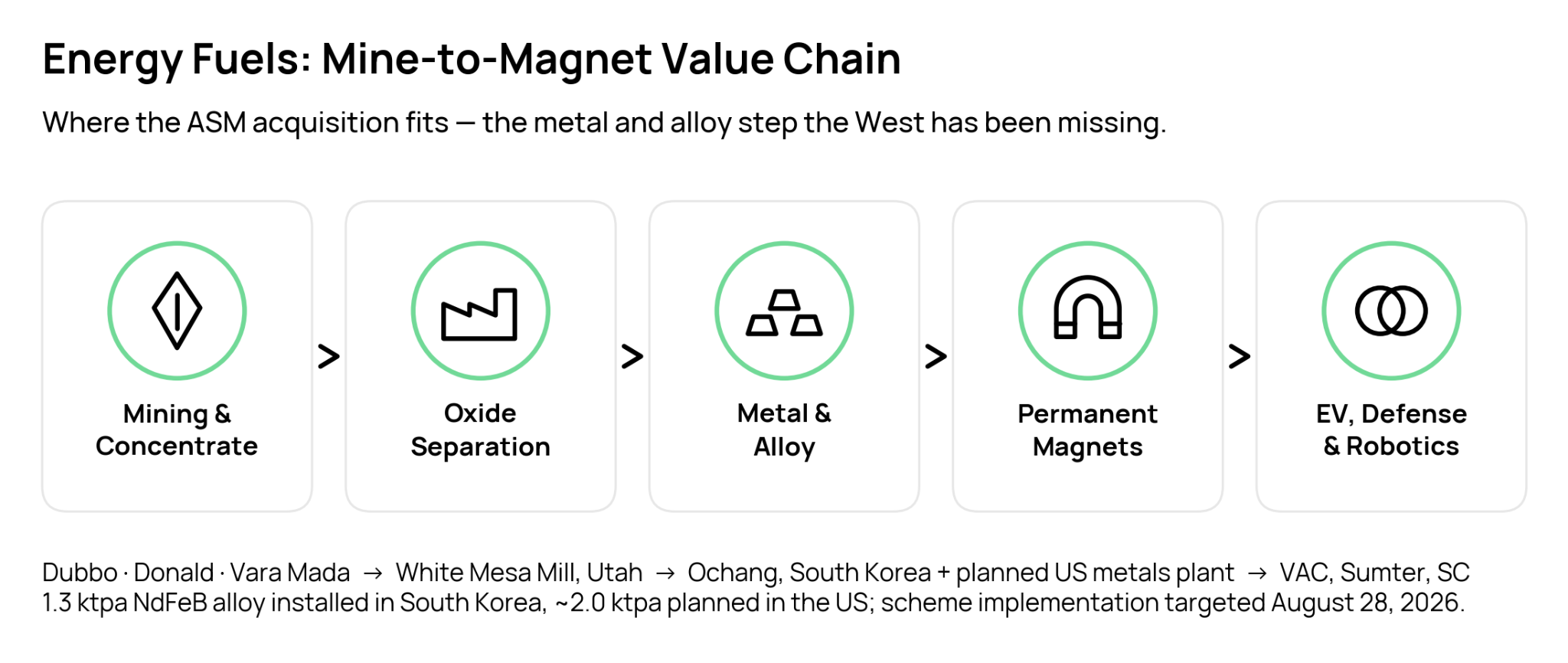
By controlling every phase of production from ore extraction to alloy fabrication, the company is building a captive demand model designed to capture margins across the full supply chain. In traditional rare earth development models, upstream mining companies sell raw concentrates or unalloyed oxides to third-party processors, which exposes their revenues to open-market commodity volatility and transfer markups. The integration of ASM Limited's alloying capacity ensures that the company's separated oxides can be converted directly into high-value alloys within a closed loop, eliminating transaction markups and securing a captive midstream customer for White Mesa's oxide output.
This midstream capability is designed to feed directly into the company's downstream magnet manufacturing segment. In a separate transaction, the company is targeting the acquisition of permanent magnet manufacturer Vacuumschmelze (VAC) for a total transaction value of nearly $2 billion, with closing targeted for early 2027. Once integrated, the South Korean and planned US metal plants are targeting to supply alloy feedstock directly to VAC's permanent magnet plant in Sumter, South Carolina, which features an operating capacity of approximately 2,000 tonnes per annum of permanent magnets and a scalable design targeting 12,000 tonnes per annum, thereby establishing a closed-loop mine-to-magnet platform.
Bhappu detailed the strategic impact:
"This is really a transformational acquisition for us. It sets us apart from anyone else operating in this space. It gives us the ability to go from the mine all the way to the magnet."
Operational, Financial & Integration Risks
Despite clearing a decisive shareholder hurdle, the company's vertical integration strategy faces significant residual risks that have not been independently verified. First, the corporate combination causes immediate equity dilution for existing Energy Fuels Inc. shareholders through the issuance of 0.053 Chess Depositary Interests per ASM’s Limited share. Furthermore, all disclosed metallurgical design capacities, including the 1.3 thousand tonnes per annum Ochang facility capacity and the forty-two-year Dubbo Project mine life, are based on company-issued feasibility studies and management projections rather than independent operational audits.
Second, the planned mine-to-magnet supply loop involves unprecedented logistical complexity, requiring the coordination of monazite mining in Australia, heavy rare earth separations at the White Mesa Mill in Utah, metallization in South Korea, and permanent magnet manufacturing in South Carolina. Additionally, the downstream value-capture thesis is entirely dependent on closing the pending VAC transaction, which is delayed until early 2027 and remains subject to separate regulatory, shareholder, and court approvals. Upstream, raw material supply remains exposed to project-level development risks, where the Donald Project's Phase 1 capital expenditure relies on securing government-backed debt financing. Finally, the construction of the planned American Metals Plant is in the pre-operational stage, exposing the company's capital allocation model to construction cost inflation and commissioning delays.
Investment Thesis for Energy Fuels
- The transaction directly resolves the Western metallization gap by incorporating the operating Korean Metals Plant in South Korea, which has an installed capacity of approximately one thousand three hundred tonnes per annum of neodymium-iron-boron alloy, and a planned American Metals Plant in the United States of America with an initial planned capacity of approximately two thousand tonnes per annum of alloy.
- The acquisition adds the construction-ready Dubbo Project in Australia, with its forty-two-year mine life, complementing the Donald Project joint venture in Victoria, Australia, and the wholly owned Vara Mada Project in Madagascar, to ensure diversified monazite supply streams for the Utah refinery.
- Integrating midstream metallurgy with the company's separated rare earth oxides from Utah and downstream permanent magnet manufacturing through the planned acquisition of Vacuumschmelze eliminates open-market feedstock markups and establishes captive internal demand across the entire value chain.
- Establishing a secure supply chain spanning Australia, South Korea, Blanding, and South Carolina provides electric-vehicle, defense, and robotics customers with a reliable, geopolitically insulated alternative to Chinese monopolies on critical materials.
- Securityholder approval on August 12, 2026, of 98.23% of Share Scheme votes cast and 99.97% of Option Scheme votes cast clears the principal conditional hurdle, leaving Federal Court of Australia sanction and lodgement with the Australian Securities and Investments Commission before scheme consideration is implemented on August 28, 2026.
By securing the essential midstream processing steps that have historically forced Western operators to rely on Chinese tolling, the company is building a critical-materials business backed by stable domestic natural-uranium revenues and strong margins in finished-goods manufacturing.
TL;DR
Energy Fuels Inc. has cleared a key transaction hurdle as ASM Limited securityholders overwhelmingly voted on August 12, 2026, to approve the schemes of arrangement, with 98.23% of Share Scheme votes and 99.97% of Option Scheme votes cast in favor of the transaction. This acquisition adds existing rare earth metal and alloy-making capacity through the Korean Metals Plant in South Korea and the planned American Metals Plant in the US, physically bridging the midstream metallization gap in the company's mine-to-magnet platform. By combining upstream monazite mining, processing at the White Mesa Mill in Utah, and downstream magnet manufacturing through the pending VAC acquisition, the company is building an integrated Western supply chain that bypasses open-market markups and provides allied industries with an independent alternative for critical materials.
FAQs (AI-Generated)
Analyst's Notes





Subscribe to Our Channel





Stay Informed