ATHA Energy Positions Angikuni as the Next Long-Cycle Uranium Story


ATHA Energy's latest Angilak drill results reinforce a long-cycle uranium basin strategy, with continuity drilling, basin-scale potential and 24 months of funded exploration.
- ATHA Energy Corp. reported additional high-grade drill results from its Angilak Uranium Project in Nunavut, including a 37-metre composite uranium mineralised intersection at the RIB-North discovery, the widest recorded on the project to date.
- The Lac 50 West discovery returned 11.5 metres of composite uranium mineralisation located 4 kilometres along strike from the existing Lac 50 Deposit.
- ATHA's 2026-2027 program moves from widely spaced discovery holes to continuity drilling, with denser delineation spacing targeted for 2027 as the next stage of a multi-decade basin evaluation.
- The company holds a C$346 million market capitalisation as of June 30, 2026, backed by a C$63 million financing completed in the first quarter of 2026 that funds roughly 24 months of exploration.
- ATHA's 6.8 million-acre land package spans the Athabasca Basin, the Angikuni Basin in Nunavut and the Central Mineral Belt in Labrador, alongside a 10% carried interest in NexGen Energy and IsoEnergy exploration lands.
ATHA Energy Corp. (TSXV: SASK | FRA: X5U | OTCQX: SASKF) is developing the Angilak Uranium Project against the backdrop of the Athabasca Basin in Saskatchewan, the reference point the company itself uses for the pace at which a uranium basin typically matures. In the Athabasca, the Rabbit Lake deposit was discovered in 1968, and the Hurricane deposit was discovered in the 2020s, a span of roughly 50 years across an area of the eastern Athabasca Basin the company says is comparable in size to the Angikuni Basin in Nunavut, where Angilak sits. ATHA's newest intercepts arrive against that timeline: a basin still in its early stages of exploration, with the current results serving as data points rather than a conclusion.
Drill Results Read as Early Markers of a Multi-Decade System
The widest intercept reported to date came from the RIB-North discovery, which returned 37 metres of composite uranium mineralisation, part of the 18-kilometre Mineralised RIB Corridor (MRC) identified in 2025. At the Lac 50 Deposit Corridor, a step-out hole confirmed 11.5 metres of composite uranium mineralisation, including 1.6 metres of near-continuous high-grade material, located 4 kilometres along strike from the existing Lac 50 Deposit.
Chief executive officer and director of ATHA Energy, Troy Boisjoli, put the intercepts in context:
"The amount of the metal endowment that we see here is unlike anything I've seen on any project I've worked on, and that's 100% based on that conversion rate. When you look at going from greenfields exploration target to discovery, every target that we have tested we've made a discovery has been mineralised."
The Athabasca Basin took decades to move from initial discovery to a fully characterised, multi-deposit system. Angikuni's hit rate to date is an early-stage signal within that same type of timeline, not evidence that the system has been defined.
Continuity Drilling Follows the Same Sequence
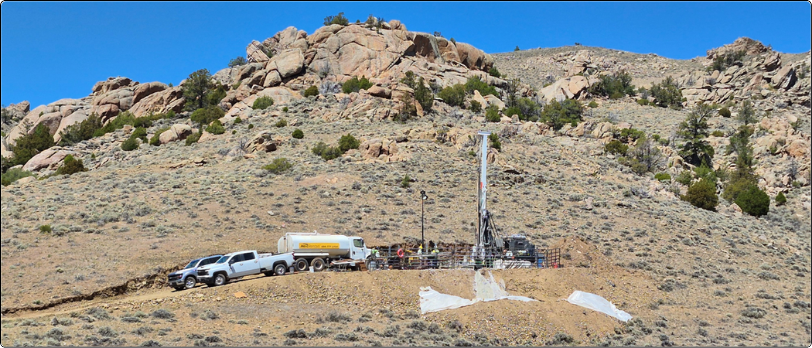
ATHA has outlined a 24-month plan running through 2026 and 2027. In 2026, drilling is directed at establishing continuity of mineralisation across widely spaced holes at both the Lac 50 corridor and the MRC, rather than moving directly to resource-definition spacing. A shift toward denser, delineation-style spacing is targeted for 2027, contingent on this year's results.
Boisjoli linked the pacing of this work to the company's financing, noting that ATHA raised C$63 million in the first quarter of 2026, which he said reduces the need to return to capital markets during a period of broader uranium equity volatility.
Two-Thirds of the Basin Still Untested
How much of the Angikuni Basin remains unexplored is central to where it sits on that timeline. Only the upper third of the basin has undergone completed technical and target-generation work to date, with data acquisition ongoing across the remaining two-thirds, which shows the same regional geophysical signatures observed in the upper third that has already produced the Lac 50 and MRC discoveries. Within the explored portion, the Lac 50 corridor extends 21 kilometres with only approximately 24% of it drill-tested to date, and the MRC extends 18 kilometres with 4 discoveries identified across a 12-kilometre strike.
No mineral resource estimate (MRE), feasibility study (FS), or project economics such as net present value (NPV) have been disclosed for Angilak, consistent with a project still in the discovery and continuity-definition phase. The sole disclosed metric is a conceptual exploration target for the Lac 50 Deposit of 60.8 million to 98.2 million pounds of uranium oxide at an average grade range of 0.37% to 0.48%, which ATHA states is not a National Instrument 43-101 compliant mineral resource.
What This Means for Investors
For investors, the significance of the latest results lies less in any single intercept than in whether successive programs continue to show Angikuni generating discoveries over many years. The 10% carried interest in NexGen Energy and IsoEnergy land supplies a second, lower-cost form of Athabasca exposure without requiring ATHA to fund that exploration. Against that backdrop, the capital already in place matters primarily for the time it buys to test the next stage of the system, not for what it proves today.
FAQs (AI-Generated)
Analyst's Notes





Subscribe to Our Channel




Stay Informed