




‘Undervalued?’ Article Series 2/5: Why Do Junior Mining Companies Become Undervalued Across the Mining Lifecycle?



Junior miners get undervalued when risk falls faster than perception adjusts, from exploration and permitting to construction and production.
- Undervaluation often emerges when a project advances faster than investor perceptions adjust, leaving the market anchored to risks that have already been reduced.
- During exploration and resource definition, the key issue is whether the geological scale is becoming sufficiently understood to support a credible development pathway.
- Economic studies and permitting progressively convert geological potential into a project with defined economics, timelines and a clearer probability of reaching construction.
- Engineering and financing decisions determine whether an economically attractive project can actually be built without imposing excessive capital requirements on shareholders.
- Commissioning and production replace development assumptions with operating evidence, making consistent throughput, recoveries, costs and cash generation the final tests of whether a re-rating is justified.
Junior mining companies can become undervalued when project risk declines faster than investor perceptions adjust. A discovery that progresses through resource definition, economic studies, permitting and construction is accumulating evidence that can reduce geological, technical, regulatory and execution uncertainty. The CIMVAL Code, the Canadian Institute of Mining, Metallurgy and Petroleum's standard for mineral-property valuation, states that the appropriate valuation approach depends on whether an asset is an exploration, mineral-resource, development or production property. In practical terms, the information available to value a project changes as the project advances, so a valuation anchored to an earlier development stage can become increasingly inappropriate.
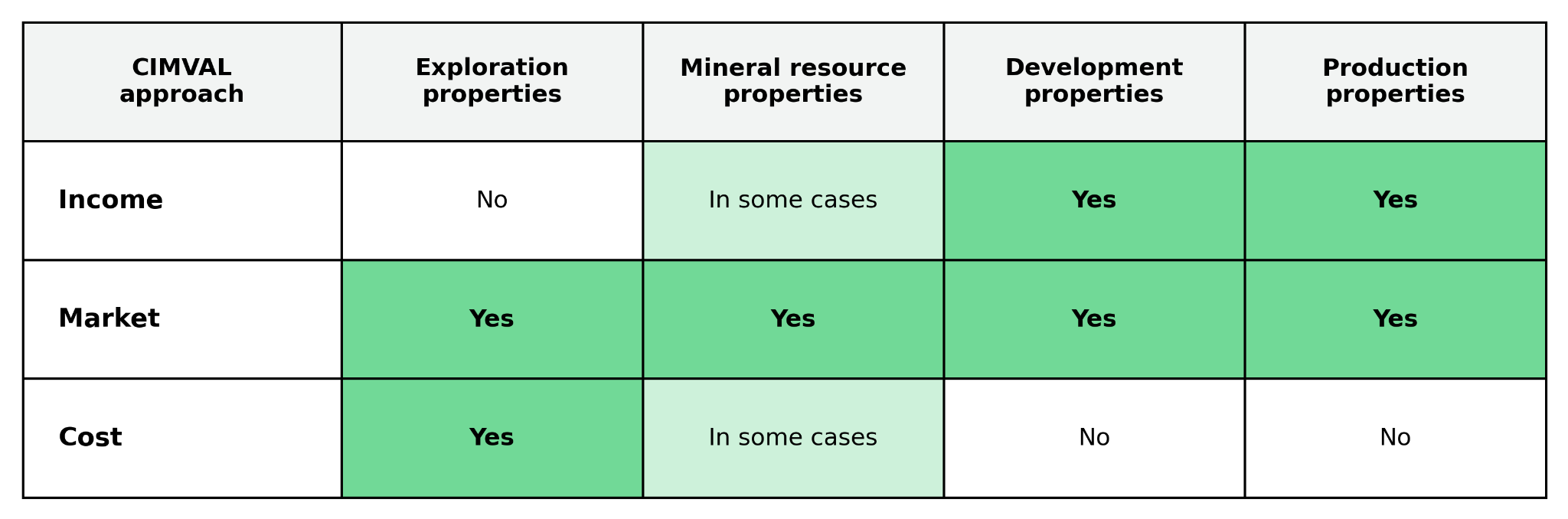
The market does not necessarily make that adjustment immediately. CFA Institute research identifies underreaction to new information and anchoring as documented investor behaviors, meaning prices can adjust more slowly than the underlying fundamentals. Applied to junior mining, this creates a potential valuation gap when investors continue to assign a project the risks associated with an earlier stage, even after new drilling, technical studies, permits, or operating results have reduced those uncertainties. The same ounce can therefore have very different investment relevance as it moves from geological potential toward an engineered mine plan and ultimately demonstrated cash generation.
Exploration & Resource Definition: When Ounce Quality Starts to Matter
At the exploration stage, EV/oz can provide a useful first comparison, as detailed mine economics may not yet be available. Enterprise value adjusts market capitalization for cash and debt, while EV/oz divides that value by defined mineral resources. The limitation is that two companies reporting the same number of ounces can have materially different economic prospects because resource classification, grade, geometry, depth, metallurgy and infrastructure determine how easily those ounces may eventually enter a mine plan.
Maple Gold Mines’ Douay and Joutel projects contain approximately 5.2 million ounces of gold, but only about 905,000 ounces are currently classified as Indicated, with the balance remaining Inferred. Indicated resources carry greater geological confidence and can support more advanced mine planning, while Inferred ounces still require additional drilling before they can be incorporated into higher-confidence development studies. Maple Gold’s next valuation step, therefore, depends less on adding ounces alone and more on converting existing resources into higher-confidence categories while demonstrating that the district can support an economically viable mine plan.
Maple Gold President and Chief Executive Officer Kiran Patankar identified the persistence of an earlier execution discount despite changes to the company’s ownership, funding and resource position:
“Maple trades at $29 US per ounce... the average of this peer group is $50 per ounce... I think we still trade at a discount because of legacy issues, which we are clawing back steadily... We now have 100% ownership, district-scale upside. Our job is actually to execute on the catalysts that make the mismatch between our current valuation and the average of the peer group or the transaction multiples. It makes that mismatch difficult to ignore.”
In another case, Cassiar Gold’s Taurus deposit contains approximately 2.3 million ounces of gold, with 91% of those ounces located within 150 meters of surface. That matters because shallower mineralization can potentially reduce the amount of waste that must be moved and simplify access compared with a deeper deposit, although the economics still need to be demonstrated. Cassiar began a fully funded 10,000-meter drill program in June 2026 and has commissioned Ausenco to prepare a preliminary economic assessment. The next important question for investors is therefore no longer simply how many ounces Taurus contains, but whether its near-surface scale can translate into an economically attractive mine plan.
Economic Studies & Mine Planning: When NAV Replaces EV/oz
A preliminary economic assessment changes the questions investors can ask. Net present value, or NPV, discounts estimated future project cash flows into today’s dollars. Internal rate of return, or IRR, measures the discount rate at which the project's NPV falls to zero. Neither metric eliminates uncertainty, particularly because preliminary economic assessments can incorporate inferred resources, but both connect geology to production rates, recoveries, operating costs and capital intensity.
Omai Gold’s April 2026 resource update increased the project to approximately 8.0 million ounces of gold, giving it the scale of a major undeveloped deposit. The company is preparing an updated preliminary economic assessment to test how much of that larger resource can be incorporated into an economically viable mine plan for both open-pit and underground mining. The earlier study reported a US$556 million after-tax NPV and US$375 million of initial capital at a US$1,950/oz gold price. The question now is whether the larger resource can improve mine life, production scale, or capital efficiency enough to support a higher project valuation. Chief Executive Officer Elaine Ellingham highlighted Omai Gold’s expanded resource base and the market’s current valuation:
“We actually doubled the size of our resource estimate in less than two years... going from 4.3 to 8 million ounces… it just hasn't been fully valued into the stock”
Permitting & Development: Regulatory Risk Has Financial Value
Permitting affects project value because delays push cash flows further into the future and can prevent technically viable resources from reaching a final investment decision. S&P Global Market Intelligence’s July 2026 study of 232 mining assets found an average 16-year discovery-to-production period, while non-operating projects that had already undergone feasibility studies were approaching 30 years, with permitting delays or permit revocations identified as the principal cause of delays for several projects targeting production from 2026 onward.
A technically attractive project cannot generate operating cash flow without approvals to build and operate it. Permitting, therefore, sits directly inside the development-stage discount rate. Environmental review, Indigenous agreements, water management, tailings design and remaining construction permits affect both the probability and timing of future cash flows. Environmental, social & governance (ESG) scores can provide comparative indicators of external risk, but project-specific permits and agreements provide more direct evidence of development readiness.
First Mining Gold crossed a major threshold at Springpole in June 2026 when the project received federal environmental assessment approval. The approval removes one of the largest sources of uncertainty for a project already supported by a 2025 prefeasibility study, which outlined a large open-pit mine producing about 330,000 ounces of gold annually during its first five years, with an estimated US$1.1 billion of initial capital and an after-tax NPV of US$2.1 billion at a US$3,100/oz gold price.
First Mining Chief Executive Officer Dan Wilton described permitting uncertainty as a source of the project’s previous valuation discount:
“Springpole has long had a real issue around the probability of us getting environmental assessment approvals and permits because the deposit sits in the bay of a lake... having been in an environmental assessment process in Canada for eight years, we've done all of that work.”
Engineering & Financing Readiness: Capital Intensity Can Be Re-Rated
Feasibility does not automatically mean financeability. A technically viable project can remain heavily discounted if its initial capital requirement is too large relative to the company’s market capitalization, balance sheet or likely debt capacity. Engineering optimization can therefore create value without adding a single ounce by reducing the amount of external capital required to reach production.
Vista Gold’s 2025 Mt Todd feasibility study outlines a resized development concept to 15,000 tonnes per day (tpd), producing an estimated average of 153,000 ounces annually during years one through fifteen. Initial capital fell to US$425 million, 59% below the previous study, which required US$1.03 billion for a 50,000 tpd operation. Vista subsequently reported US$49.5 million in cash and no debt at June 30, 2026, while advancing permit modifications and project execution work ahead of targeted detailed engineering in 2027.
Construction & Commissioning: Risk Moves From Capital to Operations
Once construction is substantially complete, the principal questions shift from procurement and capital overruns toward throughput, recovery, grade reconciliation and working capital. Oxide material, in which weathering has altered the original mineral assemblage, can sometimes support relatively simple processing, such as heap leaching. Primary or sulfide-bearing material may require additional crushing, grinding, flotation, or leaching. Heap leaching itself involves stacking crushed or run-of-mine ore and applying a leach solution to dissolve recoverable metal.
Cabral Gold entered the transition at Cuiú Cuiú in July 2026 when the company began commissioning, mining and stacking material for its Stage 1 gold-in-oxide heap-leach project. A US$45.1 million gold loan closed in November 2025 fully funded the initial development capital. Cabral President and Chief Executive Officer Alan Carter links the initial operation to capital allocation for the larger district:
“What we want to do is develop an initial project to mine the near-surface oxide material... that will provide a significant amount of cash to allow us to develop and explore the larger district... We are pursuing a two-phase development strategy aimed at achieving cash flow in the fourth quarter of this year and mitigating dilution in the capital structure.”
Production & Ramp-Up: Cash Flow Must Become Repeatable
Commercial production allows valuation to move toward EBITDA, free cash flow and operating multiples, but a new producer does not immediately deserve the same multiple as an established mine. Investors still need evidence that nameplate throughput, reserve grade, recovery and unit costs can be sustained. AISC becomes particularly important because it incorporates operating costs, sustaining capital, and other expenditures required to maintain production.
Erdene Resource Development’s Bayan Khundii mine achieved commercial production during Q1 2026 while operating at 94% of target throughput and recovered more than 96% of the gold, already exceeding the 2023 feasibility study’s approximately 93% recovery assumption. In Q2, recovery remained at 96%, while processed grade increased 25% and quarterly gold production rose 37% to 11,709 ounces. Bayan Khundii generated US$53 million of gross revenue in Q2, but the next test is whether this operating consistency translates into repeatable costs, margins and cash flow as the mine approaches its feasibility-study production profile.
President & CEO Peter Akerley identified dilution as one of the variables separating initial production from optimized production:
“We were sitting around 30% dilution for the first several months, which brings that grade from 3.5 grams down to 2.5 grams, and our target is to get that to 10% dilution... we've identified where those issues are, and we're resolving them, allowing us to get to that steady 3.5 grams.”
The company also carries longer-term optionality through projects such as Zuunmod, a molybdenum-copper porphyry system. Porphyry deposits are typically large, disseminated mineral systems whose economics depend heavily on scale, grade, recovery and capital intensity. The optionality may become increasingly financeable if Bayan Khundii generates sustained cash flow, but it should remain analytically separate from the valuation assigned to demonstrated mine performance
The Investment Thesis for Lifecycle Mispricing
- Valuation methods should change as technical certainty increases. Early explorers are best assessed on discovery potential and EV/oz, while advanced developers should increasingly be valued based on NAV, project returns, and financing requirements. Producers require a further shift toward cash flow, EBITDA, AISC and balance-sheet strength.
- The largest mispricing can occur when the market applies an outdated valuation framework. A company that has moved from resource definition into economic studies should not be valued solely on headline ounces, just as a permitted project should not carry the same regulatory discount it did before securing major approvals.
- Resource quality matters more as projects advance. Grade, geometry, depth, metallurgy, and the proportion of Indicated versus Inferred resources increasingly determine whether geological ounces can become mineable reserves and ultimately support an economic development plan.
- NAV becomes more relevant only when development assumptions become credible. NPV and IRR gain analytical value as engineering, metallurgy, capital costs and production schedules become better defined, but investors must still discount those figures for permitting, financing and execution risk.
- Capital intensity can be as important as project economics. A high NPV does not automatically translate into shareholder value if the initial funding requirement is too large relative to the company’s balance sheet and financing capacity. Engineering changes that reduce upfront capital can therefore improve the probability that modeled value is realized.
- Permitting and construction milestones reduce risk without necessarily changing the resource. Regulatory approvals increase the probability of future cash flows, while construction completion shifts the investment question from development risk to commissioning, throughput, recovery, and working-capital performance.
- Commercial production is the beginning of operating proof, not the end of de-risking. A producer earns a stronger valuation multiple by demonstrating repeatable throughput, grade, recovery, AISC and free cash flow over successive reporting periods. The final re-rating, therefore, depends on whether modeled economics translate into sustained operating performance.
Technical milestones matter only when they change the probability, timing or economics of future cash generation enough to justify a different market discount. The opportunity arises when that change is measurable but not yet fully reflected in the share price. Identifying lifecycle mispricing, therefore, requires investors to ask not only whether a project is advancing, but whether the market is still pricing risks that the latest technical, regulatory or operating evidence has already reduced.
Read more:
Why Do Contrarian Investors Outperform
TL;DR
Junior mining companies often trade below fair value because investors anchor to the risks of an earlier project stage, even after drilling, studies, permits, or operations have already reduced those risks. Valuation approaches should shift as projects advance: EV/oz suits early exploration, NAV and IRR become relevant once economic studies exist, and EBITDA/AISC/free cash flow matter most for producers. Resource upgrades, permitting approvals, engineering optimization, and production milestones can all reduce project risk without the market immediately re-rating the stock. Identifying this lifecycle mispricing means asking not just whether a project is advancing, but whether the market is still pricing risks the latest evidence has already reduced.
FAQs (AI-Generated)
Analyst's Notes





Subscribe to Our Channel












Stay Informed






















